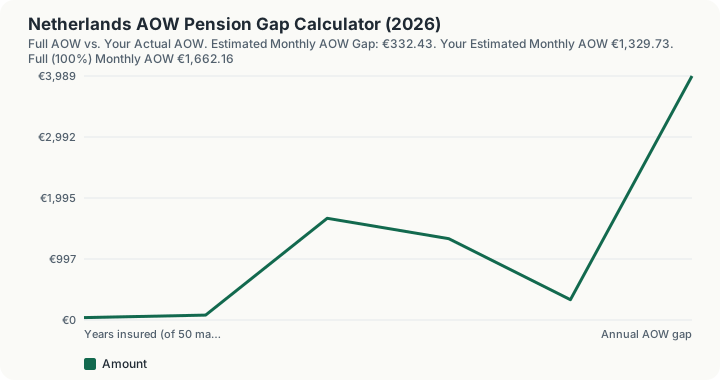
Quick Answer: Someone insured for AOW for 40 of the possible 50 years has an 80% AOW build-up, giving an estimated €1,329.73 a month against the full single-person rate of €1,662.16 a month for the second half of 2026 -- a gap of €332.43 a month, or €3,989.16 a year, from the missing 10 years of insured residency.
Overview
AOW (Algemene Ouderdomswet) is the Netherlands' universal state pension: a flat, government-paid benefit that everyone who has been insured in the Dutch system receives from the AOW pension age, regardless of their work history or private pension savings. Unlike many countries' state pensions, AOW is not earnings-related -- it does not matter how much you earned or how many years you worked. What matters is purely how many years you were insured for AOW, which for almost everyone means the years you were a resident of the Netherlands (or, in some cases, working for a Dutch employer while living abroad under specific treaty arrangements).
The build-up rule is simple in principle: you accrue AOW entitlement at 2% per year for every year you are insured between your 17th birthday and the Dutch AOW pension age (67 in 2026, and gradually rising in future years as life expectancy increases). Fifty years of continuous insurance, from age 17 to 67, produces exactly 100% of the full AOW rate. Every year you were not insured -- most commonly because you lived abroad, whether working, studying, or simply residing outside the Netherlands, and were not covered by an equivalent scheme -- reduces your eventual AOW by 2 percentage points, permanently. This is the "AOW-gat" (AOW gap) that this calculator estimates: the shortfall between what you would have received with a full 50-year build-up and what you will actually receive given a specific number of insured years.
This gap is one of the most common retirement-planning surprises for people who have spent significant time living or working outside the Netherlands -- including Dutch citizens who emigrated for part of their career and returning expats, as well as immigrants to the Netherlands who arrived partway through their working life and therefore can never reach 50 insured years before pension age. Because AOW is paid at different rates for single people and for people who are married or cohabiting with a partner at pension age (the partner rate is lower per person, since a couple's combined housing costs are assumed to be shared), this calculator asks for your household situation alongside your insured years.
How This Is Calculated
- Build-up years. The number of years insured, capped at the 50-year maximum window.
- Accrual percentage. 2% per insured year.
- Full monthly AOW. Depends on household status: the higher single-person rate, or the lower married/cohabiting per-person rate.
AOW is indexed twice a year, tied to the statutory minimum wage. The amounts above are the 1 July - 31 December 2026 rates; for 1 January - 30 June 2026, the rates were €1,637.57 (single) and €1,122.12 (per partner).
- Actual monthly AOW and the gap.
Worked Example
Using the calculator's default input: 40 years insured, single-person rate.
- Build-up years: min(40, 50) = 40 years.
- Accrual percentage: 40 × 2% = 80%.
- Full single-person monthly AOW for July-December 2026: €1,662.16.
- Actual monthly AOW: €1,662.16 × 80% = €1,329.73.
- Monthly gap: €1,662.16 − €1,329.73 = €332.43, or €3,989.16 a year over a full 12 months.
For someone married or cohabiting with only 25 insured years (a 50% build-up), the calculation uses the lower per-partner rate: €1,139.39 × 50% = €569.70 a month actual, against a gap of €569.69 a month (the one-cent difference from rounding the actual amount first) -- illustrating that both a lower build-up percentage and the partner rate itself reduce the absolute euro amounts involved, even though the percentage gap (50%) is the same regardless of household type.
What This Does Not Account For
- AOW-leeftijd changes over time. The Dutch AOW pension age is tied to life expectancy and is reviewed periodically; it is 67 in 2026 but is scheduled to rise further in future years (to 67 years and 3 months from 2028, for example). If your pension age differs from 67, your actual 50-year build-up window shifts accordingly, which this calculator does not adjust for automatically.
- Voluntary insurance (vrijwillige verzekering). People who know in advance they will have an AOW gap -- for example, before emigrating -- can sometimes buy additional insured years voluntarily within specific time limits after leaving the mandatory scheme. This calculator does not model the cost or availability of that option.
- Bilateral social security treaties. Many countries have agreements with the Netherlands that count years insured under a foreign scheme toward certain Dutch benefits, or vice versa, in specific circumstances (particularly within the EU/EEA and Switzerland, and under some bilateral treaties). This calculator treats "years insured" as a single input you supply yourself, based on your own SVB record, rather than deriving it from a residency or work history.
- The vakantietoeslag (holiday allowance). The monthly AOW figures used here exclude the roughly 8% holiday allowance paid separately each May; your actual total annual AOW income including that allowance will be somewhat higher than this calculator's monthly amount times twelve.
- AOW partner supplements and survivor benefits (Anw). Older transitional partner-toeslag rules and the separate Algemene nabestaandenwet (surviving dependents) benefit are not modeled here.
Common Pitfalls
- Assuming AOW is earnings-related like a private pension. It is not -- someone who worked minimum-wage jobs their whole career and someone who was a senior executive receive exactly the same AOW at the same build-up percentage; only insured years matter.
- Discovering the gap too late to do anything about it. Because voluntary top-up insurance is generally only available for a limited window around when you leave mandatory Dutch insurance (such as before emigrating), many people only learn about a gap decades later, when it's too late to buy back those years.
- Forgetting that time BEFORE age 17 or AFTER the AOW pension age doesn't count either way. The build-up window is strictly bounded by these two ages; working past your AOW pension age does not add further build-up percentage.
- Not checking "Mijn SVB" early. The Sociale Verzekeringsbank (SVB) maintains your exact insured-years record and will show your actual projected build-up percentage well before retirement -- relying on a rough personal estimate instead of checking this official record is a common and avoidable source of retirement-planning surprises.
- Mixing up the single and partner rates. Because the partner rate is a per-person amount for each half of a couple, a couple where both partners have full 50-year build-ups receives roughly the combined per-person rate for each of them -- not double the single-person rate.
Frequently Asked Questions
How do I find out my actual number of insured years?
Can I make up for missing years later?
Does the AOW pension age ever change?
Is AOW paid in addition to my workplace pension?
Does a partner's insured years affect my own AOW?
Sources
- Dutch Tax Administration (Belastingdienst), the official authority for the national tax authority this calculator relates to. belastingdienst.nl
Also consulted: Sociale Verzekeringsbank (SVB), AOW build-up rules (2% per insured year, age 17 to the AOW pension age, 50-year full build-up window) and 2026 AOW amounts, including the 1 July 2026 twice-yearly indexation update -- corroborated across multiple independent secondary sources (Consumentenbond, MAX Vandaag, Bruto-Netto.nl, Belastinghelden.nl, raisin.com, 65plus.nl, aow.nu); direct primary-source verification against svb.nl was blocked (HTTP 403) during this build and should be re-confirmed against the live SVB site before publishing; Rijksoverheid.nl, AOW pension age schedule (67 in 2026, rising to 67 years and 3 months from 2028) -- direct fetch blocked (HTTP 404) during this build; corroborated via secondary sources only.