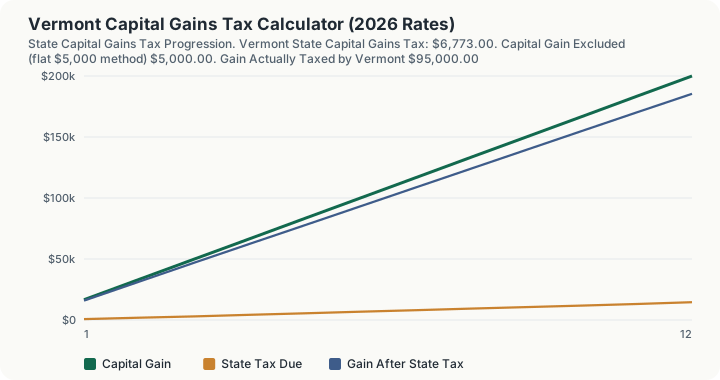
Quick Answer: On a $100,000 capital gain layered on $75,000 of other income, Vermont's tax is $6,773.00, an effective rate of 6.77%. Vermont excludes the lesser of $5,000 or the adjusted net capital gain under 32 V.S.A. § 5811(21)(B)(ii). Without the exclusion the bill would be $7,153.00.
Overview
Vermont offers two mutually exclusive elective capital gains exclusions under 32 V.S.A. § 5811(21)(B)(ii). A taxpayer picks one, not both:
- Flat method: exclude the lesser of $5,000 or the actual adjusted net capital gain. Available in all categories, with no holding-period or asset-type restriction.
- Percentage method: exclude 40% of adjusted net capital gain, with the excludable gain capped at $350,000. It requires a holding period of more than three years and excludes residential real estate, depreciable personal property other than farm property and standing timber, and publicly traded securities.
An overall cap applies under either method: the exclusion cannot exceed the lesser of 40% of federal taxable income or $350,000. And no exclusion is allowed at all if the federal return shows a net capital loss.
Whatever survives the exclusion runs through the graduated brackets, which range from 3.35% to a top marginal rate of 8.75%.
That's because Vermont evaluates capital gains alongside your other taxable earnings, not as their own separate bucket: when they land on top of baseline salary or business income, they get taxed at your top marginal bracket, reaching up to 8.75%.
That matters for high-net-worth individuals, portfolio managers, corporate executives, and real estate investors alike, since state income taxes significantly affect net internal rates of return (IRR) on capital dispositions, 1031 exchange planning, installment sale structuring, and equity compensation exercises (ISOs, NSOs, and RSUs).
Institutional wealth managers and private equity underwriters have to weigh both statutory tax rates and multi-jurisdictional residency rules when running these numbers. Publicly traded securities, privately held business interests, real property, digital assets: whatever is being sold, evaluating the state-level tax exposure is a key part of pre-liquidity tax modeling and post-sale wealth preservation.
Proper capital asset planning in Vermont means tracking taxable events across both federal and state reporting cycles. Timing and holding structure drive net after-tax proceeds, so investors need to look closely at how federal adjusted gross income (AGI) baselines interact with state modifications before closing on any substantial transaction.
How This Is Calculated
Vermont offers two capital gains exclusions and makes you pick one. The flat method excludes the lesser of $5,000 or the adjusted net capital gain and is open to every category of gain. The percentage method excludes 40% of adjusted net gain but demands a holding period longer than three years and shuts out residential real estate, publicly traded securities, and depreciable personal property other than farm property and standing timber. Either way the exclusion is capped at the lesser of 40% of federal taxable income or $350,000, and none is allowed if the federal return shows a net capital loss.
This calculator applies the flat $5,000 method, which is the one that does not depend on facts it has no field for. The exclusion comes off before the remainder is stacked and run through the 3.35% to 8.75% schedule.
The order the calculator applies:
- Start with the net gain. Capital losses and loss carryforwards are netted against the gain before anything else happens.
- Stack the gain on your other income. Ordinary income fills the lower brackets first and the gain sits on top of it, so the gain is taxed at whatever rates are still open above your salary. The same gain costs a high earner more than it costs a low earner. Enter other income as a taxable-income figure: the calculator does not subtract a standard deduction or personal exemption for you.
- Take the flat-method exclusion (32 V.S.A. § 5811(21)(B)(ii)). Subtract the lesser of $5,000 or the adjusted net capital gain before anything is stacked or bracketed. The 40% election is not applied, because it turns on holding period and asset type the calculator does not collect.
- Walk the brackets. The slice of the gain that falls in each band is multiplied by that band's rate, and the pieces are added together.
- Effective rate. Total Vermont tax divided by the whole realized gain. On a graduated schedule this sits below the top marginal rate, because the lower slices were taxed at lower rates.
- Net proceeds. Subtract the state tax from the gain to get what you keep before federal tax.
Worked Example
Consider an investor in Vermont who realizes $100,000 in capital gains on top of $75,000 in baseline ordinary income for the year.
- Apply the flat exclusion first. 32 V.S.A. § 5811(21)(B)(ii) excludes the lesser of $5,000 or the gain, so $5,000 comes out of the $100,000. $95,000 remains taxable.
- Stack the income. The $75,000 of baseline ordinary income fills the lower brackets first, so the remaining $95,000 of gain stacks on top of it.
- Apply the marginal brackets. The gain runs from $75,000 of combined income up to $170,000, crossing from the 6.60% bracket into the 7.60% bracket at $119,700. Summing each slice at its own rate produces $6,773.00.
- Effective rate. Dividing $6,773.00 by the full $100,000 realized gain gives 6.77%, below the 7.60% top marginal bracket the gain reaches.
- Net proceeds. After paying $6,773.00 in state tax, the investor keeps $93,227.00 of the $100,000 gain, before any federal tax applies.
With no exclusion at all the bill would be $7,153.00, so the flat method is worth $380.00 here. A taxpayer eligible for the percentage election, meaning a holding period over three years on an asset that is not residential real estate, ordinary depreciable personal property, or a publicly traded security, would exclude $40,000 instead and owe less.
Walking A Vermont Gain Across Two Bracket Edges
At a realized gain of $49,700. The $5,000 flat exclusion comes off first, leaving $44,700 that stacks on the $75,000 of other income for $119,700 of combined income: the exact dollar where Vermont's 6.6% band ends. The tax is $2,950.20, the effective rate 5.94%, the reported marginal bracket 6.60%.
At a realized gain of $49,800, one hundred dollars later. The tax is $2,957.80 and the reported marginal bracket has moved to 7.60%. The step itself costs $7.60 on that hundred dollars. What matters is not the $7.60 but what it signals: every dollar of gain realized after this point is a 7.6% dollar rather than a 6.6% dollar, so a $50,000 gain realized in this year rather than deferred carries a full point more state tax on all of it.
The second edge, at a gain of $179,700. Combined income reaches $249,700 there and the tax is $12,830.20, marginal bracket 7.60%. At $179,800 the tax is $12,838.95 and the marginal bracket is 8.75%. Realizing $180,700 instead returns $12,917.70, so the thousand dollars either side of that edge cost $87.50 rather than $76.00.
The marginal cost of the next $1,000. At the $100,000 default, raising the gain to $101,000 moves the tax from $6,773.00 to $6,849.00. Each additional $1,000 of gain costs $76.00, which is the 7.6% bracket rate, because the flat $5,000 exclusion is a fixed dollar amount and does not grow with the gain.
The reverse question. A Vermont seller asking how much can be realized before the 8.75% bracket opens gets $179,700 as the answer at $75,000 of other income, and the answer moves dollar for dollar with other income because the exclusion is flat rather than proportional. Splitting a $250,000 gain across two years is worth the difference between 8.75% and 7.6% on the portion moved.
Right method against wrong method, priced. Two errors are common here and both are computable. Ignoring the exclusion entirely gives $7,153.00 against the $6,773.00 the engine returns, overstating by $380.00, which is $5,000 at the 7.6% marginal rate. Using the single schedule for a married couple gives $6,773.00 against the $6,026.25 the joint schedule returns, overstating by $746.75; the joint bounds are 1.67 times the single ones at the bottom of the schedule rather than double, so the saving is smaller than a naive doubling would suggest.
What This Does Not Account For
- The percentage exclusion is not modelled. The engine applies the flat $5,000 method only. A taxpayer eligible for the 40% method with its $350,000 cap would exclude $40,000 on this $100,000 gain rather than $5,000, and no input collects the holding period or asset class the election turns on.
- The 3% of adjusted gross income alternative is not applied. Above $150,000 of AGI Vermont charges the greater of the bracket schedule and 3% of AGI less US-obligation interest; this engine walks the bracket schedule only. This calculator handles state statutory modeling with penny-exact precision, but a few federal and transactional complexities are still worth a closer look:
- Federal Capital Gains Taxes: Federal long-term brackets (0%, 15%, 20%) and short-term ordinary rates up to 37% under IRC § 1.
- Net Investment Income Tax (NIIT): The 3.8% surtax on net investment income under IRC § 1411 for single filers over $200,000 (married joint over $250,000).
- Alternative Minimum Tax (AMT): Federal AMT calculations under IRC § 55 impacting incentive stock option (ISO) exercise spread.
- Section 1031 Like-Kind Exchanges: Tax deferral mechanisms for real property held for productive use in trade, business, or investment.
- Qualified Small Business Stock (QSBS): Federal Section 1202 gain exclusions where state conformity varies significantly.
- Vermont's 40% Percentage Election: 32 V.S.A. § 5811(21)(B)(ii) alternatively excludes 40% of adjusted net capital gain, capped at $350,000 of excludable gain, for qualifying assets held more than three years. This calculator applies the flat $5,000 method, because the percentage election depends on asset type and holding period the calculator does not collect.
- The Overall Exclusion Cap and the Net-Loss Bar: Under either method the exclusion cannot exceed the lesser of 40% of federal taxable income or $350,000, and no exclusion is allowed if the federal return shows a net capital loss. Neither limit is modeled here.
Common Pitfalls
- Skipping the Vermont Exclusion Election: Vermont is not a state that taxes every dollar of capital gain at full ordinary rates. Under 32 V.S.A. § 5811(21)(B)(ii) the flat $5,000 method is available to everyone, and taxpayers holding qualifying assets more than three years can elect 40% instead. Filing without electing either forfeits the benefit.
- Failing to Track Holding Periods: The flat $5,000 exclusion carries no holding-period test, but the 40% percentage election requires more than three years, and federal short-term rates apply to anything held one year or less.
- Underestimating Multi-State Apportionment: Selling real estate or business assets located in other jurisdictions triggers multi-state non-resident return filing obligations.
- Neglecting Underpayment Penalties: Substantial one-time liquidity events require prompt estimated tax payments within the quarter of sale to avoid statutory penalties.
- Mismatched Cost Basis Records: Failure to document reinvested dividends, stock splits, or structural return-of-capital distributions leads to inflated taxable gain calculations.
Frequently Asked Questions
Does Vermont have a state capital gains tax?
How are short-term and long-term capital gains taxed in Vermont?
Are retirement account distributions subject to capital gains tax in Vermont?
Can capital losses offset capital gains in Vermont?
When are estimated state tax payments required on capital gains?
Sources
- Vermont Department of Taxes: 2026 Statutory Individual Income Tax Rate Schedules. tax.vermont.gov
- Internal Revenue Service (IRS): Publication 544 (Sales and Other Dispositions of Assets) and Publication 550 (Investment Income and Expenses). irs.gov/publications/p544
Also consulted: 32 V.S.A. § 5811(21)(B)(ii): Elective capital gains exclusion, flat method (lesser of $5,000 or the gain) or percentage method (40% of adjusted net capital gain, capped at $350,000, assets held more than three years).