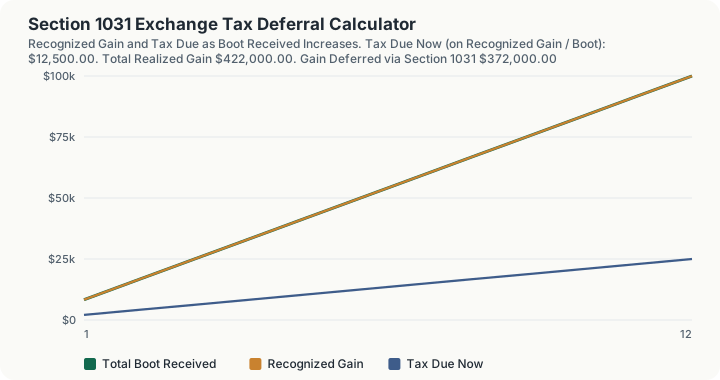
Quick Answer: A like-kind exchange defers tax on your entire realized gain except for any "boot," meaning cash or unreplaced debt you personally receive, which is taxed immediately at recapture and capital gains rates.
Overview
Section 1031 of the Internal Revenue Code lets an investor sell real property held for business or investment use and roll the proceeds into a replacement property without immediately paying tax on the gain. The gain is not forgiven; it is deferred, carried forward into the replacement property's tax basis until that property is eventually sold in a fully taxable transaction (or exchanged again). This is one of the most powerful, and most misunderstood, tools in real estate tax planning, and getting the mechanics wrong is expensive.
Two distinct types of gain get tangled together in a 1031 exchange, and this calculator keeps them separate the way the IRS actually requires. First, there is depreciation recapture: any depreciation you deducted over your holding period reduced your basis and therefore inflated your gain, and Section 1250 caps the tax rate on that specific slice of gain at 25% rather than letting it be taxed at ordinary capital gains rates. Second, there is the remaining capital gain, taxed at your regular long-term capital gains bracket. Both types of gain can be deferred through a 1031 exchange, but both become immediately taxable to the extent you receive "boot," meaning any cash or non-like-kind value you personally walk away with, including debt relief you do not replace with new debt on the replacement property.
How This Is Calculated
Step 1: Compute adjusted basis. Original purchase price, plus capital improvements made during ownership, minus accumulated depreciation taken. Depreciation reduces basis because you already received the tax benefit of those deductions.
Step 2: Compute realized gain. Net sale price (sale price minus selling expenses like commissions and closing costs) minus adjusted basis.
Step 3: Split the realized gain into recapture and capital gain components. The portion of the gain up to the total accumulated depreciation is "unrecaptured Section 1250 gain," capped at a maximum 25% federal rate. Any gain beyond that is regular long-term capital gain, taxed at your ordinary capital gains bracket.
Step 4: Compute total boot received. Boot has two forms. Cash boot is any cash or non-like-kind property you personally receive in the exchange. Mortgage boot arises when the debt you pay off on the property you are selling exceeds the new debt you take on the replacement property; that shortfall is treated as if you received cash, because you effectively pocketed the difference in leverage.
Step 5: Determine recognized (taxable now) gain. Under IRC Section 1031(b), gain is recognized to the extent of boot received, but never more than the total realized gain. If your boot is zero, no gain is recognized right now no matter how large your realized gain is.
Step 6: Allocate recognized gain to recapture first, then capital gain. The IRS requires depreciation recapture to be recognized before any remaining capital gain, so boot is first "soaked up" by the recapture bucket before it spills into the capital gain bucket.
Step 7: Compute tax due now and the replacement property's carryover basis. Recognized recapture is taxed at 25%; recognized capital gain is taxed by stacking it on top of your other taxable income using the actual 2026 federal long-term capital gains brackets. The replacement property's basis for future depreciation and eventual sale equals its purchase price minus the gain you deferred.
Worked Example
An investor sells a property for $800,000, paying $48,000 in selling expenses, for a net sale price of $752,000. They originally paid $400,000, made $50,000 of capital improvements, and had taken $120,000 of accumulated depreciation. They exchange into a $900,000 replacement property, receive $50,000 in cash boot, pay off a $300,000 mortgage on the old property, and take exactly $300,000 in new debt on the replacement property (so there is no mortgage boot). Their other taxable income is $90,000, filing single.
- Adjusted basis: $400,000 + $50,000 - $120,000 = $330,000.
- Realized gain: $752,000 - $330,000 = $422,000.
- Depreciation recapture: the lesser of the realized gain or accumulated depreciation, which is $120,000. Remaining capital gain: $422,000 - $120,000 = $302,000.
- Total boot: $50,000 cash boot plus $0 mortgage boot (debt paid off equals new debt taken) = $50,000.
- Recognized gain: the lesser of $422,000 realized gain or $50,000 boot, so $50,000 is taxable now.
- Allocation: the $50,000 recognized gain is entirely absorbed by depreciation recapture (since recapture available is $120,000, more than the $50,000 boot), leaving $0 of recognized capital gain.
- Tax due now: $50,000 x 25% = $12,500.00 on the recognized recapture, plus $0 on recognized capital gain, for a total of $12,500.00.
- Deferred gain: $422,000 - $50,000 = $372,000.
- Replacement property basis: $900,000 - $372,000 = $528,000.00.
To show the value of the deferral, compare this to what would happen with no exchange at all: the full $120,000 of recapture taxed at 25% is $30,000.00, and the remaining $302,000 of capital gain, stacked on $90,000 of other income under the 2026 single-filer brackets, generates $45,300.00 of tax, for a hypothetical total of $75,300.00. Against the $12,500.00 actually due now, this exchange defers $62,800.00 of tax liability into the future.
What This Does Not Account For
- It does not model state-level capital gains or recapture taxes, which many states impose independently and at different rates than the federal calculation shown here.
- Multiple relinquished or replacement properties, reverse exchanges, and construction/improvement exchanges are out of scope, since all of them involve additional structuring rules beyond a simple one-for-one swap.
- It does not check the 45-day identification period or the 180-day exchange completion deadline, the strict timing rules that must be satisfied through a Qualified Intermediary for an exchange to qualify under Section 1031 at all.
- The Net Investment Income Tax (NIIT) isn't included, the additional 3.8% tax that can apply to recognized capital gain for higher-income taxpayers, separate from the ordinary capital gains bracket calculation shown here.
- It assumes the replacement property is of equal or greater value and debt than the relinquished property is common practice to fully defer gain; this calculator will correctly show recognized gain if you under-invest, but it does not warn you in advance about the specific reinvestment targets needed to achieve full deferral.
Common Pitfalls
- Assuming any exchange automatically defers 100% of the gain. Deferral is only complete when you receive no boot at all, meaning you reinvest all net proceeds and either match or increase your debt level on the replacement property.
- Forgetting that reducing your mortgage counts as boot. Investors who pay off a large loan and take a smaller loan on the replacement property, even without ever touching the cash personally, are often surprised that the debt reduction itself is treated as taxable boot.
- Not realizing depreciation recapture is recognized before capital gain. A common misconception is that boot proceeds get to "choose" the more favorable capital gains rate; in fact, the recapture bucket must be exhausted first, so anyone with substantial prior depreciation should expect boot to be taxed at the 25% recapture rate before any 15% or 20% capital gains rate applies.
- Ignoring the 180-day and 45-day deadlines. Missing either strict deadline disqualifies the entire exchange retroactively, converting it into a fully taxable sale regardless of how the numbers otherwise would have worked out.
- Trying to handle the exchange without a Qualified Intermediary. The taxpayer can never have actual or constructive receipt of the sale proceeds at any point; the funds must be held by a Qualified Intermediary between the sale and the purchase, or the exchange fails entirely.
Frequently Asked Questions
What counts as "like-kind" property for a 1031 exchange?
Can I use a 1031 exchange on my primary residence?
What happens if I eventually sell the replacement property outright instead of exchanging again?
Is depreciation recapture really capped at 25%, or could it be taxed higher?
Does taking on more debt than I had before create any tax benefit?
Sources
- Internal Revenue Code Section 1031, governing like-kind exchanges of real property. law.cornell.edu/uscode/text/26/1031
- Internal Revenue Code Section 1(h)(1)(E), establishing the 25% maximum rate on unrecaptured Section 1250 gain. law.cornell.edu/uscode/text/26/1
- Internal Revenue Service, Form 8824 instructions, "Like-Kind Exchanges," for the mechanics of computing recognized gain, boot, and replacement property basis. irs.gov
Also consulted: IRS Revenue Procedure 2025-32, for the 2026 federal long-term capital gains bracket thresholds used in this calculator's tax stacking.