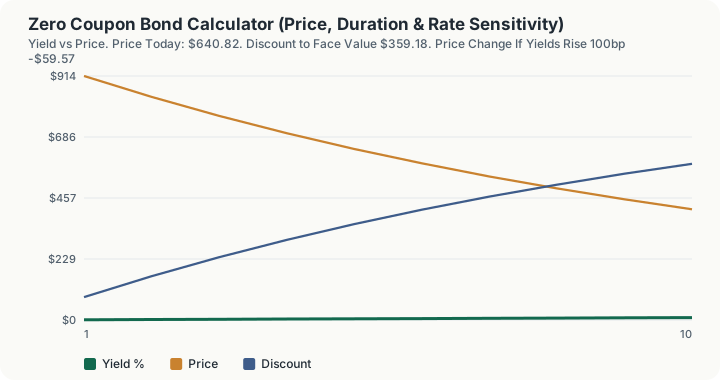
Quick Answer: A ten-year zero with a $1,000 face value yielding 4.5% semiannually is worth $640.82 today: 64.08% of par, a $359.18 discount, and a 56.05% total return if held to maturity. Its duration is exactly ten years, because there is only one cash flow. That is why a 30-year zero loses 25.37% of its value on a 100bp rise while a 2-year loses just 1.93%.
What does this calculator do?
A zero coupon bond pays nothing until maturity. The entire return comes from buying below par and being repaid in full, so its price is simply the present value of one future payment.
That single cash flow has an important consequence: a zero's Macaulay duration equals its maturity exactly. Every other bond has duration shorter than its maturity, because coupons return capital earlier. A zero has none, so nothing pulls its duration in.
This makes long zeros the most interest-rate-sensitive instruments in the bond market. A 30-year zero falls over 25% on a one-point rise in yields. That is either the reason to own one or the reason not to, depending on your view, but it should never be a surprise.
How is this calculated?
P = F/((1 + y/m)^(n × m))
where F is face value, y the annual yield, n years to maturity and m the compounding frequency. US Treasury convention is semiannual, so m = 2.
Macaulay duration equals n, the maturity, by definition. Modified duration is:
D_mod = n/(1 + y/m)
and approximates the percentage price change for a one-point move in yields.
Worked Example
A ten-year zero at 4.5%
$1,000 face, 4.5% annual yield, ten years, US Treasury semiannual convention.
Step 1: Number of compounding periods. 10 years x 2 = 20 periods
Step 2: Rate per period. 4.5% / 2 = 2.25%
Step 3: The discount factor. 1.0225^20 = 1.560509
Step 4: Price today. $1,000 / 1.560509 = $640.82, or 64.08% of par
Step 5: The discount to face. $1,000.00 - $640.82 = $359.18
Step 6: Total return if held to maturity. $359.18 / $640.82 = 56.05%
Step 7: Macaulay duration. There is one cash flow, at year 10, so duration equals maturity: 10.00 years
Step 8: Modified duration. 10 / 1.0225 = 9.78
Step 9: Reprice at 5.5% and take the difference. $1,000 / 1.0275^20 = $581.25, so a 100bp rise costs -$59.57, or -9.30%
Step 6 is the whole character of a zero. There is no coupon to reinvest and no reinvestment rate to worry about, so the 56.05% is locked at purchase and cannot be missed by a fall in rates later. Step 9 is the price of that certainty: the entire return sits at one distant date, so the whole position reprices when yields move.
Duration made visible
The same issuer and the same 4.5% yield at three maturities:
Step 10: A 2-year zero. Price $914.84, modified duration 1.96, and 100bp costs -1.93%
Step 11: The 10-year zero. Price $640.82, modified duration 9.78, and 100bp costs -9.30%
Step 12: A 30-year zero. Price $263.15, modified duration 29.34, and 100bp costs -25.37%
Step 13: The ratio. 25.37% / 1.93% = 13.1x, against a maturity ratio of 15x
The percentage loss tracks modified duration closely but not exactly, and it undershoots at the long end because of convexity: as yields rise the price falls at a decelerating rate, so the 30-year zero loses 25.37% rather than the 29.34% its modified duration alone would predict. That gap is the single largest practical difference between the linear duration approximation and the actual repricing the engine performs, and it grows with maturity.
What a higher yield does to the same bond
Step 14: The ten-year zero repriced at 8%. $1,000 / 1.04^20 = $456.39, a discount of $543.61 and a total return to maturity of 119.11%
Step 15: Its rate sensitivity. Modified duration falls to 9.62 and 100bp now costs -9.15%
Raising the yield from 4.5% to 8% cut the price by 28.8% but made the bond slightly less rate-sensitive in percentage terms, because a higher discount rate shrinks the present value of the distant payment faster than it shrinks the derivative. Long zeros are most dangerous when yields are already low, which is precisely when they look most attractive.
What does this calculator not account for?
- Phantom income. In a taxable US account the annual accretion of a zero is taxed as interest each year even though no cash is received. This is why zeros are usually held in tax-deferred accounts, and the calculator does not model it.
- Credit risk. A corporate zero can default. Treasury STRIPS carry no credit risk but every other zero does.
- Reinvestment. A zero has no coupons to reinvest, which eliminates reinvestment risk entirely. That is a genuine advantage this page does not quantify.
- Convexity. Modified duration is a linear approximation. For large yield moves the true price change differs, and for a long zero the convexity effect is substantial.
- Liquidity and bid-offer spreads, which are wider on STRIPS than on coupon Treasuries.
- Callability, on the small number of callable zeros.
- Inflation. These are nominal figures. A 30-year nominal zero carries enormous inflation risk.
- Accrued interest conventions and day counts between coupon dates, which do not apply to a zero but do affect comparison with coupon bonds.
What mistakes do people make with this?
- Underestimating long-duration risk. A 30-year zero is not a conservative holding. It loses a quarter of its value on a one-point yield move, which is equity-like volatility from a government bond.
- Holding zeros in a taxable account. The accretion is taxed annually without any cash arriving to pay the tax. Zeros belong in tax-deferred accounts in most cases.
- Comparing a zero's yield with a coupon bond's without adjusting for compounding. Quote conventions differ, and a semiannual yield is not directly comparable to an annual one.
- Assuming duration equals maturity for all bonds. It only does for zeros. Coupon bonds always have shorter duration than maturity.
- Relying on modified duration for large moves. It is a first-order approximation. Convexity matters, and for long zeros it matters a lot.
- Forgetting that the return is fixed only if held to maturity. Sell early and you get the market price, which can be far below your purchase price.
Frequently Asked Questions
Why is a zero's duration equal to its maturity?
Are zeros riskier than coupon bonds?
What is phantom income?
What are Treasury STRIPS?
Why would anyone buy a 30-year zero?
Is the yield I see annual or semiannual?
Sources
- U.S. Securities and Exchange Commission, Investor.gov, the official authority for the investing this calculator relates to. investor.gov
Also consulted: Standard fixed income mathematics. Zero coupon pricing, Macaulay duration and modified duration are closed-form results with no jurisdictional content; The observation that Macaulay duration equals maturity for a zero follows directly from the definition of duration as the weighted average time to cash flows.