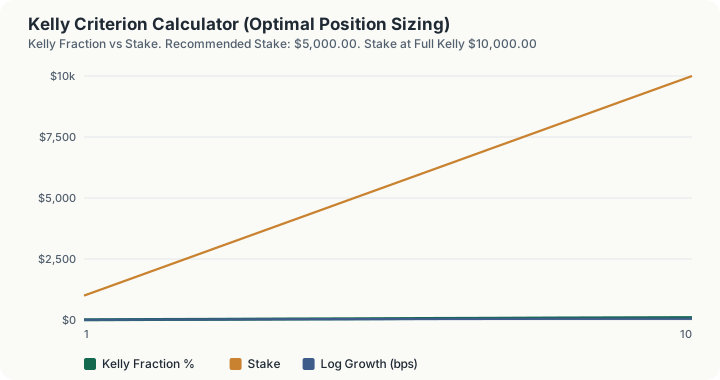
Quick Answer: With a 55% win rate on an even-money bet, full Kelly stakes 10% of bankroll. At the more common half Kelly, that is $5,000.00 of a $100,000 bankroll. Kelly maximises the compound growth rate, not expected wealth: a distinction that matters, because the stake maximising expected value can carry a near-certain probability of ruin.
What does this calculator do?
The Kelly criterion answers a question expected value cannot: how much to stake, given an edge.
f^∗ = (bp − q)/b
where b is the payoff ratio, p the win probability and q = 1 − p.
What makes Kelly different from naive expected-value maximisation is what it optimises. Maximising expected wealth on a repeated bet leads to staking everything, which produces the highest average outcome and near-certain ruin. Kelly maximises the expected logarithm of wealth, which is the compound growth rate of a bankroll bet repeatedly. That is the quantity a long-run investor actually experiences.
Two practical warnings follow, and both are more important than the formula.
Kelly is exquisitely sensitive to the win probability. Overestimating your edge overstakes you superlinearly. Most people who lose money using Kelly do so because their p was wrong, not because the formula was.
Full Kelly is very volatile. Drawdowns of 50% are routine at the optimal fraction. Half Kelly gives roughly three quarters of the growth with half the volatility, which is why practitioners overwhelmingly use fractional Kelly.
How is this calculated?
Edge is the expected profit per unit staked:
Edge = bp − q
Full Kelly fraction is the edge divided by the payoff ratio:
f^∗ = Edge/b
Fractional Kelly simply scales that by your chosen multiple.
Expected log growth at fraction f is:
g = p ln(1 + bf) + q ln(1 − f)
A negative f\* means the bet has negative expected value and should not be taken.
Worked Example
A trader believes a repeatable setup wins 55% of the time at even money, and has $100,000 of risk capital behind it.
Step 1: The loss probability. q = 1 - 0.55 = 0.45
Step 2: The edge per unit staked. (1 x 0.55) - 0.45 = 10.00%
Step 3: The full Kelly fraction. 0.10 / 1 = 10.00% of bankroll
Step 4: Full Kelly in dollars. $100,000 x 10.00% = $10,000.00
Step 5: The stake at half Kelly. $100,000 x 5.00% = $5,000.00
Halving the stake does not halve the growth, and that asymmetry is the whole case for fractional Kelly:
Step 6: Expected log growth at full Kelly. 0.55 x ln(1.10) + 0.45 x ln(0.90) = 50.08 basis points per bet
Step 7: Expected log growth at half Kelly. 0.55 x ln(1.05) + 0.45 x ln(0.95) = 37.53 basis points per bet
Step 8: What the halved stake actually costs. 37.53 / 50.08 = 74.9% of the growth retained for half the exposure
Step 9: The same at 30% of Kelly. 25.51 basis points, or 50.9% of full-Kelly growth on 30% of the stake
The curve above the optimum is flat and the curve below it is steep. Overstating your edge therefore costs far more than understating it, which is the practical argument for staying to the left of full Kelly.
Now change the shape of the bet rather than the fraction:
Step 10: A 50% win rate with a 2:1 payoff. Edge = (2 x 0.5) - 0.5 = 50.00% per unit staked
Step 11: The Kelly fraction that produces. 0.50 / 2 = 25.00%, so $25,000.00 at full Kelly and $12,500.00 at half
A coin-flip win rate justifies two and a half times the stake of the 55% edge, purely because the winners are twice the size of the losers.
Step 12: A 45% win rate at even money. Edge = (1 x 0.45) - 0.55 = -10.00%
Step 13: The Kelly fraction, and what the calculator does with it. -0.10 / 1 = -10.00%, and the recommended stake is floored at $0.00
A negative fraction is not an instruction to bet the other way. It is the formula saying this bet has no size at which it is worth taking, and it is only a signal to reverse if you can genuinely take the opposite side.
What does this calculator not account for?
- Whether your probability estimate is right. This is the entire risk. Kelly assumes p is known, and in investing it never is.
- Estimation error. Because misestimating p leads to overstaking, many practitioners deliberately use a quarter or a half of Kelly as an error margin, not merely for comfort.
- Multiple simultaneous bets. Kelly for correlated positions requires solving jointly, and the single-bet formula overstates each position's size.
- Continuous rather than binary outcomes. Real investments have distributions of returns, not two branches. The continuous analogue is mean over variance.
- Transaction costs, spreads and slippage, all of which reduce the true edge.
- Bankroll that is not fully at risk. If part of your capital is committed elsewhere, the effective bankroll is smaller.
- Drawdown tolerance. Kelly is indifferent to path. A human investor is not.
- Ruin from a single catastrophic outcome, where losses can exceed the stake.
What mistakes do people make with this?
- Overestimating the edge. Kelly's output rises faster than the error in p, so optimism is punished harshly. A believed 55% that is truly 52% turns a 10% stake into an overstake.
- Using full Kelly. It maximises growth, and the drawdowns are brutal. Half Kelly captures around three quarters of the growth at roughly half the volatility.
- Applying it to correlated positions independently. Ten positions each sized at Kelly, all correlated, is effectively one enormous position.
- Treating a negative fraction as a short signal. It means do not take this bet. Reversing it only works if the opposite bet is genuinely available at those odds.
- Forgetting costs. An edge of 10% before a 2% round-trip cost is an 8% edge, and the correct stake falls accordingly.
- Ignoring that Kelly assumes you can bet repeatedly. For a one-off decision, maximising log wealth is not obviously the right objective.
Frequently Asked Questions
What does the Kelly criterion actually maximise?
Why do people use half Kelly?
What if the formula gives a negative number?
Can a losing win rate still be a good bet?
Does Kelly work for a portfolio?
How sensitive is it to my probability estimate?
Sources
- Kelly, J. L. (1956), "A New Interpretation of Information Rate," Bell System Technical Journal. The original derivation of the Kelly fraction. doi.org/10.1002/j.1538-7305.1956.tb03809.x
Also consulted: Kelly, J. L. (1956), "A New Interpretation of Information Rate", the original derivation; Standard formulation of the criterion as maximising expected log wealth, with the fractional Kelly adjustment widely used in practice to manage estimation error and volatility.