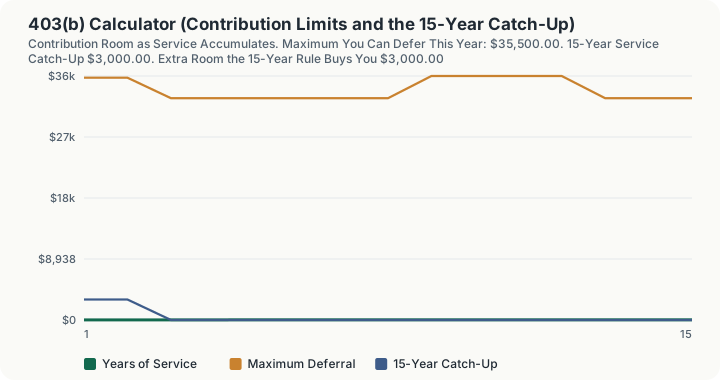
Quick Answer: A 52-year-old with 18 years of service at the same employer, $85,000 of compensation and $60,000 of elective deferrals in all prior years can put $35,500 into a 403(b) this year. That is the $24,500 elective deferral limit, plus a $3,000 15-years-of-service catch-up, plus an $8,000 age-50 catch-up.
What does this calculator do?
A 403(b) is the salary-deferral plan offered to employees of public school systems, hospitals, health and welfare agencies, home health agencies, churches and other 501(c)(3) organisations. For most participants it behaves exactly like a 401(k): the same section 402(g) elective deferral limit, the same section 414(v) age-based catch-up, the same section 415(c) ceiling on everything that goes into the plan in a year.
There is exactly one thing a 403(b) can do that no other plan type can, and it is the reason this page exists. Under IRC section 402(g)(7), an employee with at least 15 years of service with the same qualifying employer can raise the elective deferral limit itself. That extra room is worth up to $3,000 a year and up to $15,000 across a working lifetime, and it is not indexed for inflation, so its value quietly erodes each year while the underlying limits rise.
The other thing this calculator is careful about is where each catch-up sits relative to the annual additions limit. The 15-year service catch-up raises the section 402(g) limit itself, so it counts inside the section 415(c) annual additions limit. The age-based catch-up is a section 414(v) catch-up, and section 414(v)(3)(A) puts 414(v) amounts outside 415(c). That distinction is not cosmetic: it changes how much room is left for your employer's money, and this calculator reports the two separately for that reason.
How is this calculated?
The maximum elective deferral is the statutory limit plus both catch-ups, floored by your compensation:
Max Deferral = min(402(g) limit + Service Catch-Up + Age Catch-Up, Capped Compensation)
The service catch-up is itself the least of three separate tests, each floored at zero:
Service Catch-Up = min($3,000, $15,000 − Used, $5,000 × Years − Prior Deferrals)
Step 1: Cap your compensation at the section 401(a)(17) limit. min($85,000, $360,000) = $85,000
Step 2: Check eligibility for the 15-year catch-up. It requires 15 years of service with the same qualifying employer. 18 years >= 15 years = Eligible
Step 3: Test 1, the flat annual cap. $3,000
Step 4: Test 2, the lifetime cap less what you have already used. $15,000 - $0 = $15,000
Step 5: Test 3, the service credit less all prior elective deferrals. $5,000 x 18 - $60,000 = $90,000 - $60,000 = $30,000
Step 6: Take the least of the three. min($3,000, $15,000, $30,000) = $3,000 (the annual cap binds)
Step 7: Find the age-based catch-up. None under 50, the standard amount from 50, and a higher amount for those who attain age 60 to 63 during the year. At 52 the standard amount applies. $8,000
Step 8: Add them to the statutory deferral limit and floor at compensation. min($24,500 + $3,000 + $8,000, $85,000) = $35,500
Step 9: Split the deferral you actually make across the 415(c) boundary. The ceiling that counts inside the annual additions limit is the 402(g) limit plus the service catch-up. min($30,000, $24,500 + $3,000) = $27,500 counts inside 415(c)
Step 10: Find the annual additions limit. min($72,000, $85,000) = $72,000
Step 11: Work out how much employer room is left. $72,000 - $27,500 = $44,500
Step 12: Apply the employer contribution against that room. min($4,250, $44,500) = $4,250 applied, $0 turned away
Step 13: Total going into the plan. $30,000 + $4,250 = $34,250
Worked Example
Take a 52-year-old school district administrator earning $85,000, in her eighteenth year with the same district, who has deferred $60,000 into district plans across her whole career and has never used the 15-year catch-up. She wants to put in $30,000 this year, and the district adds $4,250.
Step 1: Her service catch-up. The three tests give $3,000, $15,000 and $30,000. The least is $3,000, so the annual cap is what binds her.
Step 2: Her age catch-up. At 52 she is in the standard band: $8,000.
Step 3: Her ceiling. $24,500 + $3,000 + $8,000 = $35,500.
Step 4: What the 15-year rule is actually worth to her. An identical participant with under 15 years of service would have a ceiling of $24,500 + $8,000 = $32,500. $35,500 - $32,500 = $3,000 of extra room
Step 5: Her unused room. She only wants to defer $30,000. $35,500 - $30,000 = $5,500 left on the table
Step 6: Her total contributions. $30,000 of her own plus $4,250 from the district = $34,250, comfortably inside the $72,000 annual additions limit.
Now change one thing. If she had deferred $88,000 in prior years rather than $60,000, test 3 becomes $5,000 x 18 - $88,000 = $2,000, and that becomes the binding test. A strong saving history shrinks the catch-up that rewards long service, which is the opposite of most people's intuition. This is why the calculator shows all three tests rather than only the answer: which one binds tells you what to change.
What does this calculator not account for?
- Whether your employer actually qualifies. The 15-year catch-up is available only for service with a school system, hospital, health or welfare service agency, home health service agency, or church-related organisation. The calculator takes your years of service at face value and does not test the employer type.
- Whether your plan permits the catch-up. The 15-year catch-up is optional at plan level. Your plan document, not the statute, decides whether it is available to you.
- Ordering rules between the two catch-ups. Where both are available, deferrals are generally applied against the 15-year catch-up before the age-based one. The calculator computes the total ceiling correctly but does not walk through the ordering of a mid-year payroll stream.
- Income tax, FICA, or state tax. Nothing here is converted to a take-home pay effect.
- Investment growth. This is a one-year contribution capacity calculation, not a balance projection.
- The 457(b) sitting beside it. Many public employers offer both. A 457(b) has its own separate limit under section 457(e)(15), and this page does not model it.
What mistakes do people make with this?
- Assuming 15 years of service means 15 calendar years anywhere. It means 15 years with the same qualifying employer. Moving between two school districts resets the clock.
- Treating the $15,000 as an annual figure. It is a lifetime cap on the whole catch-up. Claiming $3,000 a year exhausts it in five years.
- Forgetting that prior deferrals reduce the catch-up. The third test subtracts everything you have ever deferred with that employer, so diligent savers frequently find the catch-up is smaller than the headline $3,000.
- Assuming your own deferral leaves $72,000 minus the whole deferral for your employer. Only the portion inside the 402(g) plus service-catch-up ceiling counts against 415(c). At the defaults that is $27,500, not the $30,000 actually deferred.
- Believing the 403(b) and the 401(k) have separate limits. They share one section 402(g) limit across both. If you have both, they compete.
Frequently Asked Questions
What is the 403(b) contribution limit for 2026?
Can I use the 15-year catch-up and the age-50 catch-up in the same year?
Why is my 15-year catch-up less than $3,000?
Does my employer's contribution reduce how much I can defer?
If I have both a 403(b) and a 457(b), do I get two limits?
Is the $3,000 figure indexed for inflation?
Sources
- IRS Notice 2025-67, "Cost-of-Living Adjustments for Tax Year 2026": the $24,500 section 402(g)(1) deferral limit, the $8,000 section 414(v)(2)(B)(i) catch-up, the $11,250 section 414(v)(2)(E)(i) catch-up for ages 60 to 63, and the $72,000 section 415(c)(1)(A) annual additions limit. irs.gov/pub/irs-drop/n-25-67.pdf
- IRS, "Retirement topics - 403(b) contribution limits": the 15-years-of-service catch-up and its three-part test. irs.gov/retirement-plans/plan-participant-employee/retirement-topics-403b-contribution-limits
- IRC section 402(g)(7) (the 15-year service catch-up), section 414(v)(3)(A) (catch-ups outside the annual additions limit), section 415(c)(1)(A) and section 401(a)(17). law.cornell.edu/uscode/text/26/402