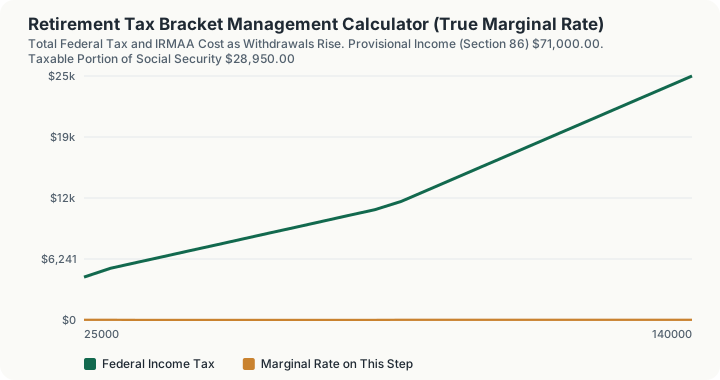
Quick Answer: A married couple with $42,000 of Social Security, $30,000 of other ordinary income and a $20,000 traditional IRA withdrawal faces a true marginal rate of 22.20% on the next dollar withdrawn, while the statutory bracket says 12.00%. That is a multiplier of 1.85: each extra dollar of withdrawal drags 85 cents of Social Security into taxable income under section 86. Federal tax for the year is $3,278.00 on $78,950 of AGI, an effective rate of 4.15%.
What does this calculator do?
Almost every retirement planning tool answers the question "which bracket am I in." For a retiree that is frequently the wrong question, because the bracket is frequently not the rate being paid.
Three separate provisions bolt themselves onto the ordinary rate schedule, and the same additional dollar of withdrawal triggers all three:
- The Social Security phase-in, section 86. Between the base and adjusted-base amounts each extra dollar of provisional income drags 50 cents of benefits into taxable income; above the adjusted base it drags 85 cents. Those thresholds ($25,000 and $34,000 single, $32,000 and $44,000 joint) have never been indexed since 1983 and 1993. They were written for the wealthy and now reach ordinary retirees.
- The senior deduction phase-out, section 151(d)(5), added by the OBBBA for years before 2029. $6,000 per individual aged 65 or over, reduced by 6% of modified AGI above $75,000 ($150,000 joint). Inside the range each extra dollar of AGI costs 6 cents of deduction, multiplying the marginal rate by 1.06, and it stacks multiplicatively with the Social Security phase-in.
- IRMAA, the Medicare Part B and Part D income-related surcharges. Not a rate at all but a cliff: one dollar over a threshold costs the whole annual surcharge, for every beneficiary on the return.
So the useful output is not a bracket. It is the marginal rate curve: what the next dollar costs at every level of withdrawal, with the cliffs marked where they fall.
How is this calculated?
Provisional Income = other income + withdrawal + tax-exempt interest + 0.5 × benefit
Taxable SS = min(0.85(PI − adj. base) + min(0.5(adj. base − base), 0.5B), 0.85B)
Senior Deduction = max(0, $6,000n − 0.06 × max(0, MAGI − threshold))
True Marginal Rate = (T(withdrawal + $1,000) − T(withdrawal))/$1,000
Step by step, as the engine runs it:
Step 1: Compute provisional income. Other ordinary income, plus the withdrawal, plus tax-exempt interest in full, plus half the gross Social Security benefit. Municipal bond interest is never taxed directly and still counts here in full.
Step 2: Apply IRS Publication 915 Worksheet 1 in closed form. Below the base amount nothing is taxable. Between base and adjusted base the inclusion is the lesser of 50% of the excess and 50% of benefits. Above the adjusted base it is 85% of the excess above the adjusted base, plus the carried tier-one amount, capped at 85% of benefits.
Step 3: Build AGI. Other income plus the withdrawal plus the taxable portion of Social Security. Tax-exempt interest is added back only for the IRMAA MAGI test.
Step 4: Build the deductions. The basic standard deduction, plus the section 63(f) additional standard deduction for the aged ($1,650 each married, $2,050 unmarried for 2026), plus the section 151(d)(5) senior deduction after its 6% phase-out.
Step 5: Compute taxable income and the federal tax on the 2026 schedule.
Step 6: Read the statutory bracket the last dollar of taxable income falls in.
Step 7: Price the next $1,000. The engine re-runs the entire year with the withdrawal $1,000 higher and divides the tax difference by $1,000. This is the true marginal rate, and it is measured, not assumed.
Step 8: Divide by the bracket to get the multiplier.
Step 9: Look up the IRMAA tier against MAGI, and the distance to the next threshold.
Step 10: Convert that distance into withdrawal room. This is the step that catches people out. A dollar withdrawn raises MAGI by more than a dollar wherever Social Security is still phasing in, so the room is the MAGI distance divided by (1 + phase-in slope). The withdrawal room is shorter than the MAGI headroom.
Step 11: Scan the curve. The engine steps the withdrawal upward in $5,000 increments across the entered range, computing the marginal rate over each step and flagging steps that cross an IRMAA threshold. Cliff-crossing steps are excluded from the reported peak rate, because a one-dollar threshold crossing spread across a $5,000 step is an artefact of the step width, not a rate anyone faces.
Worked Example
Using the defaults: married filing jointly, $42,000 Social Security, $30,000 other ordinary income, $0 tax-exempt interest, $20,000 withdrawal, two people 65 or over, two on Medicare.
Step 1: Compute provisional income. ($30,000 + $20,000) + $0 + (0.5 × $42,000) = $50,000 + $21,000 = $71,000.00
Step 2: Test it against the joint thresholds. $71,000 is above the $44,000 adjusted base amount, so the 85% tier applies.
Step 3: Carry the tier-one amount. min(0.5 × ($44,000 − $32,000), 0.5 × $42,000) = min($6,000, $21,000) = $6,000.00
Step 4: Apply the 85% tier. 0.85 × ($71,000 − $44,000) = 0.85 × $27,000 = $22,950.00, plus the $6,000 carry = $28,950.00
Step 5: Check it against the 85% ceiling. 0.85 × $42,000 = $35,700.00. $28,950 is below it, so the phase-in is still live and the slope is still 85 cents. Taxable Social Security = $28,950.00, which is 68.9% of the benefit.
Step 6: Build AGI. $30,000 + $20,000 + $28,950 = $78,950.00
Step 7: Build the deductions. Basic joint standard deduction $32,200.00, plus $1,650 × 2 = $3,300.00 for the aged, plus the senior deduction of $6,000 × 2 = $12,000.00 (unreduced, because $78,950 of MAGI is below the $150,000 joint phase-out threshold). $32,200.00 + $3,300.00 + $12,000.00 = $47,500.00
Step 8: Compute taxable income. $78,950.00 − $47,500.00 = $31,450.00
Step 9: Compute the federal tax. 10% × $24,800 = $2,480.00; 12% × $6,650 = $798.00. $2,480.00 + $798.00 = $3,278.00
Step 10: Read the statutory bracket. $31,450 of taxable income sits in the 12% bracket, with $69,350.00 of room to the $100,800 top of that band.
Step 11: Price the next $1,000. Re-running with a $21,000 withdrawal costs $222.00 more tax. $222.00 ÷ $1,000 = 22.20%
Step 12: Compute the multiplier. 22.20% ÷ 12.00% = 1.85
That 1.85 is the section 86 slope made visible: the extra $1,000 of withdrawal raises taxable income by $1,850, and $1,850 × 12% = $222.
Step 13: Read the IRMAA position. MAGI of $78,950 sits in tier 1, so the annual surcharge is $0.00. The next joint threshold is $218,000, so the MAGI distance is $139,051.00.
Step 14: Convert that to withdrawal room. ($139,051 − $1) ÷ 1.85 = $75,162.16
This is the point of the page. The MAGI headroom is $139,051, but the withdrawal headroom is only $75,162, barely more than half, because each withdrawn dollar carries 85 cents of Social Security across the line with it. Crossing that threshold costs $2,296.80 a year: ($81.20 + $14.50) monthly × 12 months × 2 beneficiaries.
Step 15: Read the peak of the curve. Across the $120,000 scan range the highest non-cliff marginal rate is 23.32%, reached at a $90,000 withdrawal. That is 22% × 1.06: by that point the section 86 ceiling has been reached and the phase-in has stopped, but the senior deduction phase-out has started, and 6 cents of deduction lost per dollar multiplies whatever bracket applies.
Step 16: Read the effective rate. $3,278.00 ÷ $78,950.00 = 4.15% of AGI. The average rate is trivial. The marginal rate is nearly six times it.
What does this calculator not account for?
- State income tax, and the several states that exempt Social Security or pension income entirely.
- Qualified dividends and long-term capital gains. This page prices the next dollar of ordinary income only. It does not model how ordinary income pushes gains through the 0%/15%/20% bands.
- The 3.8% net investment income tax under section 1411.
- Required minimum distributions. The withdrawal is treated as fully discretionary. Once RMDs begin, the choice this page assumes you have is partly removed.
- Itemised deductions, including the medical expense deduction that retirees frequently do claim, and the OBBBA charitable floor.
- The IRMAA two-year lookback is described but not simulated. The surcharge shown is the 2026 schedule applied to the income you enter, which is the right way to plan, but the premium that income actually sets falls in 2028 under whatever schedule applies then.
- Married filing separately. Under section 86(c)(1)(C) a taxpayer who lived with their spouse at any point in the year has a base amount of zero and up to 85% of benefits is taxable from the first dollar. Only single and married filing jointly are supported, because those are the two statuses IRMAA is published for.
- The expiry of the senior deduction after 2028.
What mistakes do people make with this?
- Planning to "fill the 12% bracket." On these defaults the 12% bracket is charging 22.20%. Filling it costs more than the 22% bracket you were avoiding.
- Treating IRMAA headroom as withdrawal headroom. They differ by the factor 1 + phase-in slope. Here that is the difference between $139,051 and $75,162, and a retiree who plans against the wrong one crosses a cliff.
- Assuming municipal bond interest is invisible. Tax-exempt is not torpedo-exempt. It counts in full toward provisional income and toward the IRMAA MAGI.
- Missing the point where the rate falls. Once 85% of benefits is already included, further withdrawals no longer drag anything in and the marginal rate drops back toward the plain bracket. That is one of the few places in the tax code where the marginal rate goes down as income rises, and it is a genuinely good place to do a large Roth conversion.
- Crossing an IRMAA threshold by a few dollars. The surcharge is a cliff, per beneficiary. A married couple crosses each threshold twice.
- Reading the effective rate as the cost of the decision. 4.15% is what you paid on the whole year. 22.20% is what the next dollar costs.
Frequently Asked Questions
Why is my true marginal rate higher than my tax bracket?
What is the "tax torpedo"?
How much can I convert to Roth before hitting IRMAA?
Does tax-exempt municipal interest help?
Why does the marginal rate peak and then fall?
Is the senior deduction permanent?
Sources
- 26 U.S.C. 86, law.cornell.edu/uscode/text/26/86: the two-tier 50%/85% inclusion, the base amounts of $25,000 (single) and $32,000 (joint) in 86(c)(1), and the adjusted base amounts of $34,000 and $44,000 in 86(c)(2). Neither is inflation adjusted. Read 2026-08-30.
- IRS Publication 915, Worksheet 1, irs.gov/publications/p915: the worksheet implemented in closed form by the engine. Read 2026-08-30.
- 26 U.S.C. 151(d)(5), law.cornell.edu/uscode/text/26/151: "$6,000 for each qualified individual", age 65 before the close of the taxable year, reduced by "6 percent of so much of the taxpayer's modified adjusted gross income as exceeds" $75,000 ($150,000 joint), for taxable years beginning before 1 January 2029. Read 2026-08-30.
- IRS Revenue Procedure 2025-32 sec. 4.14(3), irs.gov/pub/irs-drop/rp-25-32.pdf: "the additional standard deduction amount under section 63(f) for the aged or the blind is $1,650... increased to $2,050 if the individual is also unmarried and not a surviving spouse." Read 2026-08-30. The same Revenue Procedure supplies the 2026 brackets and standard deductions held in
engine/tables/2026/federal-tax.json. - Centers for Medicare & Medicaid Services, 2026 Medicare Parts A & B premiums and deductibles, cms.gov/newsroom/fact-sheets/2026-medicare-parts-b-premiums-deductibles: the IRMAA tier thresholds and Part B and Part D surcharges held in
engine/tables/2026/irmaa.json.