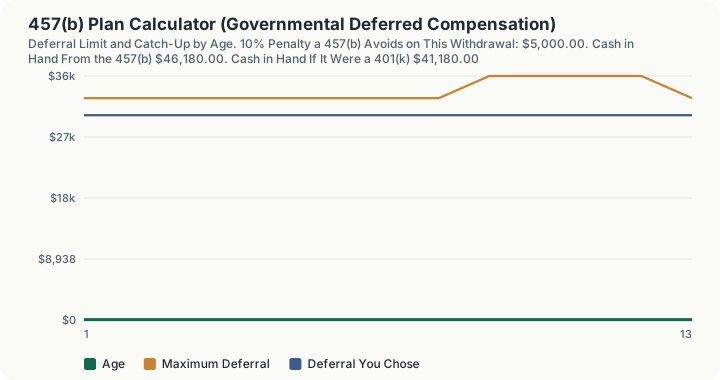
Quick Answer: Leaving a government job at 52 and drawing $50,000 with no other income that year, a governmental 457(b) avoids $5,000 of the 10% additional tax on early distributions that the identical withdrawal from a 401(k) would owe. You keep $46,180 rather than $41,180, and the same year you can defer up to $32,500 into the plan, a limit entirely separate from the one a 401(k) and a 403(b) share.
What does this calculator do?
A governmental 457(b) is the deferred compensation plan offered to employees of states, counties, cities, school districts and other political subdivisions. It looks like a 401(k) from the outside: pre-tax salary deferrals, tax-deferred growth, ordinary income tax on the way out. Two things make it genuinely different, and both are what this calculator prices.
The first is the deferral limit. The section 457(e)(15) limit is its own bucket. It is not shared with the section 402(g) limit that a 401(k) and a 403(b) split between them. A public employee offered both a 403(b) and a 457(b) therefore has two full deferral limits available in the same year, not one.
The second is the far larger point. Governmental 457(b) distributions sit outside the 10% additional tax on early distributions entirely. Not at 55, not with a rule-of-55 separation test, not by building a 72(t) payment plan: at any age, on separation from service. That single fact makes a 457(b) the most useful early-retirement bridge account in the American system, and it is the reason a public employee planning to leave at 52 or 55 should usually fill the 457(b) before anything else. The one carve-out is money rolled into the 457(b) from a 401(k) or an IRA, which keeps the 10%. Consolidating other accounts into a 457(b) does not launder the penalty away.
How is this calculated?
The headline is the difference between the additional tax two identical withdrawals would owe:
Penalty Avoided = Penalty_401(k) − Penalty_457(b)
where each penalty is 10% of the portion of the withdrawal not covered by an exception:
Penalty = 0.10 × Penalised Portion
Step 1: Determine the 457(b) status at the withdrawal age. Age 52 is under 59 1/2, but the plan type is a governmental 457(b), so the exception applies. Penalised portion = the rolled-in balance only = $0
Step 2: Price the 10% on the 457(b). 0.10 x $0 = $0
Step 3: Determine the status of the same withdrawal from a 401(k) by someone who also separated at 52. The separation-from-service exception needs separation at 55 or later, so it does not apply. Penalised portion = the whole withdrawal = $50,000
Step 4: Price the 10% on the 401(k). 0.10 x $50,000 = $5,000
Step 5: The difference is the headline. $5,000 - $0 = $5,000
Step 6: Compute the ordinary income tax, which is identical either way. The withdrawal stacks on $0 of other income, the 2026 standard deduction is applied, and the 2026 single brackets are run. $50,000 - $16,100 = $33,900 of taxable income 10% on the first $12,400 = $1,240 12% on the remaining $21,500 = $2,580 $1,240 + $2,580 = $3,820 of federal income tax
Step 7: Cash in hand from the 457(b). $50,000 - $3,820 = $46,180
Step 8: Cash in hand had it been a 401(k). $50,000 - $3,820 - $5,000 = $41,180
Step 9: Total cost as a share of the withdrawal. $3,820 / $50,000 = 7.64%
The deferral side is computed separately, and exactly one catch-up is applied. This calculator never adds the age-based catch-up to the final-three-years catch-up.
Max Deferral = min(457(e)(15) limit + Catch-Up, Capped Compensation)
Step 10: Start from the 2026 section 457(e)(15) limit. $24,500
Step 11: Add the age-based catch-up. At 52 the standard amount applies. $24,500 + $8,000 = $32,500
Step 12: Floor at compensation. min($32,500, $90,000) = $32,500 maximum deferral
Step 13: Compare with the deferral you want to make. $32,500 - $30,000 = $2,500 of room left unused
Worked Example
A county employee, 52 years old, earning $90,000, leaves the county this year and takes $50,000 out of her 457(b) to bridge to a later pension start. She has no other income in the withdrawal year and files single. Nothing in the account was rolled in from elsewhere.
Step 1: Is she penalised? No. A governmental 457(b) distribution is outside the 10% additional tax regardless of age. Her penalised portion is $0.
Step 2: What would the same withdrawal cost from a 401(k)? She separated at 52, below the age-55 threshold for the separation-from-service exception, so the whole $50,000 is penalised: $5,000.
Step 3: Her federal income tax. $3,820 either way, because the ordinary income tax does not care which plan type the money came from.
Step 4: What she keeps. $46,180 from the 457(b) against $41,180 from a 401(k): $5,000 of difference, which is the whole of the additional tax.
Step 5: What she can still defer this year. $32,500, of which she is using $30,000, leaving $2,500 unused.
Change one input and the picture shifts. If half the balance had been rolled in from an old 401(k), $25,000 of the withdrawal would be penalised at 10%, costing $2,500 and cutting the advantage in half. And if she waited until 60 to withdraw, the 401(k) penalty would disappear on its own past 59 1/2, and the 457(b) advantage on that withdrawal would fall to zero. The 457(b) advantage is entirely an early-access advantage.
What does this calculator not account for?
- Non-governmental 457(b) plans. A tax-exempt employer's 457(b) is a fundamentally different animal: the assets remain subject to the employer's creditors, and the distribution rules are far more restrictive. Everything on this page describes a governmental plan.
- State income tax. Only federal ordinary income tax is modelled.
- The final-three-years catch-up amount. That figure depends on your own underutilised deferrals in earlier years, which only your plan administrator can compute. This calculator uses the number you enter and never derives one. Confirm it before relying on it.
- Investment growth on the balance. This is a one-year contribution and withdrawal calculation, not a projection.
- Any 403(b) or 401(k) running alongside. The separate section 402(g) limit is not sized here.
- Whether your plan permits the withdrawal at all. A 457(b) distribution normally requires separation from service, an unforeseeable emergency, or reaching age 59 1/2 in-service. Eligibility is a plan question, not a tax one.
What mistakes do people make with this?
- Rolling a 457(b) into an IRA "to simplify". Doing so permanently destroys the penalty-free early access, which is the plan's single most valuable feature. Once the money is in an IRA it is subject to the 10% before 59 1/2 like any other IRA.
- Assuming rolled-in money is protected too. It is not. Balances rolled into a 457(b) from a 401(k) or an IRA keep the 10% additional tax. The calculator prices that portion separately for exactly this reason.
- Adding the two catch-ups together. You may use the age-based catch-up or the final-three-years catch-up, not both in the same year.
- Treating the special catch-up as a headline number. It is built from your own prior-year shortfalls. Two colleagues on the same salary can have wildly different amounts certified.
- Thinking the 457(b) limit is shared with the 403(b). It is not. That is the point of having both.
Frequently Asked Questions
Can I withdraw from a 457(b) at 50 without penalty?
What is the 457(b) contribution limit for 2026?
Can I contribute to both a 403(b) and a 457(b) in the same year?
What is the final-three-years catch-up worth?
Does a 457(b) have required minimum distributions?
Is the 457(b) money safe if my employer has financial trouble?
Sources
- IRS Notice 2025-67, "Cost-of-Living Adjustments for Tax Year 2026": the $24,500 section 457(e)(15) deferral limit, the $8,000 section 414(v)(2)(B)(i) catch-up, and the $11,250 catch-up for ages 60 to 63. irs.gov/pub/irs-drop/n-25-67.pdf
- IRS, "Retirement topics - Exceptions to tax on early distributions": governmental 457(b) distributions outside the 10% additional tax except for rolled-in amounts, and the separation-from-service exception at age 55. irs.gov/retirement-plans/plan-participant-employee/retirement-topics-exceptions-to-tax-on-early-distributions
- IRS Revenue Procedure 2025-32: the 2026 federal ordinary income brackets and standard deduction used for the income tax on the withdrawal. irs.gov/pub/irs-drop/rp-25-32.pdf
- IRC section 72(t)(1) (the 10% additional tax), section 457(b)(3) (the final-three-years catch-up) and section 401(a)(17). law.cornell.edu/uscode/text/26/72