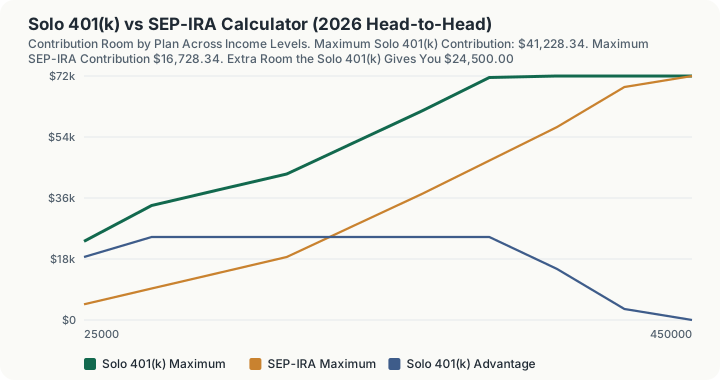
Quick Answer: $90,000 of Schedule C net profit at age 45, with no common-law employees, supports a Solo 401(k) contribution of $41,228.34 against $16,728.34 for a SEP-IRA. The Solo 401(k) wins by $24,500.00, which is 146.46% more room, and every dollar of that gap is the employee elective deferral. The employer piece is $16,728.34 under both plans: identical arithmetic, identical result.
What does this calculator do?
The two plans are usually presented as rivals with different formulas. They are not. For a sole proprietor they share one formula and differ by one component.
Both start from Schedule C net profit, subtract the deductible half of self-employment tax to reach net earnings from self-employment under IRC section 401(c)(2), and apply the same 20% reduced rate to it. That produces the same employer contribution in both plans, to the cent.
The Solo 401(k) then adds something a SEP-IRA has no equivalent of: an employee elective deferral of up to $24,500 for 2026, plus catch-up from age 50.
That single fact determines the whole comparison, and it determines it in a direction most write-ups state backwards. The Solo advantage is largest at low income, where the 20% employer piece is small and the flat deferral is enormous relative to it, and it converges to zero at $360,000 of net earnings from self-employment, where the employer 20% alone fills the section 415(c) limit and there is no room left for the deferral to occupy.
At $25,000 of net profit the Solo permits 400% more than a SEP. At $432,535 of net earnings they are identical.
How is this calculated?
Net earnings = net profit − 1/2 SE tax
Reduced rate = r/(1 + r) = 0.25/1.25 = 0.20
Employer piece = 0.20 × net earnings
Solo total = min(deferral + employer piece, §415(c) cap + catch-up, net earnings)
Step by step:
Step 1: Compute self-employment tax. Schedule C net profit times 92.35%, times 15.3% up to the Social Security wage base, with Medicare continuing above it.
Step 2: Take half of it as the section 164(f) deduction.
Step 3: Subtract that from net profit to get net earnings from self-employment. This is the self-employed equivalent of a W-2 employee's compensation, and it is the base both plans use.
Step 4: Convert the stated 25% plan rate to the self-employed reduced rate. Because the contribution is a percentage of earnings after the contribution is subtracted, the IRS worksheet resolves the circularity as r ÷ (1 + r). At 25% that is exactly 20%. "20% of net self-employment earnings" and "25% of compensation" are the same worksheet expressed two ways, not two competing methods.
Step 5: Compute the employer contribution: 20% of net earnings. This is step 5 for both plans. The SEP-IRA stops here, capped at the 2026 dollar limit of $72,000.
Step 6: Determine the Solo 401(k) catch-up tier. None below 50, $8,000 from 50, and $11,250 in the SECURE 2.0 band for ages 60 to 63, which replaces rather than stacks with the standard catch-up.
Step 7: Size the employee deferral. The smallest of what you asked for, the statutory limit of $24,500 plus catch-up, and your actual net earnings from self-employment.
Step 8: Fit the employer piece into the remaining section 415(c) room. The combined cap is $72,000 for 2026, and the non-catch-up deferral consumes part of it. Catch-up contributions sit outside the cap.
Step 9: Cap the total at net earnings. You cannot contribute more than you earned.
Step 10: Difference the two plans, and find the convergence point. The employer 20% reaches the $72,000 cap when net earnings reach $72,000 ÷ 0.20 = $360,000. Above that, the plans are level except for catch-up.
Worked Example
Using the defaults: $90,000 of Schedule C net profit, age 45, a requested deferral of $24,500, no employees, a 24% combined marginal rate.
Step 1: Compute self-employment tax. $90,000 × 92.35% = $83,115.00 of net earnings subject to SECA, taxed at 15.3%. $83,115.00 × 15.3% = $12,716.60
Step 2: Take the deductible half. $12,716.60 ÷ 2 = $6,358.30
Step 3: Compute net earnings from self-employment. $90,000.00 − $6,358.30 = $83,641.70
Step 4: Compute the employer contribution at the reduced rate. 20% × $83,641.70 = $16,728.34
Step 5: That is the entire SEP-IRA contribution. $16,728.34, well below the $72,000 dollar cap. SEP-IRA total: $16,728.34
Step 6: Determine the catch-up tier. Age 45 is below 50, so the tier is none and the catch-up is $0.00. The statutory deferral limit is $24,500.00.
Step 7: Size the employee deferral. min($24,500 requested, $24,500 statutory, $83,641.70 net earnings) = $24,500.00
Step 8: Check the section 415(c) room. $72,000 − $24,500 = $47,500 of room remains for the employer piece, and $16,728.34 fits inside it comfortably. The cap does not bind.
Step 9: Total the Solo 401(k). $24,500.00 + $16,728.34 = $41,228.34
Step 10: Difference the two plans. $41,228.34 − $16,728.34 = $24,500.00
Step 11: Express it as a percentage. $24,500.00 ÷ $16,728.34 = 146.46% more room
Step 12: Value the extra room at the marginal rate. $24,500.00 × 24% = $5,880.00 of tax deferred this year
Step 13: Find where the advantage disappears. $72,000 ÷ 0.20 = $360,000 of net earnings from self-employment. At $83,641.70 you are far below it, so the deferral is pure extra room.
The shape across income, from the engine's own sweep at these settings:
| Net profit | Net earnings | Solo 401(k) | SEP-IRA | Solo advantage |
|---|---|---|---|---|
| $25,000 | $23,233.80 | $23,233.80 | $4,646.76 | $18,587.04 (400%) |
| $50,000 | $46,467.61 | $33,793.52 | $9,293.52 | $24,500.00 (264%) |
| $100,000 | $92,935.22 | $43,087.04 | $18,587.04 | $24,500.00 (132%) |
| $200,000 | $185,882.85 | $61,676.57 | $37,176.57 | $24,500.00 (66%) |
| $300,000 | $284,543.77 | $72,000.00 | $56,908.75 | $15,091.25 (27%) |
| $450,000 | $432,535.16 | $72,000.00 | $72,000.00 | $0.00 (0%) |
Read the last column. In dollars the advantage is flat at the full deferral through the middle of the range and then collapses. As a percentage of what a SEP would allow, it is overwhelming at the bottom and gone at the top. That is the opposite of the usual claim that a Solo 401(k) is the high-earner's plan.
What does this calculator not account for?
- Businesses with common-law employees. This is the largest limitation. A "solo" 401(k) stops being solo the moment there is an eligible employee other than a spouse, and it picks up nondiscrimination testing, an employer contribution obligation and a full Form 5500. A SEP must give every eligible employee the same percentage of compensation you give yourself, under section 408(k)(3). Neither figure here is reliable for a business with staff; the calculator flags the case rather than modelling it per employee.
- Roth deferrals in a Solo 401(k), and the SECURE 2.0 requirement that catch-up contributions be Roth for higher earners.
- Plan loans, available in a Solo 401(k) and never in a SEP.
- S corporation owners paying themselves W-2 wages. The reduced-rate worksheet applies to sole proprietors and partners. A W-2 owner-employee uses 25% of compensation directly, on a different base.
- The actual tax saving. The marginal rate input is your own figure, not verified against any table, and it is used only to put a dollar value on the extra room.
- State tax, and states that do not conform to federal retirement plan treatment.
- Administration. The SEP has no Form 5500 and can be opened and funded after year end, up to the extended filing deadline. A Solo 401(k) generally requires the plan to exist before year end, and files Form 5500-EZ once assets pass the threshold.
- Multiple plans and controlled groups, where the section 415(c) limit and the deferral limit aggregate across employers.
What mistakes do people make with this?
- Applying 25% to raw Schedule C profit. This is the single most common error in self-employed retirement math, and it overstates the contribution twice: it skips the SE-tax deduction and it uses the stated rate rather than the reduced rate. On these defaults it would give $22,500 instead of $16,728.34.
- Believing the two plans have different employer formulas. They do not. Both give $16,728.34 here.
- Believing the Solo advantage grows with income. It shrinks. At $25,000 of net profit it is 400%; at $432,535 of net earnings it is zero.
- Deferring more than you earned. The deferral is capped at net earnings from self-employment, which is why the $25,000 row above contributes $23,233.80 rather than the full $24,500 plus an employer piece.
- Opening a SEP because it is easier and then hiring someone. The section 408(k)(3) rule means you must fund every eligible employee at your own percentage.
- Forgetting catch-up is the only Solo advantage left at high income. A SEP-IRA has no catch-up at any age.
- Assuming the section 415(c) cap includes catch-up. It does not; catch-up sits outside it.
Frequently Asked Questions
Which is better, a Solo 401(k) or a SEP-IRA?
How much can I contribute to a Solo 401(k) in 2026?
Why is my employer contribution 20% and not 25%?
At what income do the two plans become equivalent?
Can I have both?
What if I hire an employee?
Sources
- IRS Notice 2025-67, irs.gov/pub/irs-drop/n-25-67.pdf: the 2026 retirement plan limits, including the $24,500 elective deferral limit and the SECURE 2.0 catch-up figures. Fetched and read 2026-08-30.
- IRS Publication 560, chapter 5, "Table and Worksheets for the Self-Employed": the rate table and the reduced-rate calculation r ÷ (1 + r), and the requirement to reduce net profit by the deductible half of self-employment tax first. irs.gov/publications/p560
- IRC section 401(c)(2): the definition of net earnings from self-employment. law.cornell.edu/uscode/text/26/401
- IRC section 164(f): the deduction for one-half of self-employment tax. law.cornell.edu/uscode/text/26/164
- IRC section 408(k)(3): the SEP nondiscrimination rule requiring the same contribution percentage for every eligible employee. law.cornell.edu/uscode/text/26/408
Also consulted: IRS section 415(c) COLA table, the $72,000 overall defined contribution limit for 2026, which is also the SEP-IRA dollar cap; IRS, "Self-employed individuals: Calculating your own retirement plan contribution and deduction", the worked example the primitive is tested against: net profit $100,000, SE tax $14,130, half-SE-tax deduction $7,065, net earnings $92,935, reduced rate for a 10% plan of 9.0909%, contribution $8,449; IRC section 401(a)(17), the $360,000 annual compensation limit for 2026.