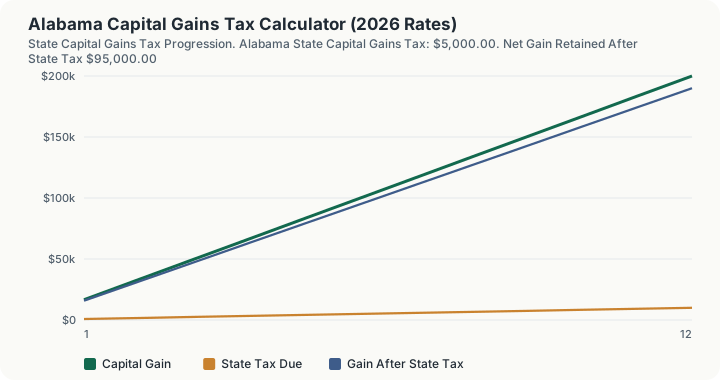
Quick Answer: On a $100,000 capital gain layered on $75,000 of other income, Alabama's graduated state tax adds $5,000.00 to your bill, an effective rate of 5.00%.
What Alabama's Schedule Actually Does to a Gain
Alabama taxes capital gains as ordinary income, folded into the same graduated bracket schedule that applies to wages and business earnings. Marginal statutory rates run from 2.00% up to a top rate of 5.00%, and because gains stack on top of whatever else you earned that year, a large sale can land partly or entirely in that top bracket even if your regular income is modest.
The distinctive feature of Alabama is where the schedule ends. The 5% top rate arrives at $3,000 of taxable income for a single filer, and at $6,000 for a married couple filing jointly. On the default inputs the calculator returns $5,000.00 on a $100,000 gain, which is exactly 5.00% of the whole gain: the $75,000 of other income filled the 2% and 4% bands long before the gain arrived, so nothing is left for them to catch. The graduation is real in the statute and, for most filers, invisible in the result.
The mechanics do not change by asset type. Whether the gain comes from publicly traded securities, a privately held business interest, real property, or digital assets, Alabama runs it through the same bracket array. What varies is how much of the gain lands in the top bracket, and that is decided entirely by the other-income figure you enter.
How This Is Calculated
The gain is stacked on top of your other income and walked through the bands from there.
Step by step, with your numbers:
- Enter the gain already netted. The calculator takes the figure you type as the net taxable gain and does not net losses or carryforwards against it. There is no loss input, and nothing in the engine reduces the gain before the brackets see it.
- Stack the gain on your other income. Ordinary income fills the lower brackets first and the gain sits on top of it. Enter other income as a taxable-income figure: the engine subtracts no standard deduction and no personal exemption, so a gross salary typed into that box overstates the bracket fill.
- Walk the brackets. The slice of the gain that falls in each band is multiplied by that band's rate and the pieces are added. Single filers use the 2% / 4% / 5% array breaking at $500 and $3,000; the married-filing-jointly selection switches to the doubled array breaking at $1,000 and $6,000.
- Effective rate. Total Alabama tax divided by the whole realized gain, which sits at or below the top marginal rate.
- Net proceeds. Subtract the state tax from the gain to get what you keep before federal tax.
Worked Example
Consider an investor in Alabama who realizes $100,000 in capital gains on top of $75,000 in baseline ordinary income for the year.
- Stack the income. The $75,000 of baseline income already occupies every band below $3,000, so the entire $100,000 gain sits in the 5% bracket.
- Apply the marginal brackets. Each slice of the gain is taxed at its own band's rate; here that is one slice at 5.00%.
- Total state tax due. $5,000.00.
- Effective rate. 5.00%, equal to the marginal rate, because no part of the gain reached a cheaper band.
- Net proceeds. The investor keeps $95,000.00 of the $100,000 gain, before any federal tax applies.
Walking the Bracket Edges: Where the Rate Actually Steps
The bracket steps are only visible when the gain itself is doing the filling, so this walk sets other taxable income to $0 and moves the gain across the two statutory edges. Every figure below is a separate run of the calculator.
At a $500 gain, the top of the 2% band. Alabama tax = $10.00, an effective rate of 2.00%.
At a $501 gain, one dollar later. Alabama tax = $10.04. The extra dollar was taxed at 4%, not 2%, and the reported marginal rate flips from 2.00% to 4.00%.
At a $3,000 gain, the top of the 4% band. Alabama tax = $110.00, an effective rate of 3.67%.
At a $3,001 gain. Alabama tax = $110.05, and the marginal rate now reads 5.00%. That is the last step the schedule has. Above $3,001 of stacked income there is no further edge at any income level, which is why the sweep table on this page rises in a perfectly straight line from $833.33 of tax at a $16,666.67 gain to $10,000.00 at a $200,000 gain.
Married filing jointly moves both edges but changes nothing else. On a $6,000 gain with no other income the joint schedule returns $220.00 against the single schedule's $260.00 on the same gain, and at $6,001 the joint marginal rate reaches 5.00% as well.
The Marginal Cost of the Next $1,000
Once stacked income clears $3,000, each additional $1,000 of gain costs $50.00 in Alabama tax. The sweep confirms it at scale: a $99,000 gain produces $4,950.00 and a $100,000 gain produces $5,000.00, a difference of exactly $50.00 on the extra $1,000. Doubling the gain to $200,000 doubles the tax to $10,000.00, and a $250,000 gain returns $12,500.00.
The Reverse Question: How Much Can Be Realised Before the Top Rate?
For a single filer with no other taxable income, $3,000 of gain can be realised before the 5% rate applies to the next dollar, and the tax on that $3,000 is $110.00. For a married couple filing jointly the figure is $6,000 of gain at $220.00 of tax. Those are the only two answers Alabama's schedule supports, and they are small enough that the question is usually academic: a filer with $2,500 of other income already pays $4,995.00 on a $100,000 gain against the $5,000.00 paid by someone with $75,000 of other income, a gap of five dollars across a $72,500 difference in salary.
The practical consequence runs the other way. Because the whole schedule is exhausted by $3,000 of income, timing a sale into a low-income year saves at most $40.00 in Alabama tax: a $100,000 gain against $0 of other income returns $4,960.00 rather than $5,000.00. Deferral strategies that are worth real money federally are worth forty dollars here.
What This Does Not Account For
This calculator is precise about Alabama's bracket arithmetic and deliberately narrow everywhere else: - Federal capital gains tax. Long-term brackets (0%, 15%, 20%) and short-term ordinary rates are not computed. On the default $100,000 gain the federal bill is the larger number by a wide margin and appears nowhere in the $5,000.00 headline. - Net Investment Income Tax. The 3.8% surtax under IRC 1411 is not applied. - Loss netting. There is no capital loss input. The engine cannot apply the $3,000 excess-loss allowance, and it will not stop you entering a gain figure that has not been netted. - State standard deduction and personal exemption. Alabama's own deduction and exemption are not subtracted from the other-income figure, so the bracket fill is computed on gross taxable income as typed. - Section 1031 exchanges, QSBS, and installment reporting. None of these change the number on this page; they change whether a gain is realised in the first place, which is an input decision.
Common Pitfalls
- Assuming Alabama gives long-term gains a break. It does not. The engine applies one rate array to short-term and long-term gain alike, and there is no holding-period input.
- Typing gross salary into the other-income box. The engine treats it as taxable income. Since every band is exhausted by $3,000 anyway, the error changes the answer by at most $40.00 -- but on the calculators for graduated states with tall schedules, the same mistake is expensive.
- Reading the 2% rate as available. At $500 of stacked income the 2% band is already full. Across an entire $100,000 gain the two cheap bands are worth $40.00: $4,960.00 of tax with no other income against $5,000.00 once they are occupied.
- Multi-state apportionment. Selling property located outside Alabama triggers a non-resident return elsewhere; this calculator models one state only.
- Mismatched cost basis records. Reinvested dividends, splits and return-of-capital distributions change the gain you should be entering, and the engine takes that figure on trust.
Frequently Asked Questions
Does Alabama have a state capital gains tax?
How are short-term and long-term capital gains taxed in Alabama?
At what point does the 5% rate start applying?
Does my salary change the Alabama tax on my gain?
Can capital losses offset capital gains in this calculator?
Sources
- Alabama Department of Revenue: 2026 Statutory Individual Income Tax Rate Schedules, Ala. Code 40-18-5 (2% first $500, 4% next $2,500, 5% over $3,000 for single filers; doubled for married filing jointly). revenue.alabama.gov
- Internal Revenue Service (IRS): Publication 544 and Publication 550, for the federal treatment this calculator does not compute. irs.gov/publications/p544