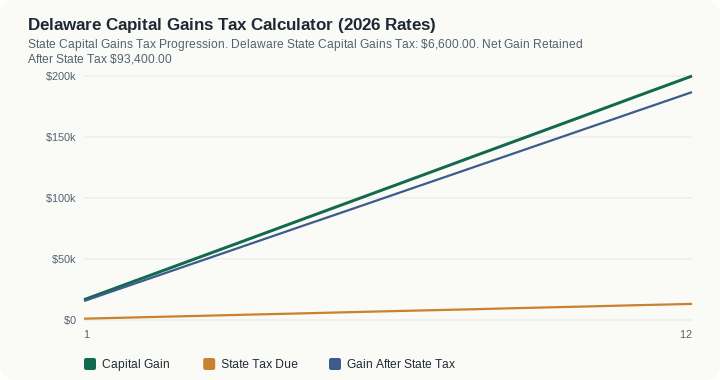
Quick Answer: A $100,000 profit on top of $75,000 of other taxable income costs $6,600.00 in Delaware, a flat-looking 6.60% of the gain, leaving $93,400.00 before federal tax. The other income has already climbed past $60,000, so the whole gain sits in the 6.6% step.
Delaware capital gains tax is ordinary Delaware income tax. The Division of Revenue applies one rate table, unchanged since tax year 2014, to wages, dividends and the profit on a Rehoboth Beach condo alike; there is no long-term rate and no exclusion in this calculator. What makes Delaware unusual is how soon its top rate arrives. At $60,000 of taxable income a seller is already paying the most the state ever charges.
Delaware's seven steps, and the $2,943.50 base
The Division of Revenue publishes the table as a base amount plus a rate on income over the start of each range:
- $0 to $2,000: nothing
- $2,000 to $5,000: 2.2%
- $5,000 to $10,000: $66 plus 3.9%
- $10,000 to $20,000: $261 plus 4.8%
- $20,000 to $25,000: $741 plus 5.2%
- $25,000 to $60,000: $1,001 plus 5.55%
- over $60,000: $2,943.50 plus 6.6%
That last base, $2,943.50, is exactly what this calculator charges on a $60,000 gain with nothing else on the return. It is the full cost of all six cheaper steps together, and it is also the most a seller can ever save compared with paying 6.6% on everything: $60,000 at 6.6% would be $3,960, so the steps are worth $1,016.50 at most.
How is this calculated?
The engine puts your other income at the bottom of the table and lays the gain on top, charging each step's rate on the part of the gain that lands in it.
DE tax = ∑_steps gain inside the step × its rate, from 0% up to 6.6%
Delaware share of the gain = (DE tax)/gain
If other income is $60,000 or more, the sum collapses to 6.6% times the gain. That is the case on the defaults, and it is why the twelve-row schedule below the result is a straight line: $1,100.00 on $16,666.67, $3,300.00 on $50,000, $13,200.00 on $200,000. To see the lower steps at work, lower the other-income box below $60,000.
Delaware's table entry has no separate joint schedule, so the Filing Status menu returns the same figure for Married Filing Jointly as for Single. Other income is read as Delaware taxable income exactly as typed; the engine subtracts no standard deduction and no personal credit.
Worked Example
Three single filers, each priced by this page's own engine.
A Lewes retiree. Ruth has $18,500 of taxable pension and IRA income and sells index fund shares at a $27,000 gain. 1. The first $1,500 of gain finishes the 4.8% step: $72.00. 2. The next $5,000 fills the 5.2% step: $260.00. 3. The remaining $20,500 lands in the 5.55% step: $1,137.75. 4. Delaware tax $1,469.75, 5.44% of the gain. She never reaches 6.6%, because her combined income stops at $45,500.
A Newark chemist. Dev earns $96,000 at a lab off Route 896 and sells a Rehoboth Beach condo he rented out in summer at a $183,000 gain. His salary is past $60,000, so every dollar of gain is at 6.6%: $12,078.00, leaving $170,922.00.
A Dover business owner. Carol draws a $140,000 salary from her Kent County grain storage company and sells it at a $1,600,000 gain. Delaware takes $105,600.00, and her first dollar of gain was charged the identical 6.6% as her millionth.
Capital gains tax in Delaware beside Pennsylvania, Maryland and New Jersey
Delaware takes $6,600 from $100,000; Delaware's neighbours take Pennsylvania $3,070, Maryland $5,125 and New Jersey $6,370. Delaware tops the group: New Jersey trails Delaware by $230, Pennsylvania by $3,530.
Every Delaware neighbour above has a calculator of its own: the Pennsylvania capital gains tax calculator, the Maryland capital gains tax calculator and the New Jersey capital gains tax calculator.
How Delaware capital gains tax ranks
Because 6.6% begins so low, Delaware sits near the top for ordinary sellers and slips only on the very largest sales, where states with higher top rates pull ahead.
- Ruth, $27,000 on $18,500: 7th highest of 50 at $1,469.75, between Kansas ($1,489.50) and New York ($1,458.00).
- Dev, $183,000 on $96,000: 7th at $12,078.00, between Maine ($13,084.50) and New Jersey ($11,657.10).
- Carol, $1,600,000 on $140,000: 10th at $105,600.00, below Connecticut ($110,776.00) and a hair above Massachusetts ($105,290.00).
Delaware's top rate is not high by national standards. It is the speed with which the rate applies that keeps the state in the top ten at every size of sale tried here.
Where other income stops mattering
A $100,000 gain shows the whole range. With no other income Delaware charges $5,583.50. With $40,000 underneath, $6,390.00: $20,000 of gain fills the 5.55% step and $80,000 is at 6.6%. From $60,000 of other income upward the answer is pinned at $6,600.00 and cannot rise, since no step exists above 6.6%. A raise, a bonus or a second job leaves the Delaware cost of a sale untouched once income is past that point.
Put another way, each extra $1,000 of gain costs $66 for anyone above the $60,000 line, $55.50 for someone whose combined income stays between $25,000 and $60,000, and $52 in the narrow $20,000 to $25,000 step. For Ruth, an extra $1,000 of sale price would have cost $55.50; for Dev and Carol, $66. That $10.50 difference per thousand is the entire benefit of a modest income in Delaware.
Selling in Delaware as a nonresident
The Division of Revenue has separate returns: residents file PIT-RES and nonresidents file PIT-NON. A Pennsylvania or Maryland owner selling Delaware property reports it on the nonresident form, which this page does not model. Wilmington's city wage tax is handled on the Delaware paycheck calculator; no local tax is added here.
What does this calculator not account for?
- The Delaware standard deduction and personal credits. Enter other income after them.
- Spouses. One table, one total; the engine has no way to split income between two returns.
- Nonresident and part-year returns on PIT-NON.
- Losses. Type the gain after netting; there is no loss input.
- Federal tax and the NIIT, covered by the federal capital gains calculator.
What mistakes do people make with this?
- Assuming 6.6% is a rich person's rate. It starts at $60,000 of Delaware taxable income.
- Expecting a joint return to widen the steps. In this calculator it does not.
- Reading Ruth's 5.44% as typical. It holds only when combined income stays under $60,000; a salaried seller pays 6.60%.
- Hoping to time a sale into a cheaper bracket. Above $60,000 there is no cheaper bracket to reach; a low-income year saves at most $1,016.50.
Frequently Asked Questions
What is Delaware's capital gains tax rate?
Does holding an asset longer lower the Delaware tax?
What does Delaware take from a $500,000 gain on $85,000 of wages?
How much tax is due on a $60,000 gain with no other income?
Has the Delaware rate table changed recently?
Does a Delaware sale owe Wilmington city tax?
Sources
- Delaware Division of Revenue, the seven-step rate table with its base amounts, for tax years 2014 and later.
- Delaware Code, Title 30, Chapter 11, Subchapter I, the resident income tax under section 1102.
- Delaware Division of Revenue, the PIT-RES resident and PIT-NON nonresident returns.