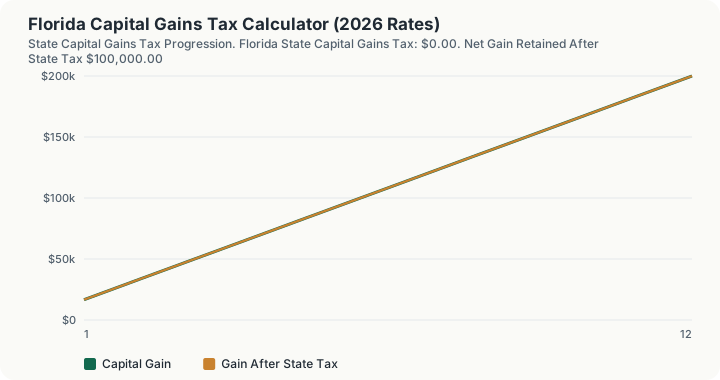
Quick Answer: Florida imposes no state-level tax on capital gains, so an investor realizing a $100,000 gain owes $0 in Florida state tax and keeps the full $100,000, subject only to federal tax.
Florida Taxes Capital Gain at Nothing
Florida has no state individual income tax, so capital gains realized by Florida residents are taxed only at the federal rate (0%, 15%, or 20% plus the 3.8% Net Investment Income Tax where applicable), resulting in a 0.00% state tax liability.
Florida is one of the distinct states with no state income tax on capital assets, stocks, real estate, or cryptocurrencies. Residents of Florida do not file an individual state income tax return for capital asset transactions. Unlike states that levy progressive income taxes up to 13.3%, Florida enables investors to retain 100% of their net capital profits prior to federal taxation.
High-net-worth individuals, portfolio managers, corporate executives, and real estate investors all need a handle on state-level capital gains taxation, since state income taxes affect net internal rates of return on capital dispositions, 1031 exchange planning, installment sale structuring, and equity compensation exercises (ISOs, NSOs, and RSUs).
In institutional wealth management and private equity underwriting, capital gains calculations must account for both statutory tax rates and multi-jurisdictional residency rules. That holds whether the asset being disposed of is a block of publicly traded securities, a privately held business interest, real property, or a digital asset: evaluating state-level tax exposure is a core part of pre-liquidity tax modeling and post-sale wealth preservation.
Planning around a Florida sale means watching two calendars that no longer line up the way they do elsewhere. There is no state return to file and no state estimate to schedule, so the only deadlines that bind are federal ones, and they arrive during the year rather than after it.
How This Is Calculated
Florida has no individual income tax, and no separate levy reaches a realized capital gain. The result on this page is $0 for every gain, which is the whole answer for the state layer. What is worth attention instead is the federal bill and, for anyone who moved recently, whether the sale was recognized while a former state still had a claim on the income.
There is no rate schedule to reproduce, so the two identities the calculator applies are simply these.
What the calculator does with your inputs:
- Start with the net gain. The figure you enter is the gain left after capital losses and loss carryforwards have been netted against it.
- Look for a Florida rate schedule. There is none to look up, so the state line resolves to zero before any bracket arithmetic runs. The other-income field has no effect here; it is kept so the page compares cleanly against states where it does matter.
- Effective rate. Zero divided by the realized gain is 0.00%, and it stays 0.00% whether the gain is $10,000 or $10 million.
- Net proceeds. The gain passes through the state layer whole.
- What is still owed. Federal capital gains tax and the federal net investment income tax are unaffected by residence in a no-tax state and are calculated separately.
Worked Example
Consider an investor residing in Florida who realizes $100,000 in capital gains alongside $75,000 in ordinary income during the year.
- Check the state rate. Florida does not levy an individual income tax, and it does not carve out a separate tax on investment gains either, so the state rate applied to this sale is 0.00%.
- Compute the state tax. $100,000 × 0.00% = $0.00. No state return, no state estimated payments, and no state withholding apply to this capital gain.
- Net proceeds. The investor retains the full $100,000 gain after state tax, compared to an investor in a high-tax state who might lose 5% to 13% of the same gain to state liability.
- Federal liability remains. Florida's 0% state rate does not eliminate federal exposure: the gain is still subject to federal long-term or short-term capital gains brackets under IRC § 1(h), plus the 3.8% NIIT surtax where applicable.
Twelve Tiers of Zero, and the Two Inputs That Do Nothing
Every row of the tier schedule returns the same number. At $16,666.67 of gain the Florida tax is $0.00; at the $100,000 baseline it is $0.00; at $200,000, the top of the sweep, it is $0.00. Take the gain past the sweep entirely and nothing moves: the engine returns $0.00 on a $1,000,000 Florida gain and reports the full $1,000,000 as net proceeds retained. The marginal cost of the next $1,000 of realised gain in Florida is $0.00, and there is no bracket edge, holding-period threshold or exclusion cliff anywhere on this page to walk across.
The other-income field is inert. Setting other taxable income to $0 returns $0.00 of Florida tax, and setting it to $200,000 returns $0.00 as well. On a state with a graduated schedule that field determines which brackets the gain stacks into and moves the answer substantially. Here it changes nothing, because Florida's stored record is flagged as a zero-tax state and the rate schedule is never consulted.
Read the marginal rate output carefully. The Top Marginal State Bracket field returns 0.00% for Florida. That is a statement that Florida levies no personal income tax on gains, not that the last dollar of a large gain happens to fall in a zero bracket. The effective rate output returns 0.00% at every gain size for the same reason.
The federal layer, which is the entire bill. Nothing on this page computes federal capital gains tax. The 0%, 15% and 20% long-term rate brackets, the 3.8% net investment income tax that applies above the statutory modified adjusted gross income thresholds, the short-term treatment of assets held a year or less, and the section 121 primary-residence exclusion are all outside this code path. A Florida investor's actual tax on a $100,000 gain is the federal figure in full, and the $0.00 above says only that no part of it goes to Tallahassee.
Where a Florida resident still owes another state. Capital gain on real property is generally sourced to the state where the property sits, not to the seller's residence. A Florida resident selling an apartment building in Illinois or Hawaii owes that state's tax on the gain, and this calculator has no situs or source input: it takes a gain and a state and cannot apportion. The $0.00 is a fact about Florida-source gain and not a clearance for the transaction.
Federal Rules That Still Apply
Nothing about Florida changes the federal treatment of a sale, and the federal treatment is the entire bill. - One year decides the rate. Held more than a year, the gain is long-term and taxed at 0%, 15%, or 20% by taxable income. Held a year or less, it is taxed at ordinary federal rates. - The 3.8% surtax is federal. IRC § 1411 reaches net investment income above $200,000 of modified AGI for single filers and $250,000 for joint filers. A Florida address does nothing to it. - Federal quarterly estimates can still be due. The IRS generally expects estimated payments when you will owe $1,000 or more after withholding and credits. Paying at least 90% of this year's tax or 100% of last year's, whichever is smaller, generally avoids the underpayment penalty. Because no Florida withholding exists on any Florida sale, a seller with a large gain frequently has to send the IRS money mid-year rather than at filing. - Losses net under federal law. IRC § 1211 lets capital losses offset capital gains, with up to $3,000 of excess net loss ($1,500 married filing separately) against ordinary income and the balance carried forward.
What Florida Charges Instead
Florida's bar on an individual income tax is constitutional rather than a matter of legislative mood. Article VII, Section 5(a) of the state constitution says no tax upon estates or inheritances or upon the income of natural persons who are residents or citizens of the state shall be levied by the state, or under its authority, in excess of the amounts creditable against a similar federal or other state tax. Because no such federal credit exists, the ceiling is effectively nothing, and changing it takes a statewide vote rather than a bill.
What the Department of Revenue does administer is a long list that reaches transactions rather than income: sales and use tax with a local discretionary surtax on top, documentary stamp tax, the nonrecurring intangible tax on obligations secured by Florida real property, corporate income tax, communications services tax, and severance taxes. Two of those meet a seller directly. Documentary stamp tax is charged on the deed transferring Florida real estate and is settled at closing, and the nonrecurring intangible tax arrives with a new mortgage. Neither is a tax on the gain, and neither varies with how much the property appreciated. Property tax at the county level, assessed and billed locally, is the other main pillar, which is why a Florida homeowner's annual bill can be substantial even in a state with no income tax.
Residency and Source Rules
Florida attracts sellers from states that do tax gains, and that migration is where the real risk sits. Gain is generally taxed by the state of residence at the moment of recognition, so closing before the move can leave the old state's tax intact even though you now live in Naples. High-tax states audit these departures and look at day counts, where the family lives, where cars and voter registration sit, and where the seller was physically present on the closing date. Florida homestead and a driver license help the story but are not by themselves a defense. Real property is separate again: a New York building sold by a Florida resident is generally taxed by New York on the New York source gain.
What This Does Not Account For
This page is exact about the state answer, which is zero. Everything below sits outside the calculator and still has to be worked out separately: - Federal capital gains tax: long-term rates of 0%, 15%, or 20%, and short-term gains taxed at ordinary rates reaching 37%. - Net Investment Income Tax: the 3.8% federal tax under IRC § 1411 on net investment income above $200,000 of modified AGI for single filers and $250,000 for married filing jointly. - Alternative Minimum Tax: federal AMT under IRC § 55, which reaches the bargain element on an incentive stock option exercise. - Section 1031 like-kind exchanges: federal deferral for real property held for productive use in a trade or business or for investment. - Qualified Small Business Stock: the federal gain exclusion under IRC § 1202, which has its own holding period and issuer tests. - Tax owed to another state: a gain sourced to a state that does tax it, which this calculator does not model.
Common Pitfalls
- Assuming no state tax means no tax. A $500,000 long-term gain still commonly carries a six-figure federal bill, plus NIIT.
- Closing a sale just before the move is final. Recognition while still a resident elsewhere generally keeps the gain in the old state's net.
- Missing federal estimates. No Florida withholding exists to absorb any of it, so the whole federal liability has to be paid deliberately.
- Confusing closing taxes with a gain tax. Documentary stamp tax is charged on the transfer, not the profit, and is owed even on a sale at a loss.
- Losing basis on an inherited or long-held property. Improvements, depreciation taken on a rental, and a step-up at death all change the gain the IRS computes.
Frequently Asked Questions
Does Florida have a state capital gains tax?
How are short-term and long-term capital gains taxed in Florida?
Can capital losses offset capital gains in Florida?
Do I need to make state estimated payments after selling stock or property?
Are retirement distributions taxed in Florida?
I sold a house in New Jersey after moving to Florida. Do I owe anything?
Sources
- Florida Department of Revenue, Taxes and Fees or Refunds (floridarevenue.com): the taxes the state administers, including sales and use, documentary stamp, nonrecurring intangible, corporate income, and severance. No personal income tax is listed. floridarevenue.com
- IRS, Topic no. 409, Capital Gains and Losses.. irs.gov
- IRS, Publication 550, Investment Income and Expenses (Including Capital Gains and Losses).. irs.gov/publications/p550
Also consulted: Florida Constitution, Article VII, Section 5(a): limits any tax on the income of natural persons to amounts creditable against a similar federal or state tax, which is why no individual income tax is levied; IRS, Estimated Taxes: the $1,000 threshold and the current-year and prior-year safe harbors.