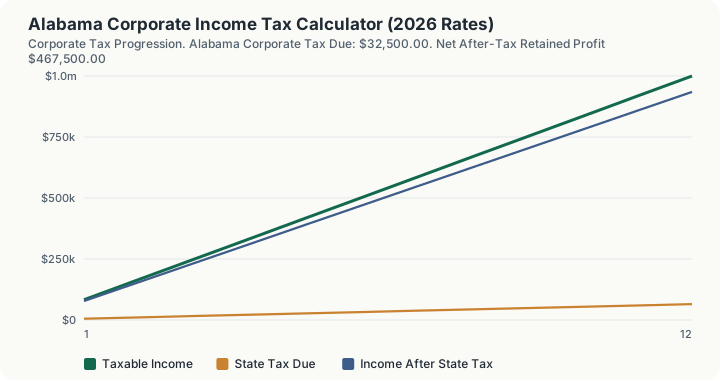
Quick Answer: On $500,000 of pre-apportioned taxable income, Alabama's flat 6.50% corporate income tax rate produces $32,500.00 in state tax due and $467,500.00 in net after-tax profit, before the separately assessed Business Privilege Tax.
Why Alabama's Base Matters More Than Its Rate
Alabama taxes C-corporation income at a flat 6.50% under Ala. Code § 40-18-31, and the rate alone tells you almost nothing useful about the state. What makes Alabama genuinely unusual is what happens to the base before that rate is applied.
Alabama is the last state in the country that still allows corporations an essentially unlimited deduction for federal income taxes attributable to Alabama income (Ala. Code § 40-18-35(a)(2), Rule 810-3-35-.01). Every other state that once permitted federal deductibility has capped it or repealed it. That single provision means Alabama's 6.50% headline rate overstates the real burden by a wide margin: with the 21% federal rate deductible against the Alabama base, the economic rate on marginal profit is closer to 5.1% than 6.50%. Any comparison that ranks Alabama against a state like Michigan or Kansas on headline rate alone is comparing rates applied to different bases and is not meaningful.
The deduction is not unconstrained. Act 2021-1 tightened how consolidated-group members compute it: the Department now accepts only the IRC § 1552(a)(1) allocation method for determining a member's share of consolidated federal tax, having withdrawn the 1552(a)(2) and 1552(a)(3) methods. Groups that historically used the withdrawn methods can see a materially smaller Alabama deduction, and therefore a higher Alabama bill, without the 6.50% rate changing at all.
Act 2021-1 also reshaped the numerator side of the calculation, moving Alabama to a single sales factor and repealing the throwback rule for tax years beginning on or after January 1, 2021, and decoupling Alabama from federal GILTI retroactively to 2018. Throwback repeal in particular matters for Alabama manufacturers shipping into states where they have no filing obligation: those "nowhere sales" no longer land back in the Alabama sales factor numerator.
At the calculator's $500,000 baseline the flat rate produces $32,500.00. Because Alabama has no brackets, the tax scales exactly with income, $1,000,000 of Alabama income yields exactly $65,000.00.
How This Is Calculated
Alabama is one of a shrinking group of states that still lets a corporation deduct its federal income tax, and that deduction, not the 6.50% rate, is what makes an Alabama return look different from anyone else's. This calculator applies 6.50% to the income you enter. If the figure you enter is already net of the federal income tax deduction, the result is your Alabama liability; if it is not, take the deduction first and re-enter.
What the engine actually executes is four steps, and no more than four:
- Take the income figure exactly as entered. There is no apportionment step, no addition or subtraction schedule, no federal income tax deduction and no NOL carryforward inside this calculator. Whatever you type is treated as final Alabama taxable income. All of the base work described above has to happen before the number reaches this box.
- Multiply by 6.50%. One rate, no bracket lookup. At $500,000 that is $32,500.00; at $1,000,000 it is $65,000.00.
- Subtract credits and floor the result at zero. The credit figure comes straight off the computed tax. Entering $10,000 of credits against the $500,000 baseline returns $22,500.00.
- Report the rates and the retained profit. The effective rate is the tax after credits divided by the income entered, which is why $10,000 of credits moves it from 6.50% to 4.50%. The marginal rate is reported before credits and stays at 6.50%. Net retained profit is income minus tax after credits: $467,500.00 at the baseline, $477,500.00 with $10,000 of credits.
Worked Example
Take the calculator's baseline: a corporation with $500,000 of Alabama-apportioned taxable income, entered net of any federal income tax deduction already claimed on Schedule D.
- Start with apportioned taxable income. $500,000 has been apportioned to Alabama under the single sales factor, before any state-level tax is applied.
- Apply Alabama's flat statutory rate. Alabama taxes all C-corporation income at 6.50% with no bracket lookup: $500,000 × 6.50% = $32,500.00.
- Alabama corporate tax due: $32,500.00.
- Net retained profit. $500,000 − $32,500.00 = $467,500.00 retained after Alabama income tax, before federal liability and before the Business Privilege Tax.
The comparison worth drawing is with the state Alabama is most often lumped with. Kansas is frequently listed alongside Alabama at 6.50%, but Kansas is graduated, 3.50% on the first $50,000 and 6.50% above, and produces $31,000 on this same $500,000 base, not $32,500. Alabama's genuinely flat rate makes it the more expensive of the two at every income level, though the federal income tax deduction runs the other direction and typically more than closes the gap.
Walking the Sweep: A Straight Line With No Edge Anywhere
Alabama has one rate and therefore no threshold. That is a finding, not an absence of one, and the sweep states it precisely: $194.94 of tax at $2,999 of income, $195.00 at $3,000, $195.07 at $3,001. Six and a half cents for the extra dollar, which is the flat rate and nothing else. The same holds at every point where graduated states break. At $24,999 the tax is $1,624.94 and at $25,001 it is $1,625.07. At $221,999 it is $14,429.94 and at $222,001 it is $14,430.07. Alaska, to take the neighbouring page in this corpus, steps at both $25,000 and $222,000. Alabama steps nowhere.
The twelve-row schedule shows the same straight line: $5,416.67 on $83,333.33 of income, $16,250.00 at $250,000.00, $32,500.00 at $500,000.00, $65,000.00 at $1,000,000.00. Each row is exactly double the row three places below it, because doubling the base doubles the bill on a flat schedule.
Each additional $1,000 of Alabama taxable income costs $65.00. The proof pair: $499,000 of income returns $32,435.00 and $500,000 returns $32,500.00. It is the same $65.00 at the bottom of the range, where $25,000 returns $1,625.00 and $26,000 returns $1,690.00. The reverse question -- how much can be earned before the rate rises -- has no answer in Alabama, because it never rises: $5,000,000 of income returns $325,000.00 at the same 6.50%.
What the Credits Field Does, and What It Silently Throws Away
The credit input is subtracted from the computed tax and the result is floored at zero, which produces a sharp and easily missed cliff. On the $500,000 baseline the tax is $32,500.00. Enter $50,000 of credits and the answer is $0.00. Enter $1,000,000 of credits and the answer is also $0.00.
That is $950,000 of credit value that vanishes between those two runs. The engine models the credit as a non-refundable offset with no carryforward and no refund of the excess, so any credit larger than the computed tax is worth exactly the same as a credit equal to it. Real Alabama incentive credits frequently do carry forward; this calculator does not track that, and cannot tell you what an unused balance would be worth in a later year.
One more thing the credits field does not touch: the twelve-row schedule. Those rows are computed from the rate alone and ignore the credit input entirely, so a run with $10,000 of credits shows $22,500.00 in the headline while the sixth row of the table still reads $32,500.00. The table is a pre-credit rate walk, not a projection of what you will pay.
Filing Mechanics: Form, Deadlines & Estimated Payments
- Return: Alabama Form 20C, Corporation Income Tax Return, filed on a separate-entity basis by default.
- Consolidated filing is elective, not mandatory. Alabama is not a mandatory unitary combined reporting state. An Alabama affiliated group may elect to file a consolidated return on Form 20C-C, but the election is binding for a term of years and carries a separate consolidated filing fee. Absent that election, each corporation files its own Form 20C.
- Due date: Alabama returns are due one month after the corresponding federal due date, including extensions, so May 15 for calendar-year C corporations, not April 15. This one-month offset is statutory (Act 2022-53) and applies to the filing only.
- Payment: The full tax liability is due on the original due date without benefit of the extra month. Paying on the extended date generates interest.
- Estimated payments: Required when Alabama income tax liability exceeds $500, in installments due the 15th day of the 4th, 6th, 9th, and 12th months of the tax year.
Alabama Levers That Sit Outside This Calculator
Alabama's planning levers are unusual because they operate on the base rather than the rate: - Managing the Federal Income Tax Deduction: For a consolidated federal group, the § 1552(a)(1) method is now mandatory for Alabama purposes. Groups with loss members should note that under 1552(a)(1) a member's share is computed on positive federal taxable income only, losses count as zero, which changes how much federal tax the profitable Alabama member can claim. - Business Privilege Tax Planning: Alabama levies a separate Business Privilege Tax on net worth, filed on Form CPT for C corporations. It is a capital-based tax, so a profitable low-net-worth company and a break-even high-net-worth company face very different BPT outcomes than their income tax bills suggest. Since tax years beginning after December 31, 2023, entities whose calculated BPT is $100 or less are fully exempt and need not file, the minimum BPT was phased out entirely by Act 2022-252. - Financial Institutions Use a Different Regime: Banks and financial institutions do not file Form 20C at all. They pay the Financial Institution Excise Tax (FIET) on Form ET-1 at 6.50%, administered under Ala. Code Title 40, Chapter 16, with its own apportionment and estimated payment rules. Modeling a bank's Alabama exposure off the corporate income tax rules will produce the right rate for the wrong tax. - Elective Pass-Through Entity Tax: Act 2021-1 created Alabama's elective PTE tax, letting qualifying partnerships and S corporations pay Alabama tax at the entity level and deduct it federally, bypassing the individual SALT cap.
The Statutes Behind These Figures
- Ala. Code § 40-18-31 and § 40-18-35: The 6.50% corporate rate and the federal income tax deduction that defines Alabama's base.
- Act 2021-1 (HB 170): Single sales factor, throwback repeal, GILTI decoupling, PTE election, and the restriction to the § 1552(a)(1) method for the federal income tax deduction, all effective for tax years beginning on or after January 1, 2021 (GILTI retroactive to 2018).
- Public Law 86-272: Shields out-of-state corporations from Alabama's net income tax when in-state activity is limited to soliciting orders for tangible personal property. It does not shield them from the Business Privilege Tax, which is a privilege tax rather than a net income tax, a distinction that catches protected sellers regularly.
- Ala. Code Title 40, Chapter 16 (FIET): The separate excise tax regime governing financial institutions.
What This Does Not Account For
- Federal corporate income tax (21% under IRC § 11), though in Alabama, unusually, that federal tax is itself deductible against the state base.
- The Alabama Business Privilege Tax (Form CPT), assessed on net worth rather than income and payable regardless of profitability above the $100 exemption.
- The Financial Institution Excise Tax (Form ET-1) applicable to banks in place of the corporate income tax.
- Base Erosion and Anti-Abuse Tax (BEAT) provisions; Alabama does not tax GILTI.
- Alabama's local business license taxes levied by municipalities and counties, which are gross-receipts-based rather than income-based.
- Every step that produces the base. The engine performs no apportionment, no single-sales-factor computation, no throwback test, no nexus or P.L. 86-272 determination, no GILTI or 163(j) modification, no federal income tax deduction and no NOL carryforward. All of those must be settled before the income figure is entered.
- Credit carryforward and refundability. Credits are subtracted once and the result is floored at zero; $50,000 and $1,000,000 of credits both return $0.00 on the $500,000 baseline.
Common Pitfalls
- Assuming Alabama Requires Combined Reporting. It does not. Alabama is a separate-entity filing state; consolidated filing on Form 20C-C is an election with a binding term and a filing fee, not a requirement imposed on unitary groups.
- Comparing Alabama to Kansas at "the Same 6.50%." Kansas is graduated (3.50% / 6.50%) and produces $31,000 on a $500,000 base against Alabama's $32,500. The shared top-rate number conceals a real difference.
- Forgetting the Federal Income Tax Deduction Entirely. Applying 6.50% to a base that has not been reduced by deductible federal tax overstates Alabama liability substantially, the opposite of the error most state calculators produce.
- Calendaring Alabama Off the Federal Due Date. Alabama's Form 20C is due one month after the federal deadline, but the payment is still due on the original date. Filers routinely get one half of this right and the other half wrong.
- Treating the BPT as Abolished. The minimum BPT was eliminated for tax years after 2023, and returns with $100 or less of calculated tax need not be filed, but the tax itself remains in force for entities above that threshold.
Frequently Asked Questions
What is Alabama's corporate income tax rate?
Does Alabama require unitary combined reporting?
When are Alabama corporate tax returns due?
Does Alabama have a franchise tax?
How is multi-state corporate income apportioned to Alabama?
Sources
- Alabama Department of Revenue: Form 20C Instructions (TY2025); Corporate Income Tax and Business Privilege Tax guidance; FAQ on the federal income tax deduction. revenue.alabama.gov
Also consulted: Ala. Code § 40-18-31, § 40-18-35(a)(2); Rule 810-3-35-.01; Act 2021-1 (HB 170), Act 2022-53, Act 2022-252.