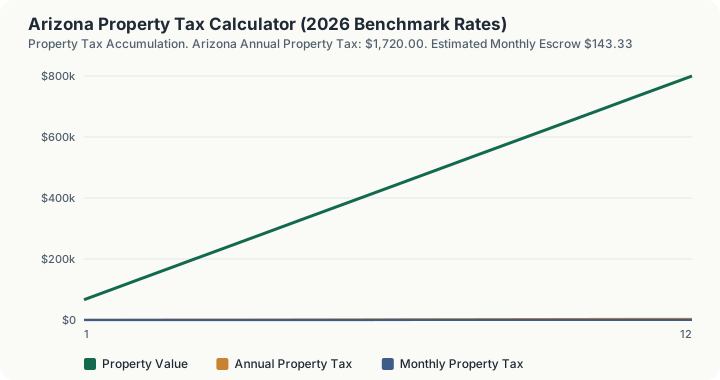
Quick Answer: A $400,000 home in Arizona carries an estimated $1,720.00 in annual property tax at the state's 0.43% effective rate, or about $143.33 a month.
Reading the 0.43% Honestly
The 0.43% this page uses is an observed ratio rather than a rate anyone legislated: median real estate taxes paid over median home value, from the U.S. Census Bureau's 2024 1-Year American Community Survey, published in SmartAsset's property tax dataset and cross-checked against WalletHub's 2025 ranking for relative order. Arizona lands at #47 of 50, among the four lightest effective burdens in the country.
Arizona's real machinery is unusually elaborate. County assessors maintain a Limited Property Value that is capped in how fast it can rise, apply a residential assessment ratio of 10% to reach an assessed value, and then layer primary and secondary rates from the county, city, school district and any special districts on top. The 0.43% has all of that collapsed into a single observed ratio, which is why it can be applied to a purchase price with no further steps and why it can never match a specific parcel's bill.
The rate never varies with value here, so the output is a straight proportional line. $200,000 returns $860.00. $300,000 returns $1,290.00. $500,000 returns $2,150.00. $750,000 returns $3,225.00. $1,000,000 returns $4,300.00.
How This Is Calculated
The engine runs one subtraction and one multiplication, in that order.
- Value as entered. The figure in the value box is used verbatim. There is no Limited Property Value derivation, no assessment ratio and no county lookup in the code path.
- Exemption subtracted, floored at zero. A flat dollar subtraction guarded by
max(0, ...), so the taxable figure can reach zero but not go below it. - One rate applied. 0.43% multiplies the whole remaining amount. No band, no threshold, no cap exists in the engine.
- Twelfths for the escrow figure. $1,720.00 a year is $143.33 a month, arithmetic only, with no lender cushion modelled.
The LPV and the 10% residential ratio described above are Arizona statute, offered here as background. This calculator does not perform either conversion.
Worked Example
Baseline inputs: a $400,000 Arizona home, no exemption.
- Value. $400,000.00.
- Exemption. $0.00, so the taxable figure is $400,000.00.
- Annual tax. $1,720.00.
- Monthly escrow. $143.33.
Switching on the calculator's $25,000 exemption scenario returns $1,612.50 a year and $134.38 a month on the same home.
Where the Curve Actually Bends
Nowhere, except at zero. The 12-row sweep table under the result rises without interruption from $286.67 of annual tax at a $66,666.67 value, through $1,720.00 at $400,000, to $3,440.00 at $800,000. A flat rate produces a straight line and there is no bracket edge to walk.
The one discontinuity the engine contains is the zero floor on the exemption. Taking a $150,000 property through it, each line a separate run:
Exemption $100,000. Taxable $50,000, annual tax $215.00, monthly $17.92.
Exemption $150,000, equal to the value. Annual tax $0.00.
Exemption $200,000, above the value. Annual tax $0.00 again, with the surplus $50,000 of exemption simply discarded.
Pricing an Exemption Dollar and a Value Dollar
On a $400,000 home the exemption is worth 0.43 cents on the dollar and nothing more. $25,000 of exemption moves the annual bill from $1,720.00 to $1,612.50, a saving of $107.50. $50,000 returns $1,505.00. The input's $200,000 ceiling returns $860.00, half the unexempted figure, because half the value has been removed.
Value moves the same way. $400,000 returns $1,720.00 and $401,000 returns $1,724.30, so each additional $1,000 of value costs $4.30 a year. Ten thousand dollars costs $43.00, taking the annual figure to $1,763.00 and the monthly escrow from $143.33 to $146.92. A buyer stretching from a $300,000 house to a $500,000 house adds $860.00 a year of modelled property tax, moving from $1,290.00 to $2,150.00.
The Reverse Question: Value Under a Target Bill
Working backwards through the sweep, $500,000 of value produces $2,150.00 of annual tax while $400,000 produces $1,720.00, so a $2,000 annual property tax budget is exhausted between those two runs. A $750,000 home reaches $3,225.00 a year, or $268.75 a month of escrow, and $1,000,000 reaches $4,300.00.
Asked as an exemption question, halving a $400,000 home's bill takes the full $200,000 the input allows, which lands at $860.00. Nothing smaller gets there, because the relationship is strictly linear at $4.30 per $1,000 removed.
The Assessment-Ratio Double Count, Priced
Arizona applies a 10% assessment ratio to residential property, so a county valuation notice on a $400,000 house shows an assessed value near $40,000. Typing that assessed figure into this calculator feels like the careful thing to do and produces a badly wrong answer.
Market value entered. $400,000 returns $1,720.00 a year.
County assessed value entered instead. $40,000 returns $172.00 a year.
That is an understatement of $1,548.00, a factor of ten. The reason is that 0.43% is already the ratio of tax actually paid to market value, so Arizona's 10% ratio is inside it. Applying the ratio a second time charges for the same discount twice. The engine performs no assessment-ratio conversion of its own, cannot tell which kind of value it was given, and will happily return the smaller figure. This input wants the full market or purchase price of the home.
What This Does Not Account For
- The exemption field is a flat dollar subtraction with no eligibility test. Whatever you type is removed from the base before the 0.43% rate is applied, and the engine treats a general homestead, a senior freeze and a disabled-veteran exemption as the same number. A $25,000 entry returns $1,612.50 on a $400,000 home, $50,000 returns $1,505.00 and $100,000 returns $1,290.00; no step of that sweep asks whether the amount is one you actually qualify for, and no per-programme cap is enforced beyond the field's own maximum.
- Limited Property Value and its growth cap. A first-year LPV is usually below the purchase price and rises on a capped schedule, so a real Arizona bill can diverge from a flat percentage of price for years.
- Primary and secondary rates by district. Maricopa, Pima, Pinal and Yavapai each set their own combined rates, and school and special districts vary block by block. None is looked up.
- Arizona's specific relief programs. The widow, widower and disability exemptions and the senior valuation protection freeze are not modelled as programs. The exemption box is an unconditional dollar subtraction with no eligibility test.
- Classification. One rate serves every property. There is no residential-versus-commercial or owner-occupied-versus-rental split in the engine.
- Time. No year selection, no appreciation, no reassessment. Each result is a single static valuation.
Common Pitfalls
- Entering the county assessed value. Priced above: $172.00 instead of $1,720.00 on a $400,000 home.
- Reading the schedule as a forecast. All twelve rows price a different property at today's rate, not this property in a later year. Row 12 sits at $800,000 of value and returns $3,440.00 with no exemption entered; there is no appreciation, reassessment or levy growth anywhere in the code path.
- Reading 0.43% as a tax rate on a bill. It is a median-over-median ratio, not a primary or secondary rate any Arizona district levies.
- Assuming a break at higher values. There is none: $4,300.00 on a $1,000,000 home is the same 0.43% that produces $860.00 on a $200,000 home.
- Treating $143.33 as a full escrow line. It covers property tax only, with no insurance, no cushion and no shortage adjustment.
Frequently Asked Questions
How high are property taxes in Arizona?
Should I enter the purchase price or my Limited Property Value?
What does each additional $10,000 of value cost?
What is a $25,000 exemption worth?
Can the result be zero?
Sources
- U.S. Census Bureau: 2024 1-Year American Community Survey, median real estate taxes paid over median home value. census.gov/programs-surveys/acs
- Arizona Department of Revenue, Property Tax Division: Limited Property Value and the 10% residential assessment ratio, cited as background only and not applied by this engine. azdor.gov