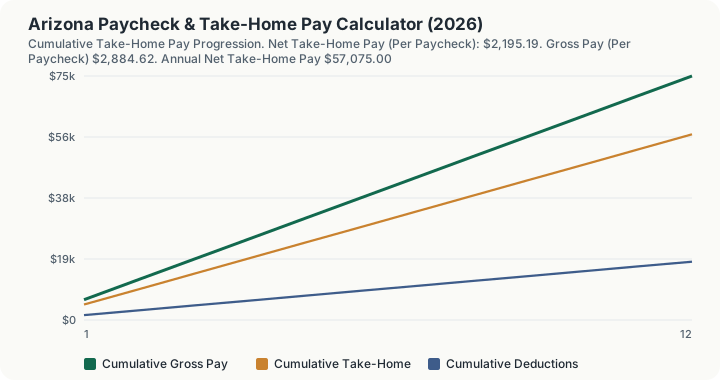
Quick Answer: A $75,000 annual salary in Arizona, paid bi-weekly and filing single, takes home about $2,195.19 per paycheck ($57,075.00 per year) after federal tax, FICA, and Arizona state withholding.
How This Is Calculated
Arizona applies a single 2.5% rate to taxable income, the lowest rate among the states that use a flat schedule. There are no brackets to climb and no local wage taxes, so state withholding scales in a straight line with taxable pay. The paycheck comes out of one subtraction:
The calculator makes four passes over the annual salary:
- FICA Payroll Tax Computation: Assessed on the full gross salary, before any pre-tax deduction is subtracted. - Social Security (OASDI): 6.20% withheld on wages up to the 2026 statutory wage base ($184,500). - Medicare (HI): 1.45% withheld on all gross earnings (no wage cap), plus 0.90% Additional Medicare Tax on earnings exceeding $200,000 (single) or $250,000 (married filing jointly).
- Federal Income Tax Withholding: Evaluated using 2026 progressive federal tax brackets (10%, 12%, 22%, 24%, 32%, 35%, 37%) on gross salary less the pre-tax deduction, after applying standard deduction thresholds ($16,100 single / $32,200 married joint).
- Arizona State Income Tax Withholding: A flat 2.5% applied to the same gross-less-pre-tax figure. No state standard deduction and no state personal exemption are subtracted first, which is why the state line here is higher than an Arizona employer would actually withhold.
- Pay Period Proration: Annual net compensation is divided across the designated pay frequency (26 bi-weekly, 24 semi-monthly, 12 monthly, or 52 weekly pay periods).
Worked Example
Consider an employee in Arizona earning $75,000 annually, paid bi-weekly (26 paychecks per year), filing single, with $3,500 in annual pre-tax 401(k) contributions.
- Gross pay per paycheck. $75,000 ÷ 26 pay periods = $2,884.62 before any withholding.
- Pre-tax deduction. The $3,500 annual 401(k) contribution reduces each paycheck by $134.62 and also shrinks the wages used to calculate federal and state income tax; FICA is still assessed on the full gross amount.
- FICA payroll taxes. Social Security withholds 6.2% of gross pay and Medicare withholds 1.45%, for $220.67 per paycheck.
- Federal income tax withholding. Applying the 2026 federal schedule to the reduced taxable wage withholds $265.38 per paycheck.
- Arizona state tax withholding. The flat 2.5% applied to the same reduced wage withholds $68.75 per paycheck.
- Net take-home pay. $2,884.62 gross, minus $134.62 pre-tax, minus $220.67 FICA, minus $265.38 federal tax, minus $68.75 state tax leaves $2,195.19 per paycheck, equal to $57,075.00 per year, an effective total tax rate of 19.23%.
From Month Two To The Twelve-Month Total
A flat 2.5% is the lowest broad-based state rate in the country, and the cumulative view shows how little of the annual gap Arizona is actually responsible for.
Step 7 -- Two months of cumulative pay. The schedule's first row shows $6,250.00 of cumulative gross against $4,756.25 of cumulative take-home. Row two doubles both: $12,500.00 gross, $9,512.50 take-home, with $2,987.50 accumulated on the deduction side.
Step 8 -- The full year. By month twelve the schedule reaches $75,000.00 of cumulative gross and $57,075.00 of cumulative take-home, adding $4,756.25 every month without variation.
Step 9 -- What the year actually withheld. The cumulative deduction column closes at $17,925.00. That column carries the $3,500 pre-tax 401(k) contribution alongside the tax, so tax alone is $17,925.00 - $3,500 = $14,425.00, an effective total tax rate of 19.23% on $75,000.00 of gross pay.
Step 10 -- Why the monthly increment never changes. The cumulative columns advance by a constant amount each month. That is by construction: the engine caps Social Security at the $184,500 annual wage base and charges the extra 0.9% Medicare above $200,000 for a single filer, then divides the resulting annual total by twelve. The step-change a real ledger shows when Social Security stops mid-year is therefore invisible in this schedule. On $75,000 of gross the question does not arise -- neither threshold is within reach.
A Flat State Rate, And The Federal Edges Underneath It
Sweep the salary axis and the Arizona line does nothing interesting, which is itself the finding. State withholding rises from $25.48 per bi-weekly check at $30,000 of salary to $68.75 at $75,000, $116.83 at $125,000 and $285.10 at $300,000, a perfectly straight line with no kink anywhere in it. There is no state bracket edge on this page because Arizona has no brackets. Every step in an Arizona take-home curve comes from the federal schedule or from FICA.
The federal edge that lands at $70,000 of gross salary
With the default $3,500 pre-tax deduction and the $16,100 single standard deduction, the federal 12% band is exhausted at exactly $70,000 of gross salary.
At $69,000 of salary. Take-home is $2,034.77 per bi-weekly check, federal withholding $218.46, state $62.98. Annual net is $52,904.00.
At $70,000, at the boundary. Take-home is $2,064.71 per check, federal withholding $223.08, state $63.94. Annual net is $53,682.50, so that thousand added $778.50.
At $71,000, past it. Take-home is $2,090.81 per check, federal withholding $231.54, state $64.90. Annual net is $54,361.00, and the same thousand now adds only $678.50.
The edge costs $100.00 of annual take-home on an identical raise, and Arizona is responsible for none of it: the state took $25.00 of each of those two thousands, flatly, on both sides.
The Social Security wage base at $184,500
At $184,000 of salary, annual net is $129,857.50 with FICA of $541.38 per check.
At $185,000, annual net is $130,547.00, FICA $543.13. That thousand was worth $689.50.
At $186,000, entirely above the base, annual net is $131,267.50 and FICA per check is $543.69. That thousand was worth $720.50, $31.00 more than the one below it, because the 6.2% Social Security component has stopped and only 1.45% Medicare continues.
None of that reaches the schedule. At $186,000 its twelve rows still rise by one constant increment, because FICA is settled annually before it is divided by twelve.
The marginal cost of the next $1,000
Annual net take-home is $56,396.50 at $74,000 of salary, $57,075.00 at $75,000 and $57,753.50 at $76,000. Each additional $1,000 of salary is worth $678.50 of annual take-home in Arizona, and costs $321.50 in tax. Exactly $25.00 of that cost is the state's share, at every salary, because 2.5% of a thousand does not vary.
Running the calculator backwards
Sweeping the salary axis in $500 steps at the default settings, $106,000 is the first salary at which the bi-weekly check reaches $3,000, paying $3,004.17 against $2,991.13 at $105,500. And $139,000 is the first salary whose annual net take-home clears $100,000, at $100,225.00 against $99,895.75 at $138,500. A round intermediate result worth keeping: at $125,000 of salary the bi-weekly check is exactly $3,500.00.
The pre-tax dollar, priced
At $3,500 of pre-tax deductions, annual net take-home is $57,075.00, with state withholding of $68.75 per check.
At $10,000, annual net take-home is $52,017.50, with state withholding of $62.50 per check.
Contributions rose by $6,500.00 while spendable take-home fell by only $5,057.50. The $1,442.50 difference is tax never withheld, and the whole $10,000 remains the employee's money. Arizona's flat rate makes the state portion of that saving trivially predictable: 2.5% of the extra $6,500, or $162.50 across the year.
The Total Effective Tax Rate output reads 19.23% at $3,500 and 17.31% at $10,000, falling because the contribution is excluded from that ratio's numerator, while the schedule's Cumulative Deductions column rises because it counts the contribution as a deduction. Same page, opposite direction, both correct for what they measure.
Common Pitfalls
Multiplying the paycheck by 26 instead of reading the annual output. Twenty-six times $2,195.19 is $57,074.94, six cents under the engine's $57,075.00. The annual figure is computed first and the check derived from it, which is why annual net stays $57,075.00 whether you pick weekly ($1,097.60), bi-weekly ($2,195.19), semi-monthly ($2,378.13) or monthly ($4,756.25).
Reading Cumulative Deductions as a tax total. The column closes at $17,925.00 against $14,425.00 of real tax. Quoted as tax it reads 23.90% of $75,000 where the correct figure is 19.23%, overstating the burden by 4.67 percentage points.
Treating this state figure as what an Arizona employer withholds. It is not. The engine applies 2.5% with no state standard deduction and no personal exemption subtracted, so the $68.75 per check here is an upper bound on real Arizona withholding, not a match to it.
What This Does Not Account For
- No state standard deduction and no state personal exemption. The flat 2.5% is applied to gross less the pre-tax box and nothing else. This is the single largest source of overstatement in the state line on this page.
- No local wage taxes. Arizona cities and counties levy none on wages, and none are modelled.
- No W-4 detail. No dependents, no multiple-jobs checkbox, no extra per-period withholding, no other-income entry. Filing status is single or married filing jointly and nothing else.
- One pre-tax box, no post-tax box. 401(k), HSA and FSA contributions share one annual field with no employer match and no per-plan limit. Roth contributions, garnishments and post-tax premiums are absent.
- FICA is annual, then prorated. The twelve schedule rows never show the wage-base step at any salary, for the reason given in Step 10.
- Two definitions on one page. The effective rate output excludes the pre-tax deduction from its numerator; the Cumulative Deductions column includes it, and the gap is exactly the contribution.
Frequently Asked Questions
Does Arizona have a state income tax on paychecks?
Does a raise ever push me into a higher Arizona bracket?
What does the next $1,000 of salary actually add?
What is the Social Security wage cap for 2026?
Sources
- Internal Revenue Service (IRS): Publication 15 (Circular E) and Publication 15-T (2026). irs.gov/publications/p15
- Social Security Administration (SSA): 2026 Social Security Wage Base Limit. ssa.gov
- Arizona Department of Revenue: Individual Income Tax Highlights, flat 2.5% rate for tax year 2023 and beyond. azdor.gov