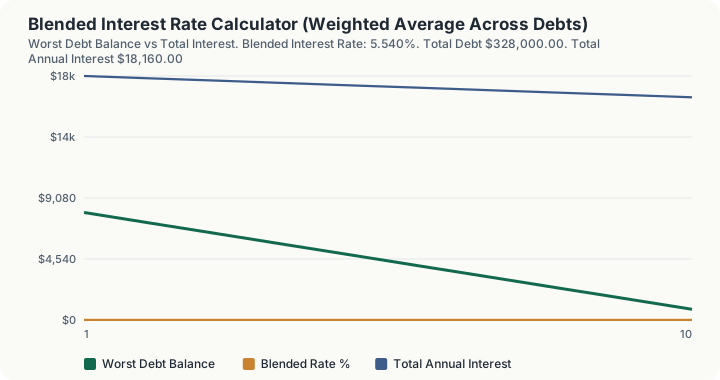
Quick Answer: A $300,000 mortgage at 5%, a $20,000 car loan at 7% and an $8,000 credit card at 22% blend to 5.540% across $328,000 of debt. That number is nearly useless on its own: the card is 16.46 points above the blend but only 2.4% of the balance, so the average barely notices the most expensive money you owe.
Why the Blend Is Weighted by Balance
The blended rate is the single rate that would generate the same total annual interest as all your debts combined. It is weighted by balance, not by the number of loans, and that weighting is the whole story.
A mortgage usually dominates. It is large and cheap, so it drags the blend toward its own rate and leaves small expensive balances almost invisible in the average. Here a 22% card sits 16 points above the blended figure while moving it by less than half a point.
The practical conclusion runs against the instinct the number invites: do not manage to the average. Clearing the $8,000 card saves $1,760 a year, a guaranteed 22% return on the money used. No investment offers that.
The blend is genuinely useful for one thing: comparing a consolidation offer against what you currently pay in aggregate.
How is this calculated?
Blended rate = (∑(Balanceᵢ × Rateᵢ))/∑Balanceᵢ
The numerator is total annual interest; the denominator is total debt. Equivalently, each rate is weighted by that debt's share of the total balance.
Because the weights are balances, a debt that is 2.4% of your total moves the blend by at most 2.4% of its distance from the average, no matter how punishing its rate.
Worked Example
A household carries three debts: a $300,000 mortgage at 5%, a $20,000 car loan at 7%, and $8,000 on a credit card at 22%. Averaging them into one number is a natural instinct, and a revealing mistake.
Step 1: Annual interest on the mortgage. $300,000 x 5% = $15,000
Step 2: Annual interest on the car loan. $20,000 x 7% = $1,400
Step 3: Annual interest on the card. $8,000 x 22% = $1,760
Step 4: Total annual interest. $15,000 + $1,400 + $1,760 = $18,160
Step 5: Total balance. $300,000 + $20,000 + $8,000 = $328,000
Step 6: The blended rate. $18,160 / $328,000 = 5.540%
Step 7: The card's share of the balance. $8,000 / $328,000 = 2.4%
Step 8: The card's share of the interest. $1,760 / $18,160 = 9.7%
Step 9: The spread between the blend and the worst rate. 22.000% - 5.540% = 16.46 points
Steps 7 and 8 are the whole argument. The card is a rounding error on the balance sheet and a tenth of the interest bill, and the blended 5.540% conceals it completely by burying a 22% debt inside a mortgage-weighted average.
Clearing the card: total annual interest falls to $16,400 and the blend to 5.130%. Spending $8,000 to remove $1,760 of annual interest is a 22% guaranteed, tax-free return: unavailable anywhere in public markets.
If rates were uniform (5%, 5.5%, 6%): the blend is 5.050% and genuinely describes what you pay, because there is no hidden extreme.
With a $60,000 card balance instead: the blend jumps to 7.790%, total interest to $29,600, and the card's share of the balance to 15.8%. Now the high rate is a large enough share to show up, and the average becomes informative again.
Walking the Payoff Table, and Finding Where the Advice Flips
The table on this page is a genuine parameter sweep: it holds the mortgage and the car loan fixed and steps the worst debt's balance down from $8,000 to zero in ten equal slices, recomputing the blend at each. Total annual interest falls from $18,160 to $16,576 across the ten rendered rows, and the blended rate reads 5.537 in the first row and 5.167 in the last. Clearing the card outright, which is the row past the end of the table, drops total annual interest to $16,400 and the blend to 5.130%.
Read that as a rate of return rather than as a rate reduction. Retiring $8,000 of balance removes $1,760 of annual interest, which is the engine's interestOnWorstDebt output at the defaults. Retiring half of it removes half. The blend moves by four tenths of a point across the entire sweep, which is the point: the average is nearly insensitive to the debt doing the damage.
Marginal effect of the next $1,000 on the card. At $8,000 the blend is 5.540% and the card carries $1,760 of interest. At $9,000 the blend is 5.590% and the card carries $1,980. Each $1,000 added to a 22% balance costs $220 a year and moves the headline rate by five hundredths of a point. At $16,000 the blend is 5.930% with $3,520 of card interest; at $18,000 it is 6.020% with $3,960.
Where the calculator's advice changes, by rate. The engine flips its warning output when the gap between your worst rate and the blend exceeds five points. Holding the balances at the defaults and moving the card's rate, the edge is exact and findable:
Card at 10.25%. Blend 5.250%, gap 5.00 pts, card interest $820. Verdict: your rates are reasonably uniform, so the blend is a fair summary.
Card at 10.30%, five basis points later. Blend 5.250%, gap 5.05 pts, card interest $824. Verdict: the blend badly understates your worst debt.
Four dollars of annual interest separates the two readings. That is what a threshold on a spread looks like: the money barely moves and the recommendation inverts. It is worth knowing the edge is there before treating the verdict line as a measure of severity.
Where the advice changes again, by balance, in the direction nobody expects. Push the card balance up and the warning eventually switches off, because the blend climbs to meet the worst rate. At a card balance of $750,000 the blend is 16.950%, the gap 5.05 pts, and the engine still warns. At $760,000 the blend is 17.000%, the gap 5.00 pts, and the engine reports the rates as reasonably uniform, while total annual interest stands at $183,600 and the card alone accounts for $167,200 of it. The verdict is describing dispersion, not danger, and at that balance the two have come apart completely.
The reverse question. How much card balance does it take before the average stops hiding it? At $8,000 the card is 2.4% of the balance and adds $1,760 of interest to a 5.540% blend. At $16,000 it is 4.8% and 5.930%. At $60,000 it is 15.8%, the blend is 7.790% and total annual interest is $29,600. At $100,000 it is 23.8% and the blend is 9.140%. Somewhere around a fifth of the balance, the blend stops being a mortgage rate with noise and starts describing what you actually pay.
Right target against wrong target, priced. Managing to the blend means treating 5.540% as your cost of debt and refinancing the mortgage. Attacking the worst rate means clearing $8,000 and taking total annual interest from $18,160 to $16,400. The second removes $1,760 a year for $8,000 committed. To remove the same $1,760 by cutting the mortgage rate instead, you would have to move $300,000 of debt by more than half a point. The blend told you neither of those things; the spread of 16.46 pts did.
What the sweep cannot tell you. It is not a time series. Row 10 is not a later year than row 1; it is the same instant with a smaller card balance, and nothing in the engine amortises, accrues or compounds between rows. Every interest figure on this page is a single year at today's balances.
What does this calculator not account for?
- Tax deductibility. US mortgage interest may be deductible while credit card interest is not, so the after-tax blend differs from this figure and tilts even further toward paying the card first.
- Amortisation. Balances change over time, so the blend is a snapshot at today's balances rather than a forward-looking rate.
- Minimum payments and cash flow. The mathematically optimal order is not always the survivable one.
- Variable rates. Cards and HELOCs reprice; fixed mortgages do not.
- Promotional and teaser rates, and what happens when they expire.
- Fees. Annual fees, balance transfer fees and origination costs are real borrowing costs excluded here.
- Prepayment penalties, which can make paying a debt early more expensive than the rate suggests.
- Behavioural factors. The debt snowball clears small balances first for motivational reasons, which is not what this calculation optimises.
What mistakes do people make with this?
- Managing to the average. A 5.54% blended rate looks manageable and conceals a 22% balance. The average is the wrong target.
- Assuming a consolidation loan below the blend is a good deal. A 6% consolidation loan beats a 5.54% blend only if it also has no fees and no longer term. Stretching the term can raise total interest even at a lower rate.
- Forgetting the tax asymmetry. Deductible mortgage interest and non-deductible card interest are not comparable at face value.
- Weighting by number of loans. Three debts do not each carry a third of the weight. The mortgage here carries 91%.
- Ignoring variable rate risk. A card at 22% today can be higher next year; a fixed mortgage cannot.
- Using the blend to decide payoff order. Payoff order should follow the highest rate, or the smallest balance if you need the psychological win. Never the average.
Frequently Asked Questions
What is a blended interest rate?
Why is my blended rate so much lower than my credit card rate?
Should I pay down debts in blended rate order?
When is the blended rate actually useful?
Does clearing a small high-rate debt matter?
Should the mortgage be included?
Sources
- Consumer Financial Protection Bureau, "What is the difference between a mortgage interest rate and an APR?" consumerfinance.gov/ask-cfpb/what-is-the-difference-between-a-mortgage-interest-rate-and-an-apr-en-135
Also consulted: Standard weighted average mathematics. The blended rate is total interest divided by total balance and carries no jurisdictional content; The tax asymmetry between deductible mortgage interest and non-deductible consumer interest is noted as a factor excluded from the calculation.