Quick Answer: A boat loan is a standard installment loan on the amount financed (purchase price minus down payment), and this calculator computes your exact monthly payment and total interest using the same amortization math that underlies any fixed-rate auto or personal loan.
Overview
Financing a boat works much like financing a car, though the loans tend to run longer and, for larger purchases, sometimes resemble a mortgage more than a typical auto loan. A marine lender advances the amount financed (the purchase price minus your down payment), and you repay it in equal monthly installments over the loan term, at a fixed interest rate, until the balance reaches zero.
A few practical differences separate boat loans from car loans. Terms tend to be longer, commonly ranging from 10 to 20 years for larger boats, compared to the 3-to-7-year range typical for auto loans, since boats are more expensive relative to typical household income and lenders extend the term to keep payments manageable. Rates also tend to run somewhat higher than auto loan rates, reflecting a combination of factors: boats depreciate quickly, resale markets are thinner and slower than for cars, and many marine loans are secured but still carry more risk than a comparably priced car loan. Down payment requirements are often higher too, frequently in the 10% to 20% range, particularly for larger or older vessels.
Despite those differences, the underlying math is identical to any other fixed-rate installment loan: a constant payment, calculated so that by the final payment, the loan is paid down to exactly zero.
How This Is Calculated
The amount financed is simply:
Amount Financed = Boat Price − Down Payment
The monthly payment uses the standard amortization formula:
Payment = P × i / (1 − (1 + i)⁻ⁿ)
where P is the amount financed, i is the monthly interest rate (the annual rate divided by 12), and n is the loan term in months.
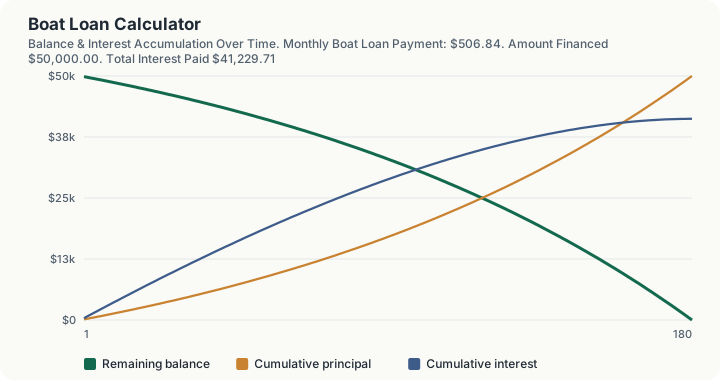
Each month, that fixed payment is split between interest, calculated as the current balance multiplied by the monthly rate, and principal, which is whatever remains of the payment after interest. As the balance declines month over month, the interest portion of each payment shrinks and the principal portion grows, even though the total payment itself stays exactly the same for the life of the loan. This calculator generates the complete month-by-month schedule, not just the final summary figures, so you can see exactly how the balance, interest, and principal evolve over the full loan term.
Worked Example
Consider a $60,000 boat purchase with a $10,000 down payment, financed over 180 months (15 years) at an 8.99% annual interest rate.
Step 1: Amount financed. $60,000 − $10,000 = $50,000.
Step 2: Monthly interest rate. 8.99% / 12 = 0.749167% per month, or 0.00749167 as a decimal.
Step 3: Monthly payment. Using the amortization formula with P = $50,000, i = 0.00749167, and n = 180: Payment ≈ $506.84 per month.
Step 4: Total cost and total interest. Total of all 180 payments: $506.84 × 180 ≈ $91,230.46. Total interest paid: $91,230.46 − $50,000 = $41,230.46.
Over the life of this loan, the borrower pays back more in interest than 80% of the amount originally financed, a direct consequence of the long 15-year term at a nearly 9% rate. Shortening the term substantially reduces total interest, at the cost of a higher required monthly payment: financing the same $50,000 over 120 months (10 years) instead of 180 raises the monthly payment but meaningfully lowers the total interest paid over the life of the loan.
What This Does Not Account For
- Sales tax, title, and registration fees. These vary significantly by state and locality and are not included in the amount financed calculated here; check with your state's tax authority and the marine lender for the exact figures that apply to your purchase.
- Marine insurance costs. Lenders typically require proof of hull insurance for the life of the loan, an ongoing cost not reflected in the payment shown here.
- Depreciation. Boats generally depreciate faster than most cars, especially in the first few years of ownership. This calculator does not model the boat's value over time or whether the loan balance could exceed the boat's resale value at any point (being "underwater" on the loan).
- Maintenance, storage, and slip fees. Ongoing ownership costs like haul-outs, winterization, marina or storage fees, and routine maintenance are substantial for boat ownership and are entirely separate from the loan payment modeled here.
- Variable-rate loans. This calculator assumes a fixed interest rate for the full loan term. Some marine loans, particularly larger ones, may carry adjustable rates that would need to be modeled period by period as the rate changes.
Common Pitfalls
- Focusing only on the monthly payment. A longer term lowers the monthly payment but can substantially increase total interest paid, sometimes by tens of thousands of dollars on a large loan. Always compare total cost across term lengths, not just the payment.
- Underestimating total cost of ownership. The loan payment is often just one part, and sometimes the smaller part, of the true monthly cost of owning a boat once insurance, storage, fuel, and maintenance are included.
- Not shopping the rate. Marine loan rates can vary meaningfully between lenders, and the difference between a good and mediocre rate compounds significantly over a long term like 15 or 20 years.
- Financing 100% of the purchase price. A larger down payment reduces the amount financed directly, which lowers both the monthly payment and the total interest paid, and also reduces the risk of owing more than the boat is worth if it needs to be sold or is declared a total loss.
- Ignoring the term-length mismatch with expected ownership. Taking out a 20-year loan on a boat you expect to sell in 5 years can leave you owing significantly more than the boat's depreciated resale value at the time of sale, since very little principal is paid down in the early years of a long amortization schedule.
Frequently Asked Questions
How is a boat loan different from a car loan?
Why do boat loan rates tend to be higher than auto loan rates?
What down payment should I plan for on a boat loan?
Does a longer loan term always cost more overall?
Can I pay off a boat loan early to save on interest?
Does this work for a pontoon, sailboat, yacht or houseboat?
Can I use this to check a refinance or an outboard repower?
Is boat loan interest tax-deductible?
Sources
- Consumer Financial Protection Bureau (CFPB): Regulation Z (Truth in Lending Act), installment loan disclosure requirements. ecfr.gov/current/title-12/chapter-X/part-1026
- Internal Revenue Service (IRS) Publication 936, Home Mortgage Interest Deduction, second-home qualification rules relevant to boat loan interest. irs.gov/publications/p936
Also consulted: National Marine Lenders Association, industry data on marine loan terms and underwriting standards.