Quick Answer: A balloon mortgage keeps your monthly payment low by calculating it as if the loan amortized over a long term like 30 years, but the entire remaining loan balance actually comes due in one lump sum after a much shorter period, such as 5 or 7 years.
Overview
Most mortgages are structured so that the monthly payment fully pays off the loan by the end of the stated term. A 30-year fixed mortgage means exactly that: 360 payments, and the balance hits zero on the final one. A balloon mortgage borrows the low monthly payment of a long amortization schedule without actually giving the borrower 30 years to pay it off. The payment is computed exactly as if the loan would take 30 years to retire, but the loan agreement specifies a much shorter maturity date, often 5, 7, or 10 years. When that date arrives, whatever principal balance remains, which is still the vast majority of the original loan, becomes due in full, immediately.
Borrowers choose balloon structures for a few reasons: a lower monthly payment than a fully amortizing loan of the same short term would require, an expectation of selling or refinancing the property before the balloon date arrives, or a business reason to keep near-term cash outflows low. The tradeoff is real and significant: the borrower is betting on being able to refinance, sell, or otherwise come up with a very large lump sum by a fixed deadline, and that bet does not always play out, particularly if interest rates rise or lending standards tighten between origination and the balloon date.
This calculator shows both halves of that picture: the artificially low monthly payment, and the large balloon amount that will actually be owed when the note matures.
How This Is Calculated
The monthly payment is computed using the standard mortgage amortization formula, applied over the full amortization length (for example, 30 years, or 360 months), exactly as if the loan would run its full course:
Payment = P × i / (1 − (1 + i)⁻ⁿ)
where P is the loan principal, i is the monthly interest rate (annual rate divided by 12), and n is the number of months in the amortization schedule.
The loan is then run through that amortization math for only as many months as the balloon term actually specifies, for example 84 months for a 7-year balloon. At each of those months, the payment is split into interest (current balance times the monthly rate) and principal (the payment minus that interest), and the balance declines the same way it would on any standard amortizing loan.
Because the payment was sized for a 30-year payoff but the loan only runs for 7 years, the vast majority of the original principal is still outstanding when the balloon term ends. That remaining balance, the "balloon payment," is the amount due in full at maturity, on top of that final month's regular payment.
Worked Example
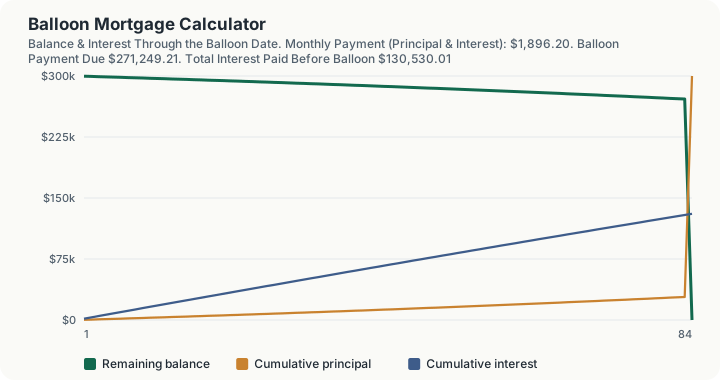
Consider a $300,000 loan at a 6.5% annual interest rate, with the payment calculated on a 30-year (360-month) amortization schedule, but a 7-year (84-month) balloon maturity.
Step 1: Monthly interest rate. 6.5% / 12 = 0.541667% per month, or 0.00541667 as a decimal.
Step 2: Monthly payment (sized for 360 months). Using the standard amortization formula with P = $300,000, i = 0.00541667, and n = 360: Payment ≈ $1,896.20 per month.
Step 3: Remaining balance after 84 payments. Running the loan forward through 84 months of principal-and-interest payments at $1,896.20 a month, the balance declines from $300,000 down to approximately $271,249.21.
That $271,249.21 is the balloon payment: the lump sum due in full at the end of month 84, in addition to that month's regular $1,896.20 payment. Over those 7 years, the borrower will have paid roughly $28,751 of principal (the difference between the original $300,000 and the $271,249.21 balance) while paying a combined total of about $159,481 in regular monthly payments, the overwhelming majority of which was interest.
This is the essential character of every balloon loan: years of relatively low, mostly-interest payments, followed by one very large principal repayment.
What This Does Not Account For
- Refinancing risk. This calculator does not model whether refinancing will actually be available at the balloon date, or at what rate. If rates have risen or the borrower's credit or income situation has weakened, refinancing the balloon into a new loan may be more expensive or unavailable entirely.
- Prepayment penalties. Some balloon notes include penalties for paying the loan off early, which are not modeled here and should be checked against the specific loan documents.
- Balloon payment financing costs. If the balloon is paid off with a new loan, this calculator does not include the closing costs, appraisal fees, or other expenses typically associated with originating that replacement loan.
- Property value changes. If the plan is to sell the property to cover the balloon payment, this calculator makes no assumption about future property values or the transaction costs of a sale.
- Rate resets. Some balloon products include a one-time rate reset option at maturity instead of requiring a full new loan; this calculator models the standard fixed-rate, lump-sum-due structure only.
Common Pitfalls
- Confusing "low payment" with "affordable loan." The monthly payment on a balloon mortgage is deliberately understated relative to what it would take to actually pay off the loan in the shorter balloon window. Do not evaluate affordability using the monthly payment alone.
- Assuming refinancing is guaranteed. A balloon mortgage is, in effect, a bet that future refinancing or a sale will be available on reasonable terms. That assumption failed for a meaningful number of borrowers during past periods of tightened credit, leaving them owing a lump sum they could not pay or refinance.
- Overlooking how little principal is actually paid down. Because payments are calculated on a long amortization schedule, almost all of each early payment goes toward interest, not principal. Do not assume a balloon loan builds equity at the same pace as a shorter, fully amortizing loan.
- Ignoring the exact maturity date. Balloon payments are due on a specific date, not "sometime around" that date. Missing it can trigger default, even if the borrower has a refinancing plan already underway that simply has not closed yet.
- Comparing the balloon payment to the original loan amount instead of the actual amortization. The balloon balance is not an arbitrary number; it is the mathematically exact result of amortizing at the stated rate and payment for the stated number of months. Two loans with different rates or amortization lengths will produce meaningfully different balloon amounts even on the same original principal.
Frequently Asked Questions
How is the monthly payment on a balloon mortgage calculated if the loan does not actually last that long?
What happens if I cannot pay the balloon amount when it comes due?
Why would anyone choose a balloon mortgage over a standard fixed-rate loan?
Is a balloon mortgage the same as an interest-only loan?
Does the interest rate stay fixed through the balloon date?
How much of the balloon payment is principal I could have avoided by choosing a shorter fully amortizing loan instead?
Sources
- Consumer Financial Protection Bureau (CFPB): Regulation Z (Truth in Lending Act), disclosure requirements for balloon payment mortgages. ecfr.gov/current/title-12/chapter-X/part-1026
- Federal Reserve consumer guidance on adjustable and non-standard mortgage structures. federalreserve.gov
Also consulted: Fannie Mae and Freddie Mac underwriting guidelines on balloon mortgage products (where currently offered).