Quick Answer: A business holding stock for 60 days, collecting from customers in 45 and paying suppliers in 30 has a cash conversion cycle of 75 days. On $5 million of revenue that locks up $1,027,397.26 of cash. A retailer with the same revenue but a −38 day cycle has that cash working for it instead of against it.
How Long Your Money Is Someone Else's
The cash conversion cycle measures how long your money is someone else's: the gap between paying suppliers and collecting from customers.
CCC = DIO + DSO − DPO
It is one of the few working capital measures that translates directly into cash. Every day of cycle is a day of revenue tied up, so a 75-day cycle on $5 million of revenue is roughly a million dollars that cannot be spent on anything else.
A negative cycle is possible and powerful. Supermarkets and many subscription businesses collect from customers before paying suppliers, which means growth generates cash rather than consuming it. That structural advantage is often worth more than a margin advantage.
How is this calculated?
- DIO, days inventory outstanding: average inventory ÷ cost of goods sold × 365
- DSO, days sales outstanding: average receivables ÷ revenue × 365
- DPO, days payables outstanding: average payables ÷ cost of goods sold × 365
CCC = DIO + DSO − DPO
The operating cycle is DIO + DSO: how long from buying stock to collecting cash, ignoring supplier credit. Subtracting DPO gives the portion you actually have to fund yourself.
Cash tied up is the cycle in days multiplied by daily revenue.
Worked Example
A distributor turning over $5,000,000 a year holds stock for 60 days, waits 45 days to be paid, and settles supplier invoices in 30. The finance director wants to know how much of the company's cash that pattern is holding hostage.
Step 1: The operating cycle. 60 days inventory + 45 days receivables = 105 days
That is the full round trip from paying for goods to being paid for them.
Step 2: Subtract the supplier float. 105 days - 30 days payables = 75 days
Step 3: Daily revenue. $5,000,000 / 365 = $13,698.63 a day
Step 4: Cash tied up in the cycle. 75 days x $13,698.63 = $1,027,397.26
Step 5: The value of a ten-day improvement. 10 days x $13,698.63 = $136,986.30
Step 4 is the number that reframes the conversation. Just over a million dollars is permanently parked inside normal trading, and it is not on the profit and loss anywhere. Step 5 prices every negotiation: ten days off the collection cycle releases $136,986.30 of cash without a single additional sale, and without a single point of extra margin.
A retail model (DIO 20, DSO 2, DPO 60): the cycle is -38 days. Customers pay at the till while suppliers wait two months, so roughly $520,548 of supplier money funds the business permanently.
Customers taking 90 days instead of 45: the cycle stretches to 120 days, adding some $616,000 to the cash requirement without a single extra sale.
Halving inventory to 30 days: the cycle falls to 45 days. Inventory is usually the largest and most controllable component.
Walking the Payables Sweep Through the Sign Change
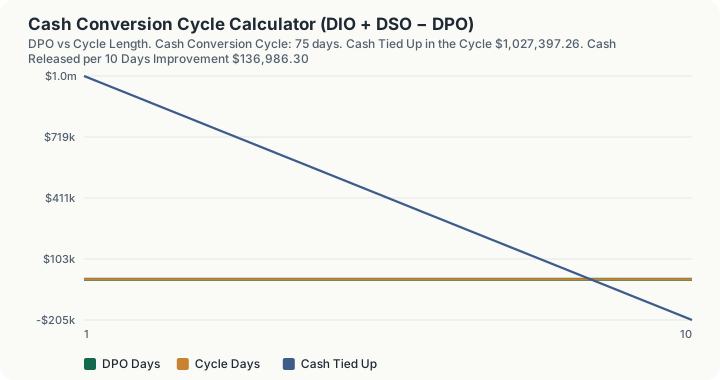
The table on this page varies one input only. It holds inventory at 60 days, receivables at 45 and revenue at $5,000,000, and steps days payables outstanding from 30 upward in ten-day increments. The cycle falls in a straight line: 75 days at DPO 30, 65 at 40, 55 at 50, 45 at 60, 35 at 70, 25 at 80, 15 at 90, 5 at 100, then -5 at 110 and -15 at 120. The cash figure tracks it exactly, from $1,027,397.26 at the top to -$205,479.45 at the bottom. Below the axis the number stops being a requirement and becomes a source: at DPO 110 the business is holding $68,493.15 of other people's money.
The value of one day. $13,698.63, the engine's daily revenue at $5,000,000. Ten days is $136,986.30, which is the cashPerTenDays output and is unchanged by every row of the sweep, because it depends only on revenue.
The sign change, either side. This is the edge that matters, and the engine puts it at DPO 105 with the other two inputs at their defaults. At DPO 105 the cycle is 0 days, cash tied up is $0.00, and the verdict reads short cycle: little working capital is locked up. At DPO 106, one day later, the cycle is -1 days, cash tied up is -$13,698.63, and the verdict flips to negative cycle: customers pay before suppliers, so growth funds itself. A single day of supplier terms moves the business from funding nothing to being funded, and the zero point itself is classified as short rather than negative.
The two interior band edges. The verdict string has four bands, and both interior edges are exact. At DPO 75 the cycle is 30 days, cash $410,958.90, verdict short cycle. At DPO 74 the cycle is 31 days, cash $424,657.53, verdict moderate cycle. One day of payables, $13,698.63 of cash, and the label changes. The upper edge behaves the same way: at DPO 15 the cycle is 90 days on $1,232,876.71 and reads moderate, while at DPO 14 it is 91 days on $1,246,575.34 and reads long. These are thresholds in the wording, not in the mathematics; nothing about the cash requirement bends at 30 or 90 days.
The same walk on the collections axis. Receivables move the cycle one for one as well, but they also move the operating cycle, which payables do not. At DSO 30 the cycle is 60 days on an operating cycle of 90 days and $821,917.81 of cash. At DSO 45 it is 75 days, 105 days and $1,027,397.26. At DSO 60, 90 days, 120 days and $1,232,876.71. At DSO 90 the cycle reaches 120 days and $1,643,835.62, and the verdict turns long. Letting customers take three months instead of six weeks adds $616,438.36 to the cash requirement, which is the same figure the engine returns as the whole requirement of a 45-day cycle.
The reverse question. How many days of supplier credit does it take to fund the trading cycle outright? 105 days, at which point cash tied up is $0.00. How much inventory reduction achieves the same thing? Not enough on its own: at DIO 20 the cycle is still 35 days and $479,452.05, because collections and payables leave 25 days uncovered even with almost no stock.
Right measure against wrong measure, priced. Budgeting working capital off the operating cycle rather than the cash cycle is the common error, and the engine prints both. The operating cycle at the defaults is 105 days, worth $1,438,356.16. The cash conversion cycle is 75 days, worth $1,027,397.26. Financing to the first figure over-reserves by $410,958.90, which is exactly the 30 days of supplier credit the business already has. The retail configuration shows the error in the other direction: DIO 20, DSO 2, DPO 60 gives an operating cycle of 22 days but a cash cycle of -38 days and -$520,547.95, so a business measured on its operating cycle alone would appear to need funding when the engine says its working capital position is -$520,547.95, a surplus rather than a requirement.
What the sweep is not. The ten rows are not ten periods. Row 1 and row 10 are the same business at the same instant under different payables assumptions, and the engine carries nothing from one row to the next. No row discounts the cash figure, applies an interest rate to it, or costs the discounts forgone by stretching payables to 120 days.
What does this calculator not account for?
- Seasonality. Year-end balance sheet figures can badly misrepresent a seasonal business. Averages across the year are better where available.
- Which denominator to use. DPO and DIO are conventionally computed on cost of goods sold and DSO on revenue. Using revenue throughout is common but not comparable across companies.
- The cost of stretching DPO. Lengthening supplier terms shortens the cycle on paper while forfeiting early payment discounts and straining relationships. A 2/10 net 30 discount forgone is an expensive form of financing.
- Bad debt. DSO measures how long customers take to pay, not whether they pay.
- Inventory obsolescence. Low DIO achieved by writing stock off is not an improvement.
- Financing cost. This shows the cash locked up, not what it costs to fund. Multiply by your borrowing rate for that.
- Service businesses, which carry no inventory, so DIO is zero and the cycle is DSO less DPO.
- Contract assets and deferred revenue, which sit outside the three classic components.
What mistakes do people make with this?
- Improving the cycle only by stretching suppliers. It works arithmetically and can be expensive commercially. Forfeiting a 2% discount for 20 days of extra credit is an annualised cost well above most borrowing rates.
- Using year-end balances for a seasonal business. A December stocktake at a toy company tells you very little about the average.
- Mixing denominators. Comparing your DSO on revenue with a competitor's on cost of goods sold produces a meaningless gap.
- Treating a negative cycle as free money. It is supplier and customer financing, and it reverses instantly if the business shrinks. Negative-cycle businesses are exposed on the way down.
- Ignoring bad debt when celebrating low DSO. Collections speed and collections quality are different things.
- Assuming shorter is always better. Cutting inventory too far causes stockouts, and tightening customer terms can cost sales.
Frequently Asked Questions
What is a good cash conversion cycle?
Can the cycle really be negative?
Which component should I attack first?
How much is a day worth?
Does a shorter cycle always mean a healthier business?
How do service businesses use this?
Sources
- U.S. Small Business Administration, the official authority for the business this calculator relates to. sba.gov
Also consulted: Standard working capital analysis. DIO, DSO, DPO and the cash conversion cycle are conventional accounting ratios with no jurisdictional content; The convention of computing DIO and DPO on cost of goods sold and DSO on revenue is noted, since mixing denominators is a common comparability error.