Quick Answer: The quick ratio measures whether a company's most liquid assets, cash, marketable securities, and receivables, can cover its current liabilities without needing to sell any inventory.
Overview
The quick ratio, also called the acid-test ratio, is a stricter version of the current ratio. Where the current ratio counts every current asset (including inventory and prepaid expenses) against current liabilities, the quick ratio deliberately strips out anything that can't be converted to cash quickly and with certainty. That means excluding inventory, since inventory has to be sold first, at an uncertain price and on an uncertain timeline, before it becomes cash, and excluding prepaid expenses, since those have already been consumed and cannot be converted back to cash at all.
The name "acid test" comes from a 19th-century assaying technique where gold miners tested a metal's purity by applying nitric acid; if it survived, it was genuinely gold. Applied to a balance sheet, the quick ratio asks a similarly blunt question: if a company had to pay off all of its current liabilities right now, using only assets it could realistically convert to cash within days, would it have enough?
Lenders and credit analysts favor the quick ratio over the current ratio specifically because inventory is the least reliable current asset in a liquidity crunch. A company forced to liquidate inventory quickly to raise cash often has to accept steep discounts, sometimes 30-50% below book value, meaning the inventory line on the balance sheet can meaningfully overstate what's actually recoverable in a stress scenario.
How This Is Calculated
This is the "additive" version of the formula, building the numerator up from the specific liquid assets. An equivalent "subtractive" version starts from total current assets and removes the illiquid pieces:
Both formulas produce the same result when applied consistently; this calculator uses the additive version, which avoids ambiguity about which specific line items within "current assets" should be excluded.
A ratio of 1.0 means quick assets exactly cover current liabilities. Above 1.0 indicates a cushion; below 1.0 means the company would need to either sell inventory, delay some obligations, or raise new financing to meet its short-term liabilities in full.
Worked Example
A mid-sized company reports the following on its balance sheet:
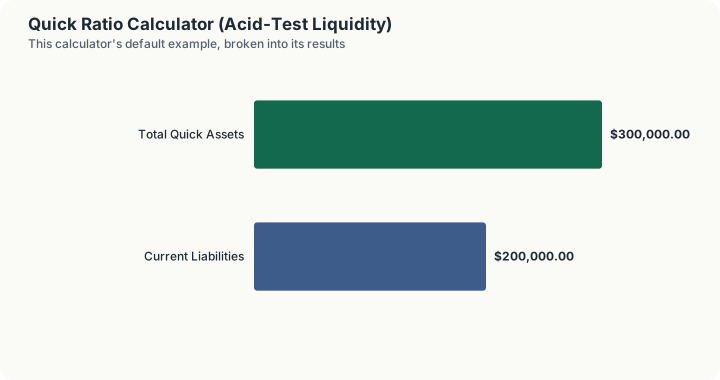
- Cash & Cash Equivalents: $120,000
- Marketable Securities: $30,000
- Accounts Receivable: $150,000
- Total Current Liabilities: $200,000
Step 1: Sum the quick assets:
Step 2: Divide by current liabilities:
A quick ratio of 1.50 means this company has $1.50 of readily convertible assets for every $1.00 of liabilities due within the year, a comfortable cushion that suggests it could meet its near-term obligations even if accounts receivable collection slowed somewhat, without needing to touch inventory or seek emergency financing.
What This Does Not Account For
- The quality of accounts receivable. The formula counts all receivables as equally liquid, but a receivables balance heavily concentrated in a few large, slow-paying, or financially shaky customers is far less certain to convert to cash on schedule than a diversified base of prompt-paying customers.
- Timing mismatches within the current-liability bucket. The ratio treats all current liabilities as due at the same moment, but in practice some obligations (payroll, certain payables) may be due within days while others (the current portion of long-term debt) may not be due for many months.
- Off-balance-sheet liquidity, like undrawn credit lines. A company with a large committed but undrawn revolving credit facility has meaningfully more liquidity cushion than its balance sheet alone suggests, and the quick ratio has no way to capture that.
- Marketable securities that aren't actually liquid in a crisis. The formula assumes marketable securities can be sold quickly at close to book value; in a severe market dislocation, some securities classified as "marketable" can become considerably harder to sell without a discount.
- Industry-specific working capital cycles. A subscription software company collecting cash upfront (deferred revenue) has a fundamentally different liquidity profile than a capital-equipment manufacturer, even at an identical quick ratio.
Common Pitfalls
- Including inventory in the numerator. This is the defining difference from the current ratio; accidentally including inventory (or forgetting to exclude prepaid expenses when using the subtractive formula) produces the current ratio instead of the quick ratio, and typically overstates true liquidity.
- Treating any quick ratio below 1.0 as automatically alarming. Some industries, particularly ones with fast inventory turnover and short cash conversion cycles like grocery retail, routinely operate with quick ratios below 1.0 without genuine liquidity stress, because inventory converts to cash quickly enough that excluding it entirely is overly conservative for that business model.
- Comparing the quick ratio across industries without context. A capital-intensive manufacturer holding large amounts of inventory will naturally show a lower quick ratio than a services business with little to no inventory at all, even if both are equally creditworthy.
- Ignoring the trend in favor of a single period. A quick ratio declining steadily over several quarters, even while still above 1.0, can be an earlier warning sign of deteriorating liquidity than waiting for the ratio to actually cross below 1.0.
- Assuming a very high quick ratio is always good news. An unusually high quick ratio can indicate a company is sitting on excess cash rather than deploying it productively into growth, buybacks, or dividends, which shareholders may view as inefficient capital allocation.
Frequently Asked Questions
What is a good quick ratio?
What is the difference between the quick ratio and the current ratio?
Why exclude inventory specifically?
Can a company have a healthy current ratio but a weak quick ratio?
Does a quick ratio below 1.0 always mean a company is in financial trouble?
Sources
- U.S. Small Business Administration, the official authority for the business this calculator relates to. sba.gov
Also consulted: Investopedia, "Quick Ratio Formula and What It Measures, With Examples"; Corporate Finance Institute (CFI), "Quick Ratio (Acid-Test Ratio)"; Investopedia, "Current Ratio Explained With Formula and Examples".