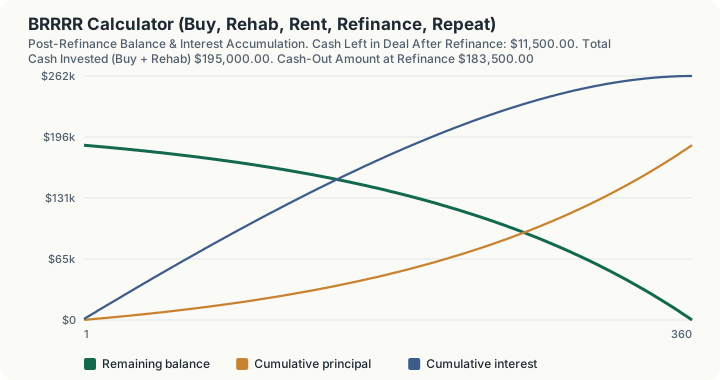
Quick Answer: BRRRR investors buy a distressed property with cash or short-term financing, force appreciation through rehab, then take out a cash-out refinance sized off the after-repair value. On this calculator's baseline inputs ($150,000 purchase, $40,000 rehab, $250,000 ARV, 75% refinance LTV), the refinance returns $183,500 of the $195,000 invested, leaving $11,500 still tied up in the deal and a 30.53% cash-on-cash return on that remaining balance.
Overview
BRRRR is a real estate investing strategy popularized by the BiggerPockets community: Buy a property below market value (usually distressed or dated), Rehab it to force appreciation, Rent it to a tenant, Refinance out of the short-term acquisition financing with a long-term amortizing loan sized off the new, higher appraised value, and Repeat the process with the capital recovered. The mechanism that makes it work is simple but easy to get wrong in your head: a bank will lend against what the property is worth today, not what you paid for it. If a rehab genuinely creates enough value, the resulting cash-out refinance can return most or all of the original cash invested, letting the same capital fund another deal.
This calculator models the full cycle. It starts by totaling the cash an investor actually put in during the Buy and Rehab phases (purchase price, rehab budget, and acquisition closing costs, which is the standard basis for an all-cash or hard-money BRRRR purchase). It then sizes a cash-out refinance against the after-repair value at a lender-set loan-to-value ceiling, nets out refinance closing costs, and compares the resulting cash-out proceeds against the original cash invested. Whatever is left over becomes the equity still tied up in the deal, and the calculator explicitly flags whether the investor hit the "infinite return" scenario, meaning the refinance returned all (or more than all) of the original cash, so the ongoing cash flow is generated on effectively zero remaining capital.
Once the new permanent loan is in place, the calculator computes standard post-refinance operating numbers: monthly and annual cash flow after debt service, the Debt Service Coverage Ratio (DSCR) a lender would check, and the cash-on-cash return on whatever cash, if any, remains in the deal.
How This Is Calculated
Step 1: Total cash invested through Buy + Rehab.
Step 2: New loan and cash-out proceeds at refinance. The refinance lender lends against the after-repair value (ARV), not the cost basis:
Step 3: Cash left in the deal.
If cash-out proceeds exceed the total cash invested, the excess is reported separately as surplus cash extracted, and the deal is flagged as an infinite-return deal.
Step 4: Post-refinance debt service. A standard amortizing mortgage payment is calculated on the new loan using the same amortization primitive used across this site's lending calculators:
Step 5: Post-refinance cash flow and returns.
Worked Example
Using this calculator's baseline inputs: $150,000 purchase price, $40,000 rehab budget, $5,000 acquisition closing costs, a $250,000 after-repair value, a 75% refinance LTV at 7.0% over 30 years with $4,000 in refinance closing costs, $2,200 projected monthly rent, and a 30% operating expense ratio.
- Total cash invested: $150,000 + $40,000 + $5,000 = $195,000
- New loan amount: $250,000 × 75% = $187,500
- Cash-out proceeds: $187,500 − $4,000 = $183,500
- Cash left in the deal: $195,000 − $183,500 = $11,500 (not an infinite-return deal; some capital stays in)
- Monthly mortgage P&I on the $187,500 refinance loan at 7.0% over 360 months: $1,247.44
- Annual NOI: ($2,200 × 12) × (1 − 30%) = $26,400 × 70% = $18,480
- Post-refinance monthly cash flow: ($18,480 ÷ 12) − $1,247.44 = $1,540.00 − $1,247.44 = $292.56
- Annual cash flow: $292.56 × 12 = $3,510.72
- DSCR: $18,480 ÷ ($1,247.44 × 12) = $18,480 ÷ $14,969.28 = 1.23x
- Cash-on-cash return on remaining cash: $3,510.72 ÷ $11,500 × 100 = 30.53%
A second reference point shows the strategy's namesake payoff: buy at $100,000, put $30,000 into rehab plus $3,000 in closing costs ($133,000 total cash invested), and appraise afterward at $220,000. A 75% refinance produces a $165,000 loan and, after $3,000 in refinance closing costs, $162,000 in cash-out proceeds, which is $29,000 more than was invested. The deal hits the infinite-return threshold: every dollar of the original cash is back in the investor's pocket, plus a $29,000 surplus, and the ongoing $232.25 in monthly cash flow is now generated on zero remaining capital.
What This Does Not Account For
- Refinance-rate and appraisal risk. This model assumes the refinance closes at the rate and the ARV you enter. Between the rehab and the refinance, both mortgage rates and the appraised value can move, and an appraisal that comes in below the projected ARV directly reduces the cash-out amount and can leave far more capital stuck in the deal than modeled here.
- Hard money and bridge loan carrying costs during the rehab. Many BRRRR investors finance the purchase and rehab with a hard money or bridge loan rather than all cash. This calculator treats the acquisition phase as cash invested; if you are carrying interest-only payments on short-term debt during the rehab period, add that carrying cost into your acquisition closing costs input to approximate it.
- Seasoning requirements. Many cash-out refinance lenders require a minimum ownership period (commonly 6 months, sometimes longer) before they will refinance off the new appraised value rather than the original purchase price. This calculator does not model financing timeline or seasoning rules.
- Rent-up and vacancy risk during stabilization. The rent and expense ratio you enter are treated as immediately stabilized; the actual time and cost to find and place a qualified tenant after rehab is not modeled.
- Rehab budget overruns. Construction cost overruns are extremely common on BRRRR projects; the total cash invested figure only reflects the rehab budget you enter, not contingency risk.
Common Pitfalls
- Confusing ARV-based refinancing with cost-based financing. The entire strategy depends on the refinance being sized off the after-repair value, not the purchase-plus-rehab cost basis. If a lender insists on a cost-basis or seasoning-adjusted valuation instead, the refinance loan (and cash-out amount) will be smaller than this model projects.
- Underestimating refinance closing costs. Refinance closing costs directly reduce cash-out proceeds dollar for dollar; treating them as a rounding error understates how much cash actually stays in the deal.
- Ignoring DSCR when planning the refinance. Cash-out refinance lenders, especially DSCR loan programs common for investor refinances, typically require a minimum DSCR (often 1.0x-1.25x). A deal that pencils on cash-out proceeds alone can still fail to qualify if post-refinance rent does not clear the lender's DSCR floor.
- Treating "infinite return" as risk-free. A deal with zero cash left in it still carries full exposure to vacancy, rate risk on the new loan (if adjustable), and market downturns; "infinite" describes the return on capital, not the absence of risk.
- Not re-underwriting rent after the rehab. The rehab is supposed to support a higher rent than the property commanded pre-renovation; using pre-rehab market rent understates post-refinance cash flow.
Frequently Asked Questions
What does "infinite return" actually mean in a BRRRR deal?
Why is the refinance loan sized off the ARV instead of the purchase price?
What refinance LTV should I assume?
Does this calculator account for the interest paid during the rehab phase?
How is this different from the rental property calculator on this site?
Sources
- Fannie Mae Selling Guide, cash-out refinance and delayed financing guidelines for investment properties, selling-guide.fanniemae.com
- Freddie Mac Seller/Servicer Guide, investment property cash-out refinance requirements, guide.freddiemac.com
- Consumer Financial Protection Bureau, refinancing and mortgage guidance, consumerfinance.gov