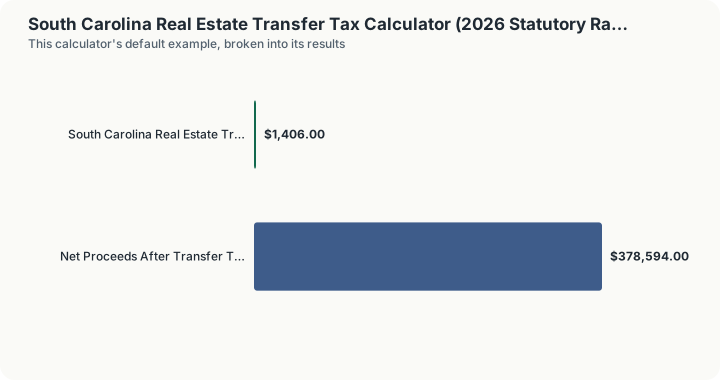
Quick Answer: A $380,000 home sale in South Carolina owes $1,406.00 in Deed Recording Fee, a flat 0.37% rate applied to the full sale price with no brackets or high-value surcharge.
Overview
South Carolina's Deed Recording Fee under Code Section 12-24-10 is itself a two-part combination baked into a single statutory rate: $1.30 per $500 for the state portion plus $0.55 per $500 for the county portion, totaling $1.85 per $500, or 0.37%, of the value. Unlike Maryland or Ohio, where the state and county pieces can vary independently by jurisdiction, South Carolina's combined rate is fixed and uniform across all 46 counties.
Local custom places the fee on the seller in most transactions, though the specific allocation is ultimately addressed in the purchase contract and can be negotiated. At 0.37%, South Carolina's rate matches Tennessee's exactly and lands close to Minnesota's 0.33%, states with structurally different statutes that happen to land on a similar effective rate.
Because the fee is embedded in the recording process itself rather than collected separately, South Carolina's register of deeds offices calculate and collect it as part of accepting the deed for recording, so the $1.85-per-$500 math is applied consistently across all 46 counties without any local variation to track.
How This Is Calculated
South Carolina does not call this a transfer tax. It is a Deed Recording Fee under S.C. Code 12-24-10, and the label matters because the money is split between two governments: $1.30 per $500 to the state and $0.55 per $500 to the county, for $1.85 total.
The engine applies the combined 0.37% rate to the full sale price and reports fee due, effective rate, and net proceeds. Despite the name, it behaves exactly like a transfer tax: it scales with the price of the property rather than with the clerical work of recording a deed. A page fee for recording is a separate, much smaller charge. There is no bracket schedule and no value threshold, so an $80,000 rural lot and an $8,000,000 commercial parcel are both charged 0.37%.
Worked Example
South Carolina calls it a Deed Recording Fee, but it behaves as a transfer tax and is calculated like one. Here it is on the calculator's baseline sale.
Step 1 -- The consideration. Realty value on the deed = $380,000
Step 2 -- The statutory rate. S.C. Code 12-24-10, $1.85 per $500 of value, comprising $1.30 state and $0.55 county = 0.37%
Step 3 -- Apply the combined rate. $380,000 x 0.0037 = $1,406.00
Step 4 -- Cross-check by the per-$500 method. 760 x $1.85 = $1,406.00
Step 5 -- Net proceeds after the fee. $380,000.00 - $1,406.00 = $378,594.00
Step 6 -- The effective rate. $1,406.00 / $380,000 = 0.370%
The calculator's $1,500,000 scenario, for comparison.
Step 7 -- The luxury sale. $1,500,000 x 0.0037 = $5,550.00
Step 8 -- The effective rate, unchanged. $5,550.00 / $1,500,000 = 0.370%
The state and county shares in Step 2 are not two separate calculations the engine performs; they are one statutory rate whose proceeds are split after collection, which is why a single multiplication in Step 3 produces the whole figure. The county's $0.55 portion applies uniformly in all 46 counties rather than varying by locality, so unlike Maryland or Michigan there is no county-by-county rate to look up before you can price a South Carolina closing. Sellers customarily pay the fee, and Step 5 is what they clear.
The Marginal $10,000, the Reverse Lookup, and the Rounding Gap
This page carries no schedule table, because the transfer tax config returns an empty schedule. The figures below come from sweeping the sale price input directly.
Each additional $10,000 of sale price costs $37.00. Sweeping from $350,000 to $400,000 in $10,000 steps returns $1,295.00, $1,332.00, $1,369.00, $1,406.00, $1,443.00 and $1,480.00. The step is $37.00 at every point, and it stays $37.00 at $2,500,000 as readily as at $350,000. There is no bracket edge to walk here and no exemption floor to cross: the rate is 0.37% from the first dollar of consideration, so a page promising a threshold to structure around would be describing a South Carolina statute that does not exist.
The reverse question. A $2,000.00 fee corresponds to a sale price of $540,540. A $1,000.00 fee corresponds to $270,270. A round $1,850.00, which is the statutory $1.85 multiplied a thousand times, falls at exactly $500,000. Note that the engine rounds the fee to the cent, so $540,540 and $540,541 both return $2,000.00; the reverse lookup identifies a narrow band of prices rather than one.
There is no mansion tax to find. The output panel carries a "Mansion Tax / High-Value Surcharge" field because the underlying primitive supports a mansion cliff for the states that have one. South Carolina has none, and the field returns $0.00 at every price tested: $0.00 at $380,000, $0.00 at $1,500,000, $0.00 at $2,500,000 and $0.00 at $10,000,000, where the total fee is $37,000.00 and all of it is base fee. A permanently zero output is a quirk of a shared primitive, not a South Carolina rule waiting to bite at some price.
Where the engine and the county register disagree, priced. The statute quotes $1.85 per $500 of realty value, and a register of deeds applies that per increment, rounding a partial $500 up to a whole one. The engine does not: it multiplies a clean 0.0037 against the exact price. On a sale of $387,300 the engine returns $1,433.01. That price is 774.6 increments of $500, which the statutory method rounds up to 775, giving 775 x $1.85 = $1,433.75. The engine is $0.74 light. On prices that are exact multiples of $500 the two methods agree to the cent, which is why the $380,000 default and the $500,000 figure above cross-check perfectly. The discrepancy is bounded by one increment, so it can never exceed $1.85 on any South Carolina sale, but it is a real difference between this page and a closing statement.
What This Does Not Account For
- Exemptions for certain transfer types. Transfers between spouses, transfers into certain trusts, transfers securing a debt, and transfers by operation of law may be exempt from all or part of the Deed Recording Fee under South Carolina law. This calculator assumes a standard arm's-length taxable sale.
- Mortgage or deed of trust recording fees. South Carolina charges separate flat recording fees for mortgages and other loan documents, distinct from the Deed Recording Fee modeled here, which applies specifically to the deed conveying the property.
- Title insurance, attorney fees, and survey costs. The Deed Recording Fee is only one line item on a South Carolina closing statement; title search fees, attorney charges, and survey costs are separate and not modeled here.
- Rounding up to the next $500 increment. The register of deeds charges $1.85 per started $500; the engine multiplies the exact price by 0.0037. On a $387,300 sale that is $1,433.01 here against $1,433.75 at the counter, a gap bounded by $1.85.
- The distinction between the state and county portions on itemized statements. Some South Carolina closing documents itemize the $1.30 state and $0.55 county components separately rather than as a single combined figure; this calculator returns the combined total consistent with the effective 0.37% rate.
Common Pitfalls
- Assuming "recording fee" means a flat administrative charge unrelated to value. Despite the name, South Carolina's Deed Recording Fee is a value-based tax proportional to the sale price, not a flat per-document administrative fee like a simple filing charge.
- Forgetting who customarily pays. In most South Carolina transactions the Deed Recording Fee is paid by the seller (grantor), though this is ultimately a matter of contract and can be negotiated between the parties.
- Applying an out-of-state rate by habit. Buyers and agents relocating from bracket-heavy states sometimes overestimate South Carolina's fee by applying a marginal rate structure that does not exist here.
- Confusing the Deed Recording Fee with a separate mortgage tax. South Carolina's recording fee structure for mortgage instruments is calculated separately from the deed transfer fee modeled in this calculator, and mixing the two produces the wrong total.
Frequently Asked Questions
What is South Carolina's real estate transfer tax rate?
Who pays the Deed Recording Fee in South Carolina?
Does South Carolina have a mansion tax on expensive homes?
Is the Deed Recording Fee the same as South Carolina's real estate transfer tax?
Are any property transfers exempt from South Carolina's Deed Recording Fee?
Sources
- South Carolina Department of Revenue: Deed Recording Fee guidance under S.C. Code 12-24-10. dor.sc.gov