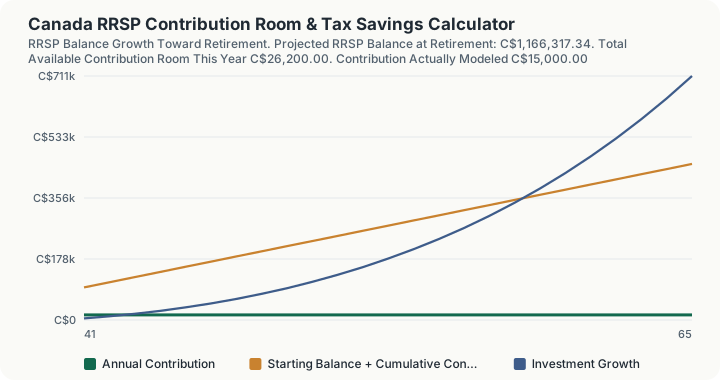
Quick Answer: On C$90,000 of prior-year earned income with C$10,000 of carried-forward room, a Canadian saver has C$26,200 of total RRSP room this year. Contributing C$15,000 at a 35% combined marginal rate produces an immediate C$5,250 refund, and projected at 6% annual growth from an existing C$80,000 balance over 25 years to age 65, the RRSP grows to C$1,166,317.34.
Overview
A Registered Retirement Savings Plan (RRSP) is Canada's flagship tax-deferred retirement account: contributions are deducted from your taxable income in the year you make them, the account grows tax-free while invested, and withdrawals (typically in retirement, when your tax bracket is often lower) are taxed as ordinary income. It is functionally similar to a U.S. traditional 401(k) or IRA, but administered federally through the Canada Revenue Agency (CRA) rather than through an employer plan, and available to virtually any Canadian resident with earned income -- self-employed or not.
The single most confusing part of RRSPs for most Canadians is contribution room. Unlike a flat annual dollar cap, RRSP room is calculated as 18% of your prior year's earned income, capped at a statutory dollar ceiling that only binds for higher earners, and -- critically -- any room you don't use in a given year never expires. It carries forward indefinitely, which is why two people earning identical current salaries can have wildly different amounts of available room depending on their contribution history.
This calculator answers three connected questions in one pass: how much room do you actually have available to contribute this year (18% of last year's income, capped, plus carry-forward); what is the immediate tax refund from making that contribution, at your own marginal tax rate; and, if you keep contributing that same amount every year going forward, what does the account grow to by your target retirement or RRIF-conversion age.
How This Is Calculated
Step 1 -- this year's new contribution room:
The 2026 RRSP dollar limit is C$33,810 (up from C$32,490 in 2025). This ceiling only binds if your 18% figure exceeds it -- which requires prior-year earned income above roughly C$187,833. Below that income level, your room is simply 18% of last year's earnings, full stop.
Step 2 -- total available room, including carry-forward:
Carry-forward room is the sum of every unused dollar of room from every prior year since you turned 18 (or since 1991, whichever is later) -- it never expires and is shown directly on your CRA Notice of Assessment.
Step 3 -- the contribution actually modeled:
Contributing beyond your available room triggers a 1%-per-month CRA over-contribution penalty tax (with a small C$2,000 lifetime cushion) -- this calculator caps the modeled contribution at your available room rather than showing an over-contribution figure, since that penalty math is a separate, narrower calculation.
Step 4 -- this year's tax savings:
Your combined marginal rate is your federal bracket rate plus your provincial bracket rate at your current taxable income level. This platform does not maintain a full federal-plus-13-province/territory Canadian bracket table, so you enter your own combined rate directly (available from a tax software estimate, an accountant, or a provincial marginal-rate table) -- the same convention this platform already uses for U.S. deferred-compensation and HSA calculators, where marginal rate is also a direct input rather than a derived one.
Step 5 -- growth projection:
Each year of the projection compounds the prior balance at your assumed annual return and adds the same modeled annual contribution, using this platform's shared time-value-of-money solver (an ordinary annuity: contributions applied at year-end). The projection assumes the same dollar contribution repeats every year, which is a simplification -- see "What This Does Not Account For" below.
Worked Example
Inputs: prior year's earned income C$90,000; C$10,000 unused carry-forward room; planned contribution C$15,000; combined marginal tax rate 35%; current age 40; retirement age 65; current RRSP balance C$80,000; expected annual return 6%.
Step 1: Gross 18% room.
This is well under the C$33,810 dollar limit, so it is not capped.
Step 2: Total available room.
Step 3: Modeled contribution. The planned C$15,000 fits comfortably under the C$26,200 available room, so the full amount is modeled. C$11,200 of room goes unused this year and carries forward.
Step 4: Tax savings.
This is the immediate refund (or reduction in taxes owed) from claiming the RRSP deduction on this year's return.
Step 5: Growth to retirement. Starting from C$80,000 and contributing C$15,000 every year at 6% for 25 years (age 40 to 65), the account compounds to C$1,166,317.34 at retirement. Of that, C$375,000 is new contributions (25 years x C$15,000), C$80,000 is the original starting balance, and the remaining C$711,317.34 is investment growth. The full year-by-year schedule, including the running balance, is shown in the table above.
The Crossover Between Contributions and Growth
Step 5 gives the endpoint. The schedule shows the shape, and the shape has a turning point worth planning around.
Step 6: age 41, the first year. Growth of C$4,800 on the opening balance plus the C$15,000 contribution closes the year at C$99,800
Step 7: age 42. Cumulative growth reaches C$10,788 and the balance is C$120,788
Step 8: growth added in year two.
Step 9: age 50, ten years in. Cumulative growth C$110,979.74 against C$230,000 of starting balance plus contributions, for a balance of C$340,979.74
Step 10: age 59, where the two lines cross. Cumulative growth of C$383,447.84 passes the C$365,000 of capital put in, and the balance is C$748,447.84
From age 59 onward more than half the account is money the account made rather than money the contributor added, and by 65 that share is C$711,317.34 of C$1,166,317.34. Nineteen years of contributions were needed to reach the crossover and only six more to add a further C$417,869.50 after it. The practical reading is that the C$5,250 deduction in step 4 is the small half of the benefit; the large half is the tax deferral on the C$711,317.34 of growth, which is only worth having if the contributions start early enough for the crossover to arrive before retirement does.
What This Does Not Account For
- A constant future contribution amount. Real RRSP room changes every year with your actual earned income; this projection assumes you contribute the same modeled dollar amount every single year to retirement, which will not exactly match reality.
- Pension Adjustment (PA) reductions. If you or your employer contribute to a Registered Pension Plan (RPP) or Deferred Profit Sharing Plan (DPSP), your RRSP room is reduced by a Pension Adjustment amount reported on your T4 slip -- not modeled here.
- The Home Buyers' Plan (HBP) and Lifelong Learning Plan (LLP). Both let you withdraw RRSP funds tax-free for a home purchase or education, with a required repayment schedule -- this calculator does not model either withdrawal program.
- Spousal RRSPs and income-splitting. Contributing to a spouse's RRSP (using your own contribution room) is a common income-splitting strategy in retirement, not modeled as a separate scenario here.
- Mandatory RRIF conversion and minimum withdrawals. An RRSP must convert to a Registered Retirement Income Fund (RRIF) -- or be cashed out or annuitized -- by December 31 of the year you turn 71, after which minimum annual withdrawals apply. This calculator projects growth only up to your chosen retirement/conversion age; it does not model the decumulation phase.
- Over-contribution penalty tax. If your planned contribution exceeds available room, this calculator simply caps the modeled amount at your available room rather than calculating the 1%-per-month CRA penalty tax on the excess.
- Provincial/territorial marginal rate lookup. You supply your own combined marginal rate; this calculator does not compute it from a bracket table.
Common Pitfalls
- Confusing the RRSP dollar limit with your actual room. The C$33,810 (2026) figure is a ceiling, not a target -- most Canadians have far less actual room than this, since it only applies in full to someone whose 18% calculation exceeds it (roughly C$187,833+ of prior-year earned income).
- Forgetting room is based on LAST year's income, not this year's. A big raise or bonus this year does not increase this year's contribution room -- it increases room available starting next year.
- Assuming unused room expires. It does not. Carry-forward room accumulates indefinitely, which is exactly why a late starter can "catch up" by contributing well above a single year's 18% figure, using room banked from earlier low-contribution years.
- Ignoring the Pension Adjustment. Anyone with a workplace pension plan should check their T4 Box 52 Pension Adjustment figure -- it directly reduces RRSP room and is a common source of "why is my room lower than I expected" confusion.
- Treating the tax deduction and tax-free growth as the same benefit. The upfront deduction (this year's tax savings) and the ongoing tax-deferred compounding are two separate benefits that stack -- losing sight of the deduction's immediate cash-flow value is a common reason people under-contribute relative to their available room.
Frequently Asked Questions
What is the RRSP contribution limit for 2026?
Does unused RRSP room expire?
How much tax will I save by contributing to my RRSP?
Should I contribute to an RRSP or a TFSA first?
What happens to my RRSP when I turn 71?
Sources
- Canada Revenue Agency, RRSPs and related plans. canada.ca/en/revenue-agency/services/tax/individuals/topics/rrsps-related-plans.html
- Canada Revenue Agency. canada.ca/en/revenue-agency.html
Also consulted: Income Tax Act (Canada), s. 146, "Registered Retirement Savings Plans" -- the 18%-of-earned-income contribution room formula and the dollar-limit ceiling; 2026 RRSP dollar limit of C$33,810 and 2025 limit of C$32,490: cross-verified across BNN Bloomberg ("CRA sets new savings and pension plan limits for 2026," Dec 2025), KPMG's "CA retirement and savings plans contribution limits" (Jan 2026), Whealth, and Canadian Money Help. canada.ca's own RRSP/DPSP statistics page returned an HTTP 403 to direct fetch in this session and could not be independently re-confirmed against the primary source in this pass -- cross-verify directly against canada.ca or a current CRA Notice of Assessment before relying on this figure for a real contribution decision; CRA, "RRSP contribution limit" and "Pension Adjustment" guidance (general program rules).