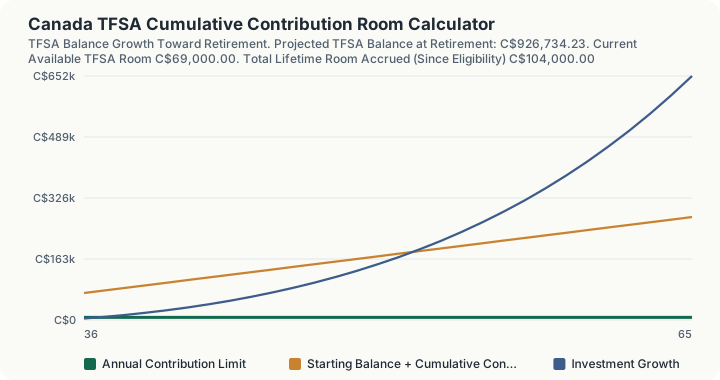
Quick Answer: Someone who turned 18 in 2010, has contributed C$40,000 to date and had C$5,000 of withdrawals in prior years has accrued C$104,000 of lifetime TFSA room, with C$69,000 available now. Contributing C$15,000 leaves C$54,000. Projected from an existing C$50,000 balance at 6% over 30 years, assuming the C$7,000 annual limit is maxed every year, the account grows to C$926,734.23, all tax-free.
Overview
A Tax-Free Savings Account (TFSA) is a registered Canadian investment account where contributions are made with already-taxed dollars -- unlike an RRSP, there is no upfront tax deduction -- but every dollar of growth, income, and withdrawal inside the account is permanently tax-free, for life, with no mandatory withdrawal age. Despite the name, a TFSA is not limited to a savings account in the "high-interest savings" sense; it can hold stocks, bonds, ETFs, mutual funds, and most other qualified investments, functioning much like a Roth IRA does in the United States.
The single hardest part of a TFSA to track by hand is cumulative contribution room. Since the account's introduction in 2009, the Canada Revenue Agency (CRA) has published a new annual dollar limit every year -- figures that have ranged from C$5,000 to a one-year outlier of C$10,000 in 2015 -- and every Canadian resident who was 18 or older in a given year accrues that year's limit as room, whether or not they had a TFSA account open yet. On top of that, any amount withdrawn from a TFSA is added BACK to your available room, but only starting January 1 of the following calendar year, not immediately -- a rule that trips up almost everyone the first time they make a withdrawal and try to re-contribute the same calendar year.
This calculator reconstructs your actual lifetime TFSA room from the year you turned 18 (or 2009, whichever is later) through 2026, nets out contributions you've already made and withdrawals from prior years, and then projects tax-free growth forward to your target age.
How This Is Calculated
Step 1 -- determine your room start year:
Room cannot accrue before the TFSA's 2009 inception, no matter how much older than 18 you were that year.
Step 2 -- sum every year's annual dollar limit from your room start year through 2026:
Someone who has been eligible for every year since 2009 has accrued exactly C$109,000 in total lifetime room, using the full published year-by-year schedule below.
| Year | Limit | Year | Limit | Year | Limit |
|---|---|---|---|---|---|
| 2009 | C$5,000 | 2015 | C$10,000 | 2021 | C$6,000 |
| 2010 | C$5,000 | 2016 | C$5,500 | 2022 | C$6,000 |
| 2011 | C$5,000 | 2017 | C$5,500 | 2023 | C$6,500 |
| 2012 | C$5,000 | 2018 | C$5,500 | 2024 | C$7,000 |
| 2013 | C$5,500 | 2019 | C$6,000 | 2025 | C$7,000 |
| 2014 | C$5,500 | 2020 | C$6,000 | 2026 | C$7,000 |
Step 3 -- net out contributions and add back prior-year withdrawals:
Step 4 -- the contribution actually modeled:
Over-contributing triggers a 1%-per-month CRA penalty tax on the excess amount for every month it remains over-contributed -- this calculator caps the modeled contribution rather than computing that separate penalty.
Step 5 -- growth projection:
The modeled contribution is added to your current balance immediately. Every subsequent year assumes you contribute the current C$7,000 annual limit again (a simplification, since the annual limit is re-indexed periodically and will very likely rise again in future years) and compounds via this platform's shared time-value-of-money solver, one ordinary-annuity year per iteration.
Worked Example
Inputs: turned 18 in 2010; C$40,000 in total contributions to date; C$5,000 in withdrawals from prior years; C$15,000 planned new contribution; current TFSA balance C$50,000; current age 35; retirement age 65; expected annual return 6%.
Step 1: Room start year.
Step 2: Total lifetime room, 2010 through 2026. Summing the annual limits from 2010 to 2026 gives C$104,000.
Step 3: Currently available room.
Step 4: Modeled contribution. The planned C$15,000 fits comfortably under the C$69,000 available, so it's modeled in full, leaving C$54,000 in remaining room.
Step 5: Growth to age 65. Starting from C$50,000 plus the C$15,000 top-up (C$65,000), and maxing out the current C$7,000 annual limit every year for 30 years at 6% growth, the account compounds to C$926,734.23 -- C$210,000 of new future contributions, C$65,000 of starting balance/top-up, and C$651,734.23 of pure tax-free investment growth that will never be taxed on withdrawal.
When the Account Starts Carrying Itself
A TFSA at C$7,000 a year looks like a slow vehicle, and for roughly fifteen years it is. Then the arithmetic changes hands.
Step 6: age 36. Cumulative growth C$3,900 on C$72,000 of capital, balance C$75,900
Step 7: age 37. Cumulative growth C$8,454 on C$79,000 of capital, balance C$87,454
Step 8: growth added in year two.
, already two thirds of the C$7,000 contribution
Step 9: age 45. Cumulative growth C$73,670.66 against C$135,000 of capital, balance C$208,670.66
Step 10: age 52, the crossover. Cumulative growth of C$188,520.39 overtakes the C$184,000 contributed, balance C$372,520.39
Step 11: age 65. Growth C$651,734.23 on C$275,000 of capital, balance C$926,734.23
Age 52 is the year the account earns more than it has ever been given. Everything after it is compounding on compounding, and by 65 growth outweighs capital by better than two to one. Because this is a TFSA rather than an RRSP, none of that C$651,734.23 is ever taxed on withdrawal and none of it consumes future contribution room, which is what makes the seventeen unremarkable years before the crossover worth sitting through.
What This Does Not Account For
- A constant future annual limit. This projection assumes the current C$7,000 limit repeats every year to retirement; in reality, CRA periodically re-indexes the limit upward (it has risen five times since 2019), so a long-horizon projection using a flat C$7,000/year likely understates future room and, if you actually max out each new higher limit, understates the final balance too.
- Multiple TFSA accounts and transfers between institutions. Room is tracked at the individual level across ALL of your TFSA accounts combined, not per-account; a direct transfer between TFSA providers (done correctly, as a transfer rather than a withdrawal-then-recontribution) does not affect room at all.
- Foreign withholding tax on U.S. dividends. Unlike an RRSP (which has a specific Canada-U.S. tax treaty exemption), a TFSA does NOT shield U.S. dividend income from the 15% U.S. non-resident withholding tax -- a commonly misunderstood limitation, not modeled here since it depends on your specific holdings.
- Excess contribution penalty tax. If your planned contribution exceeds available room, this calculator caps the modeled amount rather than calculating the 1%-per-month CRA penalty tax on the excess.
- Non-resident status. Contribution room continues to accrue for a non-resident of Canada, but contributions made while a non-resident are subject to a separate 1%-per-month tax for as long as the excess remains in the account -- not modeled here.
- Death and beneficiary/successor-holder designations. How a TFSA transfers on death (tax-free to a spousal "successor holder" versus to another beneficiary) is not modeled by this growth projection.
Common Pitfalls
- Re-contributing a withdrawal in the SAME calendar year. Withdrawn amounts are only added back to your room on January 1 of the FOLLOWING year -- contributing that same amount back before year-end, on top of your existing room, is one of the single most common ways Canadians accidentally over-contribute and trigger the CRA penalty tax.
- Assuming TFSA room is a flat number everyone shares. Because the annual limit has changed 8 times since 2009 and depends on the year you turned 18, two people the same current age can have very different lifetime room if one became eligible in, say, 2012 versus 2018.
- Forgetting non-residents still accrue (but can't cleanly use) room. Moving abroad does not stop your TFSA room from accruing, but contributions made as a non-resident face their own separate penalty tax structure.
- Confusing "room" with "contribution limit for this specific year." A TFSA does not have a single "this year's limit" the way people casually describe it -- it has a single CUMULATIVE limit built from every year's allowance since eligibility, which is exactly why late starters and long-time contributors can have very different totals.
- Ignoring the U.S. withholding-tax gap. Investors sometimes assume a TFSA shelters ALL investment income from ALL tax exactly like an RRSP does for U.S. dividends specifically -- it does not; the RRSP's treaty exemption for U.S.-source dividend withholding does not extend to TFSAs.
Frequently Asked Questions
What is the TFSA contribution limit for 2026?
How much total TFSA room do I have if I've been eligible since 2009?
Does withdrawing money from my TFSA reduce my lifetime room permanently?
Is a TFSA or an RRSP better for retirement savings?
Does TFSA income or growth ever get taxed?
Sources
- Internal Revenue Service, the official authority for the tax rules this calculator relates to. irs.gov
Also consulted: Income Tax Act (Canada), s. 146.2, "Tax-Free Savings Accounts" -- the TFSA's statutory contribution-room and withdrawal-recontribution rules; 2026 annual TFSA dollar limit of C$7,000 and the full 2009-2026 year-by-year limit history: cross-verified across Questrade, Wealthsimple, Yahoo Finance Canada, NerdWallet Canada, and multiple independent Canadian personal-finance sites, all reporting an identical sequence that sums to the widely-published C$109,000 lifetime total for anyone eligible since 2009. canada.ca's own "Calculate your TFSA contribution room" page returned an HTTP 403 to direct fetch in this session and could not be independently re-confirmed against the primary source in this pass -- cross-verify directly against canada.ca or CRA My Account before relying on this figure for a real contribution decision; CRA, general TFSA program guidance on withdrawals, over-contributions, and non-resident contribution rules.