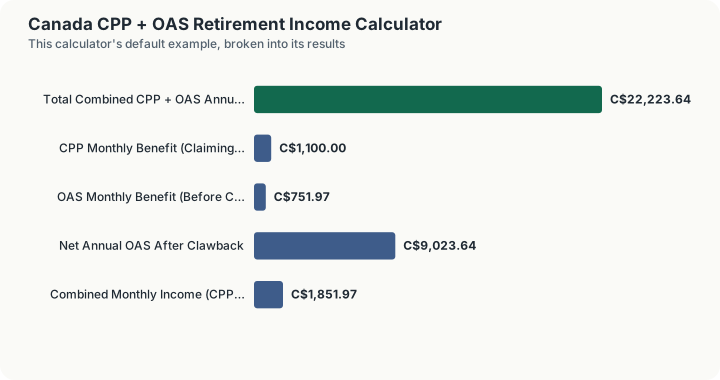
Quick Answer: A Canadian retiree with a C$1,100/month CPP estimate at 65, claiming both CPP and OAS at 65, and C$85,000 of other net income in retirement, receives C$1,851.97/month (C$22,223.64/year) combined -- with no OAS clawback, since their income sits below the C$93,454 recovery threshold. Delaying both CPP and OAS to age 70 instead raises the combined monthly total to C$2,584.68. All figures are in Canadian dollars (CAD), for Canadian residents claiming CPP and OAS.
Overview
The Canada Pension Plan (CPP) and Old Age Security (OAS) are Canada's two foundational federal retirement-income programs, and they work very differently from each other. CPP is a contributory, earnings-based pension: what you receive depends on how much and how long you contributed during your working years, and it can be claimed any time between age 60 and 70. OAS, by contrast, is a residency-based benefit funded from general tax revenue -- largely independent of your work or contribution history -- available starting at 65, with an option to defer (but never to claim early) up to age 70.
The two programs also diverge sharply once you factor in income: CPP is never reduced based on your other income, but OAS is subject to a means-tested "recovery tax," universally nicknamed the OAS clawback, that claws back 15 cents of OAS for every dollar of net income above an annually-indexed threshold -- and can eliminate the entire OAS payment for high earners.
This calculator combines both programs into a single monthly and annual retirement-income estimate: applying CPP's early/late claiming adjustment to your own benefit estimate, applying OAS's deferral increase (and the permanent age-75 bump) to the current maximum, and then running your expected retirement income through the OAS clawback formula to show your NET combined take-home from both programs.
How This Is Calculated
CPP claiming-age adjustment
CPP applies a fixed adjustment for every month you claim before or after age 65:
OAS deferral + age-75 bump
OAS cannot be claimed before 65, but deferring past 65 earns a similar (though not identical) increase:
On top of the deferral adjustment, EVERY OAS recipient gets a permanent +10% increase starting the month after they turn 75, regardless of when they originally claimed.
OAS recovery tax ("clawback")
For the payment period covering today's date (July 2026-June 2027, based on 2025 net world income), the minimum recovery threshold is C$93,454. Income above the maximum recovery threshold (roughly C$152,062 for ages 65-74, C$157,923 for 75+) results in the ENTIRE OAS payment being clawed back.
Worked Example
Inputs: C$1,100/month CPP estimate at 65; CPP and OAS both claimed at 65; current age 67; C$85,000 expected net annual income in retirement (excluding OAS).
Step 1: CPP at 65 (no adjustment).
Step 2: OAS at 65 (no deferral, not yet 75).
Step 3: OAS clawback check.
No clawback applies -- the full OAS amount is kept.
Step 4: Combined monthly income.
Alternative: delaying both CPP and OAS to age 70. CPP grows by +42% to C$1,562.00/month; OAS grows by +36% to C$1,022.68/month (still below the clawback threshold at this income level) -- a combined C$2,584.68/month, C$732.71/month more than claiming both at 65, in exchange for 5 years without either benefit.
What This Does Not Account For
- Your ACTUAL CPP entitlement. This calculator takes your own Service Canada estimate as an input; it does not calculate your CPP entitlement from a full contribution history, the Year's Maximum Pensionable Earnings (YMPE) history, or the "general drop-out" provisions that exclude your lowest-earning years.
- CPP post-retirement benefits. Continuing to work (and contribute to CPP) after starting your CPP pension generates small additional Post-Retirement Benefit amounts each year, not modeled here.
- CPP disability, survivor, or children's benefits. This calculator models only the standard retirement pension.
- Provincial income tax on CPP/OAS. Both CPP and OAS are taxable income; this calculator shows gross (pre-income-tax) benefit amounts, separate from the OAS-specific recovery tax, which is a distinct mechanism from ordinary income tax withholding.
- Guaranteed Income Supplement (GIS). GIS is a separate, additional means-tested benefit for LOW-income OAS recipients -- the opposite end of the income spectrum from the clawback modeled here -- and is not included.
- Quebec Pension Plan (QPP). Quebec residents contribute to QPP instead of CPP. QPP uses a very similar but not identical structure; this calculator's CPP figures are not a substitute for a QPP estimate.
- OAS recovery tax being based on last year's income, not this year's. In reality, the recovery tax applied to a given payment period is based on your net income from the PRIOR tax year, with any true-up handled via your tax return -- this calculator treats the input income and the recovery calculation as the same period for simplicity.
Common Pitfalls
- Assuming OAS can be claimed early like CPP. It cannot. OAS starts no earlier than 65, full stop; only deferral (up to 70) is available, unlike CPP's symmetric 60-70 range.
- Forgetting the clawback is based on ALL net income, not just work income. RRSP/RRIF withdrawals, other pensions, investment income, and even CPP itself all count toward the income figure used to calculate the OAS clawback -- a large RRIF withdrawal in one year can trigger a real, one-time OAS reduction.
- Confusing the minimum and maximum recovery thresholds. The clawback doesn't jump straight to 100% at the C$93,454 minimum threshold -- it phases in gradually at 15 cents per dollar, only reaching a full 100% clawback once income crosses the much higher maximum threshold (roughly C$152,062-C$157,923 depending on age).
- Missing the permanent age-75 OAS bump. This +10% increase applies automatically and permanently once you turn 75, regardless of your original claiming age or any deferral choice made earlier -- it's easy to underestimate late-life OAS income by forgetting this.
- Not accounting for the repayment being based on last year's tax return. The OAS clawback withheld from your CURRENT monthly payments is calculated using your net income from an EARLIER tax year, which can create a mismatch (and either an OAS "catch-up" or a tax-time reconciliation) if your income changes significantly year to year.
Frequently Asked Questions
What is the maximum CPP payment at 65 in 2026?
What is the OAS clawback threshold for 2026?
Should I take CPP at 60, 65, or 70?
Can I defer OAS the same way I can defer CPP?
Does OAS clawback apply if I have no other income besides CPP and OAS?
Sources
- Government of Canada, Canada Pension Plan retirement pension. canada.ca/en/services/benefits/publicpensions/cpp.html
- Canada Revenue Agency. canada.ca/en/revenue-agency.html
Also consulted: Canada Pension Plan (R.S.C., 1985, c. C-8) -- the statutory basis for CPP's early/late claiming adjustment factors; Old Age Security Act (R.S.C., 1985, c. O-9), Part I.1 -- the OAS recovery tax ("clawback") mechanism; 2026 CPP maximum (C$1,507.65/month) and average (C$925.35/month) monthly benefit at 65, and the C$74,600 2026 Year's Maximum Pensionable Earnings: cross-verified across Wealthsimple, lifemoney.ca, and independent CPP 2026 guides; OAS maximum monthly amounts for the Jul-Sep 2026 quarter (C$751.97 for ages 65-74, C$827.17 for 75+) and the Jul 2026-Jun 2027 recovery-tax thresholds (C$93,454 minimum; C$152,062 / C$157,923 maximum by age band): cross-verified across H&R Block Canada, Wealthsimple, and multiple independent OAS-clawback guides. canada.ca's own pension-statistics and recovery-tax pages returned an HTTP 403 to direct fetch in this session and could not be independently re-confirmed against the primary source in this pass -- cross-verify directly against canada.ca before relying on this calculator for a real claiming decision. The CPP/OAS early/late ADJUSTMENT PERCENTAGES themselves are a stable, long-standing statutory structure not re-confirmed via web search this session (the session's search budget was exhausted); included on high-confidence general knowledge, but should also be spot-checked against canada.ca.