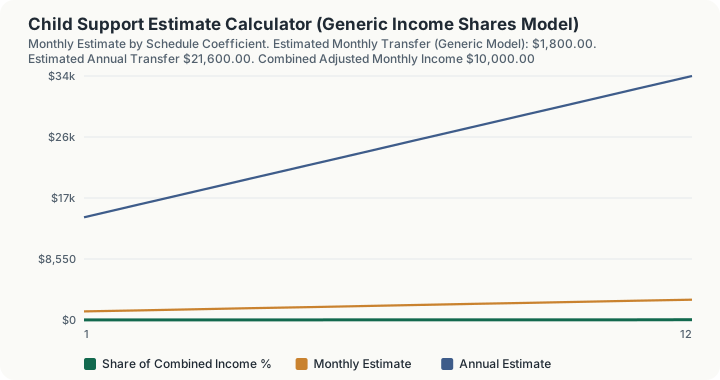
Quick Answer: A household with $4,000 and $6,000 of monthly income and 20% of overnights with the lower earner produces an estimated transfer of $1,800.00 a month, or $21,600 a year, under generic income shares arithmetic. That is not any state's guideline calculation and not a prediction of a court's order: varying the children's share of combined income from 10% to 37.5% moves it by $1,650.00.
What does this calculator do?
This calculator does not compute any state's child support order, and it is important to say that before anything else.
Every state that uses the income shares method publishes its own Basic Child Support Obligation schedule, its own rules about what counts as income and what may be deducted from it, its own parenting-time adjustment, and its own self-support reserve. None of those is encoded here and none is guessed. Every coefficient in the model is a number you supply, including the single most important one: the share of combined income treated as devoted to the children, which in a real guideline calculation is read from a published schedule that varies with income and with the number of children.
What the page can do honestly is the arithmetic that the income shares family of models has in common, at the coefficients you enter, and then show you how much the answer moves when the one coefficient it cannot know moves across a plausible range. At the defaults, that range is $1,650 a month wide on a $1,800 answer. Anyone quoting a single figure from a generic calculator as though it settles something is quoting the middle of a range that wide.
Actual orders are set by state guidelines and by a court. A court can and does deviate from the guideline figure on findings it makes about the particular family. If you need a number you can rely on, the sources for it are your state's own guideline worksheet, your state's published schedule, and a lawyer who practises family law in your jurisdiction.
With that said, the structure of the model is worth understanding, because it explains why the contested facts in a real case are contested. Overnights and income characterisation move the answer sharply, and this page lets you see by how much.
How is this calculated?
The transfer, before the parenting-time offset and the self-support cap, is:
T = (C × p + A) × I_B/(I_A + I_B)
where $C$ is combined adjusted income, $p$ is the share of it devoted to the children, $A$ is the add-on total, and I_A, I_B are the two parents' adjusted incomes. Where parent B's share of overnights exceeds the threshold you set, a cross-credit replaces that with:
T = O_B × (1 − n_B) − O_A × n_B
where O_A and O_B are each parent's pro rata share of the total obligation and n_B is parent B's share of overnights.
Step 1: Compute each parent's adjusted income. Parent A: $4,000 - $0 of deductions = $4,000 a month Parent B: $6,000 - $0 of deductions = $6,000 a month
Step 2: Sum them into combined adjusted income. $4,000 + $6,000 = $10,000 a month
Step 3: Compute each parent's share of that combined figure. $6,000 / $10,000 = 60.00% for parent B, and 40.00% for parent A
Step 4: Apply the share of combined income you supplied to get the basic obligation. $10,000 x 20% = $2,000 a month This is the step a real guideline replaces with a schedule lookup. The engine performs a multiplication; it consults nothing.
Step 5: Total the add-ons. $800 childcare + $200 children's health premium + $0 other = $1,000 a month
Step 6: Add them to the basic obligation. $2,000 + $1,000 = $3,000 a month total obligation for the children
Step 7: Take parent B's pro rata share of that total. $3,000 x 60.00% = $1,800 a month
Step 8: Test the parenting-time threshold. Parent B has 20% of overnights against a 30% threshold, so 20% is not above the threshold and no offset is applied. The parenting-time credit is $0.
Step 9: Apply the self-support reserve cap. Parent B's capacity is $6,000 - $1,200 = $4,800, which is above $1,800, so the cap does not bind: $1,800 a month
Step 10: Express it annually and as a share of the payer's income. $1,800 x 12 = $21,600 a year $1,800 / $6,000 = 30.00% of parent B's adjusted income
Worked Example
The sensitivity to the schedule coefficient is what this page exists to show, so the worked example varies that one input and holds everything else fixed.
Step 1: Run the model at a 10% coefficient. $10,000 x 10% = $1,000 basic obligation $1,000 + $1,000 add-ons = $2,000 total $2,000 x 60.00% = $1,200.00 a month
Step 2: Run it at 20%, the default. $10,000 x 20% = $2,000 basic $2,000 + $1,000 = $3,000 total $3,000 x 60.00% = $1,800.00 a month
Step 3: Run it at 37.5%, the top of the table. $10,000 x 37.5% = $3,750 basic $3,750 + $1,000 = $4,750 total $4,750 x 60.00% = $2,850.00 a month
Step 4: Measure the spread. $2,850.00 - $1,200.00 = $1,650.00 a month, which is $19,800 a year
Step 5: Put that beside the headline. The spread is 91.7% of the $1,800 headline figure. The number this engine cannot know is larger than most of the numbers it can.
Now hold the coefficient at 20% and vary overnights instead. At 40% of overnights, above the 30% threshold, the cross-credit applies: parent B's obligation of $1,800 is charged only for the 60% of time the children are with parent A, and parent B is credited with parent A's $1,200 obligation for the 40% of time they are with parent B. That is $1,800 x 0.60 minus $1,200 x 0.40, or $1,080 - $480 = $600 a month, a two-thirds reduction from a change in a single contested fact.
What does this calculator not account for?
- Any state's Basic Child Support Obligation schedule. The share of combined income devoted to the children is your input, not a lookup. This is the largest single omission and it is deliberate.
- What counts as income in your jurisdiction, which varies on overtime, bonuses, self-employment, imputed income for a voluntarily unemployed parent, and benefits.
- Which deductions are allowed before the shares are struck. The engine subtracts whatever you enter and knows nothing about whether your state permits it.
- The number of children. Real schedules scale with it. Here it is folded into the single percentage you supply.
- Where the parenting-time threshold sits, or whether one exists. Some guidelines have no threshold and adjust continuously; some have a sharp step; some have none at all.
- The form of the self-support reserve, which in several states is a graduated low-income adjustment rather than a flat floor.
- Tax treatment. Child support is neither deductible by the payer nor taxable to the recipient, and the dependency exemption, the child tax credit and head of household filing status are not allocated here.
- Uninsured medical expenses, college costs, life insurance requirements, and arrears, all of which real orders address separately.
- Judicial deviation. A court may depart from the guideline figure entirely on findings about the family.
What mistakes do people make with this?
- Quoting the headline as though it were a state figure. It is arithmetic at coefficients you chose. The output on this page says so in words for exactly this reason.
- Guessing the schedule percentage. If you do not have your state's schedule, you do not have the answer, and the table on this page shows the size of what you are missing.
- Entering gross income where the jurisdiction uses net, or the reverse. The two produce materially different combined figures and therefore different shares.
- Counting the whole family health premium instead of the children's portion. Most guidelines want only the incremental cost of covering the children.
- Treating overnights as settled. They are frequently the most contested number in a case, and above the threshold they move the answer sharply. The 40% scenario above cuts the transfer by two thirds.
- Adding childcare that would be paid anyway. Most guidelines contemplate work-related childcare, not all childcare.
- Assuming the self-support reserve is irrelevant because it does not bind here. Lower the payer's income and it becomes the entire answer.
Frequently Asked Questions
Does this calculator give me my state's child support amount?
Why does the estimate change so much when I change one percentage?
What is the income shares model?
How do overnights change child support?
What is a self-support reserve?
Can a court order something different from the guideline figure?
Sources
- Office of Child Support Services, U.S. Administration for Children and Families. acf.hhs.gov/css
Also consulted: There is no single federal authority for child support amounts, and no national schedule exists. Each state publishes its own guideline, schedule and worksheet, and this engine reproduces none of them; The federal requirement that each state establish guidelines, review them at least once every four years, and treat the guideline amount as rebuttably correct is at 45 C.F.R. 302.56. Your own state's guideline worksheet and schedule are the authority for any figure you intend to rely on; Every dollar figure this page produces comes from coefficients entered by the user. No figure on this page is sourced from any authority, because for this calculation none is available in a form the engine could apply generically.