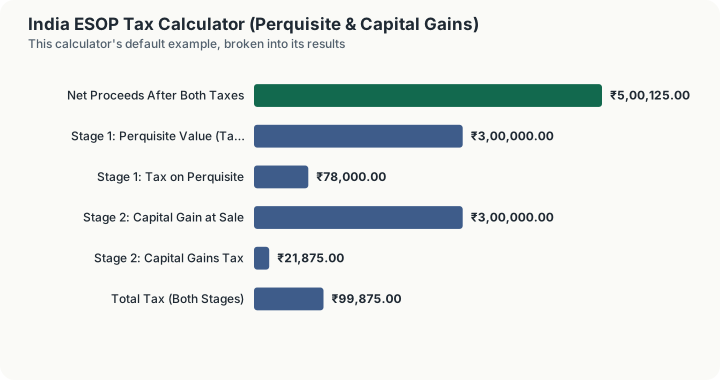
Quick Answer: An employee exercising 1,000 ESOP shares at ₹200 (FMV ₹500 at exercise), stacked on ₹10,00,000 of other income under the new regime, owes ₹78,000 in perquisite tax at exercise. Selling those shares 18 months later at ₹800 on a listed exchange adds ₹21,875 in long-term capital gains tax, for ₹99,875 total tax across both stages -- leaving ₹5,00,125 in net proceeds after the exercise outlay and both tax bills.
Overview
Employee Stock Options are taxed in India at two entirely separate points, and conflating them is the single most common ESOP tax mistake. Stage 1, at exercise: the difference between the fair market value of the shares and what you actually paid to exercise is taxed immediately as a perquisite -- ordinary salary income -- even though you haven't sold anything and may not have any cash from the transaction at all (the classic "phantom income" problem). Stage 2, at eventual sale: you owe capital gains tax on the difference between your sale price and the FMV at exercise -- not your original exercise price -- because Section 49(2AA) gives you a "step-up" cost basis equal to what was already taxed as perquisite, specifically to prevent double taxation of the same appreciation.
This calculator walks through both stages precisely for FY2025-26: the perquisite tax computed by stacking the perquisite value onto your other income at your real marginal rate, and the capital gains tax using the correct short-term/long-term threshold and rate for listed versus unlisted shares under the post-Budget-2024 capital gains regime.
How This Is Calculated
Stage 1 -- Perquisite tax (Section 17(2)(vi)), at exercise:
This is added to your other salary/taxable income and taxed at your marginal rate for the year -- computed here by running this platform's verified FY2025-26 tax engine twice: once on your other income alone, once with the perquisite stacked on top, so the incremental tax reflects exactly how many brackets it spans.
Stage 2 -- Capital gains tax, at sale:
The holding period (exercise date to sale date) determines the rate: listed shares (Securities Transaction Tax paid) use a 12-month long-term threshold, with long-term gains taxed at 12.5% above a ₹1,25,000/year exemption and short-term gains at a flat 20%. Unlisted shares use a 24-month long-term threshold, with long-term gains taxed at 12.5% with no indexation and no exemption, and short-term gains taxed at your ordinary slab rate.
Worked Example
Using the calculator's default inputs:
- Shares Exercised: 1,000; Exercise Price: ₹200/share; FMV at Exercise: ₹500/share
- Other Annual Taxable Income: ₹10,00,000, new regime
- Sale Price: ₹800/share, Holding Period: 18 months, Listed: Yes
Stage 1 (Exercise): 1. Perquisite value: (₹500 − ₹200) × 1,000 = ₹3,00,000, taxed as salary. 2. Tax on ₹10,00,000 alone: within the ₹12,00,000 rebate threshold → ₹0. 3. Tax on ₹13,00,000 (with perquisite stacked on): ₹75,000 before rebate, no rebate since income exceeds the threshold by more than the tax; cess 4% → ₹78,000. 4. Perquisite tax: ₹78,000 − ₹0 = ₹78,000.
Stage 2 (Sale, 18 months later): 1. Cost basis: ₹500/share × 1,000 = ₹5,00,000. Sale value: ₹800/share × 1,000 = ₹8,00,000. 2. Capital gain: ₹8,00,000 − ₹5,00,000 = ₹3,00,000. 3. 18 months exceeds the 12-month listed-share threshold → long-term. Remaining ₹1,25,000 exemption (none used elsewhere) applies: taxable gain = ₹3,00,000 − ₹1,25,000 = ₹1,75,000. 4. Capital gains tax: ₹1,75,000 × 12.5% = ₹21,875.
Total tax across both stages: ₹78,000 + ₹21,875 = ₹99,875. Net proceeds: ₹8,00,000 (sale) − ₹2,00,000 (exercise outlay) − ₹99,875 (both taxes) = ₹5,00,125.
Selling the same shares after only 6 months instead pushes the gain into short-term territory, taxed at a flat 20% with no exemption -- ₹60,000 instead of ₹21,875, a meaningful difference that rewards holding past the 12-month listed-share threshold.
What This Does Not Account For
- TDS deferral for eligible start-up ESOPs (Section 192(1C)). Employees of a DPIIT-recognized, Section 80-IAC-certified eligible start-up can defer TDS on the perquisite to the earliest of 48 months from the end of the relevant assessment year, the date of sale, or the date employment ends -- this calculator computes the tax liability itself, not this deferral timing.
- Foreign ESOP/RSU reporting requirements, such as Schedule FA foreign asset disclosure, applicable if the issuing company is a foreign parent -- a common scenario for Indian employees of multinational subsidiaries.
- RSUs (Restricted Stock Units) with no exercise price, which follow a similar but not identical mechanism (no "exercise price" to subtract, since RSUs typically vest with a nominal or zero cost).
- Multiple tranches exercised at different FMVs over time, which each require this two-stage calculation applied separately per tranche/vesting date.
- Employer-side TDS actually withheld, which may not precisely match the perquisite tax computed here if the employer used a simplified withholding estimate.
Common Pitfalls
- Being caught off-guard by "phantom income" tax at exercise. The perquisite tax is due in the year of exercise regardless of whether you've sold any shares or received any cash -- a genuinely common cash-flow trap for employees of pre-IPO companies exercising unlisted-share options.
- Using the exercise price instead of the FMV at exercise as the cost basis for capital gains. Section 49(2AA)'s step-up rule means your cost basis for capital gains is the FMV already taxed as perquisite, not what you originally paid to exercise -- using the wrong figure double-counts (or under-counts) the taxable gain.
- Missing the 12-month vs. 24-month long-term threshold distinction. Listed and unlisted shares use different holding-period thresholds for long-term classification -- applying the listed 12-month rule to unlisted shares (or vice versa) misclassifies the gain and applies the wrong rate.
- Forgetting the ₹1,25,000 LTCG exemption is a single aggregate limit per year, shared across all your listed-equity long-term gains, not a fresh allowance per transaction or per company.
- Not accounting for the perquisite pushing you into a higher marginal bracket. Because the perquisite stacks on top of other income, its true marginal tax cost can be meaningfully higher than your average tax rate -- this calculator's incremental method captures that correctly.
Frequently Asked Questions
When exactly is ESOP tax due -- at vesting, exercise, or sale?
Why do I owe tax at exercise if I haven't sold any shares or received cash?
Is ESOP perquisite value based on the exercise date or the vesting date?
What is the current long-term capital gains rate for ESOP shares sold on a stock exchange?
Do startup employees get any relief on the perquisite tax timing?
Does this calculator apply to RSUs the same way as ESOPs?
Sources
- Section 17(2)(vi), Income-tax Act, 1961 (ESOP perquisite taxation). incometax.gov.in/iec/foportal
Also consulted: Rule 3(8) and 3(9), Income Tax Rules, 1962 (FMV determination for listed and unlisted shares); Section 49(2AA), Income-tax Act, 1961 (step-up cost basis for capital gains); Section 192(1C), Income-tax Act, 1961 (TDS deferral for eligible start-up ESOPs); Finance (No. 2) Act, 2024 (capital gains rate changes effective 23 July 2024, unchanged through FY2025-26).