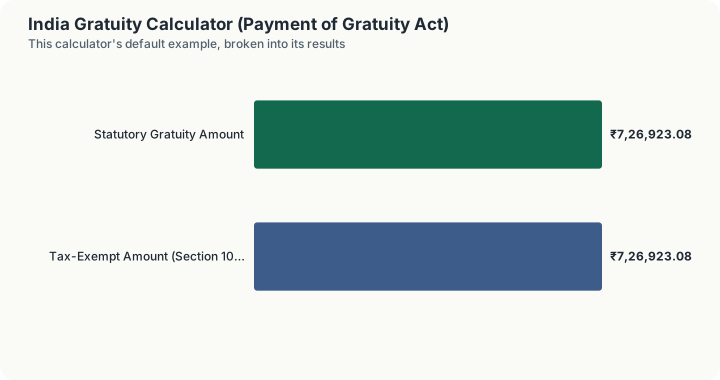
Quick Answer: An employee covered by the Payment of Gratuity Act, 1972, with a last-drawn monthly salary of ₹60,000 and 20 years 7 months of service (rounded up to 21 years), is statutorily entitled to ₹7,26,923.08 in gratuity -- and since that falls below the ₹20,00,000 exemption ceiling, the entire amount is tax-free under Section 10(10).
Overview
Gratuity is a lump-sum payment employers make to employees who complete at least 5 years of continuous service, on retirement, resignation, or (with the service requirement waived) death or disablement. Two separate rules govern it: the Payment of Gratuity Act, 1972, which fixes exactly how much gratuity an eligible employee is owed, and Section 10(10) of the Income Tax Act, which determines how much of that payout is actually tax-free. These are frequently confused -- the Gratuity Act sets the entitlement, while Section 10(10) separately caps the tax exemption, and the two numbers only match up when the entitlement falls under the exemption ceiling.
This calculator computes the exact statutory gratuity amount using the Act's 15/26 formula (correctly rounding a part-year of service that exceeds 6 months up to a full year, per the Act's own text), then applies the Section 10(10) exemption test against the current ₹20,00,000 ceiling -- telling you precisely how much of your gratuity is tax-free and how much, if any, gets added to your taxable income.
How This Is Calculated
Step 1 -- Statutory gratuity amount (Section 4(2), Payment of Gratuity Act):
The divisor 26 represents the standard days-in-a-month convention the Act uses for a monthly-rated employee. Critically, "years of service" is rounded: any part-year of service in excess of 6 months rounds up to a full year (so 7 months rounds up; exactly 6 months or fewer does not).
Step 2 -- Section 10(10) exemption, for employees covered by the Act and not employed by the government:
Government employees skip this test entirely: Section 10(10)(i) exempts their gratuity in full, with no ceiling at all. Both the entitlement formula and the tax exemption are available regardless of whether you file under the old or new tax regime -- Section 10(10) sits in Chapter III, unaffected by the new regime's Chapter VI-A restrictions.
Worked Example
Using the calculator's default inputs:
- Last Drawn Monthly Salary (Basic + DA): ₹60,000
- Completed Years of Service: 20 years, plus 7 additional months
- Covered by the Payment of Gratuity Act: Yes
- Government Employee: No
Step by step:
- 7 months exceeds the 6-month threshold, so service rounds up: 20 years → 21 years.
- Statutory gratuity: ₹60,000 × 15 ÷ 26 × 21 = ₹7,26,923.08.
- Section 10(10) exemption test: least of (actual received, ₹20,00,000 ceiling, ₹7,26,923.08 formula amount) = ₹7,26,923.08 -- the formula amount itself is below the ceiling, so it is fully exempt.
- Taxable gratuity: ₹0.
Now compare a higher earner: ₹2,00,000 last-drawn monthly salary and exactly 30 years of service (no rounding, since there are no additional months). Statutory gratuity: ₹2,00,000 × 15 ÷ 26 × 30 = ₹34,61,538.46 -- well above the ₹20,00,000 ceiling. Here the exemption caps at ₹20,00,000, leaving ₹14,61,538.46 taxable as salary income in the year of receipt.
What This Does Not Account For
- The 15/30 formula sometimes used by employers not covered by the Act. There is no single statutory 15/30 formula in the Payment of Gratuity Act itself for non-covered establishments -- any gratuity paid there is a matter of employer policy/contract, not law, and this calculator's "not covered" option uses a common market convention (15/30) rather than a specific statutory rule.
- Seasonal establishments, which the Act treats separately (7 days' wages per season of employment, not the standard 15/26 formula).
- Piece-rated employees, whose daily wage for this formula is based on the average of total wages earned over the 3 months immediately preceding termination, not a fixed monthly rate.
- Multiple gratuity payouts across a career. The ₹20,00,000 Section 10(10) ceiling is a lifetime aggregate limit across all employers, not a per-employer allowance -- a prior gratuity exemption already claimed reduces the ceiling available now.
- Death or disablement cases, where the 5-year minimum service requirement is waived -- this calculator assumes a standard retirement/resignation scenario with the service-length inputs you provide directly.
Common Pitfalls
- Assuming the entire gratuity payout is automatically tax-free. It is only fully exempt while the formula amount (and actual amount received) stays under the ₹20,00,000 ceiling -- high earners with long service routinely exceed it.
- Getting the 6-month rounding rule backwards. Only a part-year exceeding 6 months rounds up; exactly 6 months (or fewer) does not round up at all, a distinction that changes the final number meaningfully for borderline cases.
- Confusing the Gratuity Act's entitlement formula with the Income Tax Act's exemption ceiling. They are two separate rules -- you can be entitled to more gratuity than the amount that ends up tax-free.
- Not knowing the ceiling was raised in 2018. The ₹20,00,000 figure replaced an older ₹10,00,000 ceiling effective 29 March 2018 -- using the outdated figure understates the exemption for anyone still referencing pre-2018 material.
- Treating PSU employment as "government employment" for the purposes of the fully-exempt Section 10(10)(i) treatment -- PSU employees are generally treated as non-government employees for gratuity exemption purposes, subject to the ₹20,00,000 ceiling like any other non-government employee.
Frequently Asked Questions
Is gratuity taxable in India?
What is the minimum service required to receive gratuity?
How is the 15/26 gratuity formula calculated?
What is the current tax-free gratuity limit?
Does the exemption limit apply per job or over my whole career?
Is gratuity exemption available under the new tax regime?
Can my employer pay me more gratuity than the statutory 15/26 formula amount?
Does gratuity get taxed differently if I resign versus if I am terminated?
Sources
- Section 10(10), Income-tax Act, 1961 (tax exemption on gratuity, government vs. non-government treatment). incometax.gov.in/iec/foportal
Also consulted: Section 4, Payment of Gratuity Act, 1972 (formula, rounding rule, and the ₹20,00,000 ceiling as amended by the Payment of Gratuity (Amendment) Act, 2018, and Ministry of Labour & Employment Notification S.O. 1420(E), dated 29 March 2018).