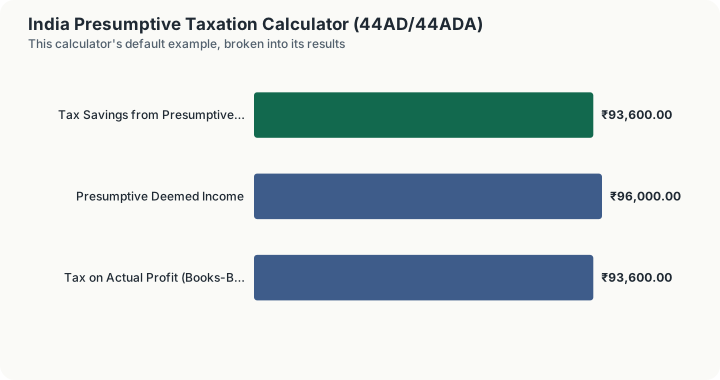
Quick Answer: A small business with ₹15,00,000 turnover (₹12,00,000 digital + ₹3,00,000 cash) and ₹14,00,000 actual profit as per books saves ₹93,600 in tax by opting for the Section 44AD presumptive scheme (deemed income just ₹96,000, taxed at ₹0) instead of paying tax on the full ₹14,00,000 actual profit (₹93,600 tax).
Overview
Sections 44AD and 44ADA let small businesses and specified professionals skip maintaining detailed books of account and instead declare a flat, deemed percentage of turnover as taxable income -- 6-8% for eligible businesses under Section 44AD, or a flat 50% for specified professionals (lawyers, doctors, engineers, architects, accountants, and a few CBDT-notified others) under Section 44ADA. The trade-off: once you opt in, you cannot separately claim any business expense deduction -- the deemed percentage is treated as already net of all expenses -- and if your real profit margin is thinner than the deemed rate, the actual-books route can leave you paying less tax.
This calculator checks your eligibility against the correct turnover/receipts threshold for FY2025-26 (including the enhanced threshold available when cash receipts stay at or below 5% of the total), computes your deemed presumptive income, and directly compares the resulting tax liability against what you would owe on your actual books-based profit -- so you can see which route genuinely costs less.
How This Is Calculated
Section 44AD (eligible businesses):
Eligibility threshold: ₹2 crore turnover, enhanced to ₹3 crore if cash receipts do not exceed 5% of total turnover. Eligible taxpayers: resident individuals, HUFs, and partnership firms (excluding LLPs) -- professionals and commission/brokerage-based businesses are excluded from 44AD entirely.
Section 44ADA (specified professionals):
Eligibility threshold: ₹50 lakh, enhanced to ₹75 lakh under the same 5%-cash-receipts condition. Eligible taxpayers: resident individuals and resident partnership firms (excluding LLPs) only -- HUFs are not eligible for 44ADA, a distinction from 44AD.
Tax comparison: the calculator computes total tax liability (via this platform's verified FY2025-26 tax engine) on the deemed presumptive income versus on your entered actual-books profit, both stacked with any other taxable income you enter, and reports which route produces the lower tax bill.
Worked Example
Presumptive taxation is decided by two thresholds -- the turnover ceiling, and the 5% cash test that moves that ceiling -- so the arithmetic below runs a base case and then walks both lines.
Base case: a small business under Section 44AD
Turnover ₹15,00,000, of which ₹12,00,000 arrived digitally and ₹3,00,000 in cash. Actual profit on the books is ₹14,00,000. New regime, under 60.
Step 1 -- The cash fraction. ₹3,00,000 / ₹15,00,000 = 20%
Step 2 -- Which turnover ceiling applies. 20% is above the 5% test, so the base ceiling applies: ₹2,00,00,000
Step 3 -- Eligibility. ₹15,00,000 is far below ₹2,00,00,000, so the business is Eligible
Step 4 -- Deemed income on the digital portion. ₹12,00,000 × 6% = ₹72,000
Step 5 -- Deemed income on the cash portion. ₹3,00,000 × 8% = ₹24,000
Step 6 -- Total deemed income. ₹72,000 + ₹24,000 = ₹96,000
Step 7 -- Tax on the deemed income. ₹96,000 sits entirely inside the 0% slab, so the presumptive tax is ₹0
Step 8 -- Tax on the actual ₹14,00,000 book profit. ₹93,600
Step 9 -- The difference. ₹93,600 - ₹0 = ₹93,600 saved by electing the presumptive scheme
The scheme is not a discount on real profit; it substitutes a statutory fiction for it. A business genuinely earning a 93% margin is taxed as though it earned 6.4%, and that is the whole design. The corollary is uncomfortable and worth stating: a business with a real margin below the deemed rate pays tax on profit it never made.
Threshold one: the 5% cash test on a profession
A consultant under Section 44ADA with ₹50,00,000 of gross receipts.
Step 10 -- Receipts of ₹50,00,000 with ₹30,00,000 in cash. Cash fraction 60%, so the base ceiling of ₹50,00,000 applies, and receipts exactly at the line are Eligible Deemed income: ₹50,00,000 × 50% = ₹25,00,000 Presumptive tax: ₹3,43,200, against ₹4,99,200 on the ₹30,00,000 book profit
Step 11 -- One rupee more, ₹50,00,001, cash unchanged. Ceiling still ₹50,00,000, receipts now exceed it: Not Eligible
Step 12 -- The same ₹50,00,001 with only ₹2,00,000 taken in cash. Cash fraction: ₹2,00,000 / ₹50,00,001 = 4.0%, at or under the 5% test Ceiling rises to ₹75,00,000, and the practice is Eligible again
Steps 11 and 12 are the discontinuity most professionals actually run into. Nothing about the size of the practice changed between them. The payment mix did, and it moved the ceiling by ₹25,00,000. A practice near ₹50 lakh has a direct financial interest in keeping cash receipts under a twentieth of the total.
Threshold two: the 44AD business ceiling
Step 13 -- Turnover ₹2,00,00,000 with ₹10,00,000 in cash. Cash fraction 5.0%, which satisfies the test, so the ceiling is ₹3,00,00,000 and the business is Eligible Deemed income: (₹1,90,00,000 × 6%) + (₹10,00,000 × 8%) = ₹12,20,000 Presumptive tax: ₹20,800, against ₹2,08,000 on a ₹20,00,000 book profit, a saving of ₹1,87,200
Step 14 -- The same turnover with the cash share nudged down. Cash of ₹9,00,000 against ₹2,00,00,001 of turnover shifts ₹1,00,000 from the 8% rate to the 6% rate Deemed income: ₹12,18,000, presumptive tax ₹18,720, saving ₹1,89,280
Step 14 is the smaller of the two effects but it runs continuously rather than at a cliff: every rupee moved from cash to a banking mode is taxed at 6% instead of 8% under 44AD. Note that the eligibility flag reported in steps 11 and 12 is informational -- this calculator still shows the presumptive comparison for an ineligible taxpayer rather than blocking it, so read the eligibility line before acting on the recommendation.
What This Does Not Account For
- Enforcement of the eligibility result. The eligibility line is reported but not enforced: if turnover exceeds the applicable ceiling, this calculator still computes and compares a presumptive figure rather than withholding the comparison. Read the eligibility status before acting on the recommendation.
- The 5-assessment-year lock-out (Section 44AD(4)/(5)). If you use 44AD one year and then report profit not in accordance with it in any of the next 5 assessment years, you lose eligibility to use 44AD for 5 years afterward, and must maintain full books and get them audited if your income exceeds the basic exemption limit during that period. This calculator does not track multi-year history.
- GST or other indirect tax implications of your turnover figures, which are entirely separate from this income-tax computation.
- Partial-year eligibility or a mid-year switch between the presumptive scheme and actual-books taxation.
- The single-installment advance tax rule for 44AD/44ADA taxpayers, who must pay 100% of their advance tax liability by 15 March in one installment rather than the standard four-date schedule -- see the Advance Tax Calculator for the standard schedule that does not apply to presumptive-scheme taxpayers.
- Depreciation and other book adjustments that would normally reduce actual taxable profit under the regular (non-presumptive) computation -- this calculator takes your "actual profit as per books" figure as already final.
Common Pitfalls
- Assuming the presumptive scheme is always the cheaper option. It genuinely depends on your real profit margin relative to the deemed 6-8% (44AD) or 50% (44ADA) rate -- a high-margin consultant with expenses well below 50% of receipts, for example, might pay less tax on actual profit than under 44ADA's flat 50% assumption.
- Missing the enhanced threshold's exact condition. The higher ₹3 crore (44AD) or ₹75 lakh (44ADA) threshold applies only if cash receipts stay at or below 5% of total turnover/receipts -- a business at 6% cash falls back to the lower base threshold entirely, not a prorated one.
- Believing HUFs qualify for 44ADA. They do not -- 44ADA eligibility (post Finance Act 2021) is limited to resident individuals and resident partnership firms other than LLPs; HUFs remain eligible for 44AD (if it's a business, not a specified profession) but not 44ADA.
- Opting out casually without understanding the 5-year lock-out. Declaring a lower profit than the deemed percentage in a later year (without maintaining books to justify it) triggers a genuine 5-assessment-year loss of eligibility, not just a one-year exception.
- Forgetting that presumptive income is deemed net of ALL expenses. You cannot separately deduct depreciation, salaries, rent, or any other business expense on top of the deemed percentage -- if your actual expenses are unusually high, the presumptive scheme may overstate your real tax base.
Frequently Asked Questions
What percentage of income is taxable under presumptive taxation?
What is the turnover limit for presumptive taxation in FY2025-26?
Can I claim business expenses if I opt for the presumptive scheme?
What happens if I stop using 44AD after using it for one year?
Are HUFs eligible for the 44ADA presumptive scheme for professionals?
Is presumptive taxation always the better option?
Sources
- Section 44AD, Income-tax Act, 1961, including the Finance Act 2023 enhanced-threshold amendment (effective AY2024-25). incometax.gov.in/iec/foportal
Also consulted: Section 44ADA, Income-tax Act, 1961, including the Finance Act 2021 eligibility restriction (excluding HUFs) and the Finance Act 2023 enhanced-threshold amendment; Section 44AA(1), Income-tax Act, 1961 (list of specified professions eligible for Section 44ADA).