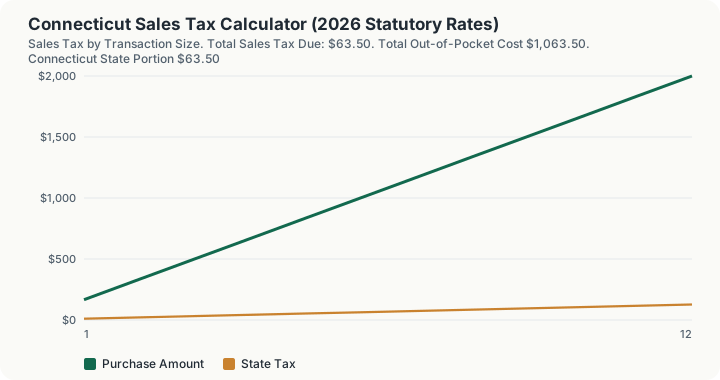
Quick Answer: A $1,000 taxable purchase in Connecticut costs $63.50 in combined state and local sales tax, for a total of $1,063.50 out the door.
Connecticut's Single Statewide Rate
Retailers doing business in Connecticut collect sales tax in two pieces at once: the state's 6.35% statutory rate, and whatever the local jurisdiction adds on top. Cities and counties in Connecticut are not permitted to stack a local option sales tax on top of that state rate, so the 6.35% figure is close to what most shoppers actually see added at the register, with little variation from one storefront to the next.
Getting that combined figure wrong, even by a fraction of a percentage point, creates exposure at audit time, since the state and any local taxing authority both expect their share to be collected and remitted correctly. That leaves Connecticut a bit below the roughly 7.3% average combined rate seen across the states that levy a general sales tax. New sellers registering to collect tax in Connecticut for the first time typically need the state-level number to open an account with the revenue department, and the local add-on on top of it to actually invoice customers correctly from day one.
How This Is Calculated
Connecticut is one of the simplest sales tax states to compute: a single statewide rate of 6.35% with no municipal or county add-on anywhere in the state. The local component is zero, so an address in Greenwich and an address in Hartford face exactly the same rate and a $1,000 purchase produces $63.50 of tax regardless of where in Connecticut it happens. The complexity in Connecticut sits elsewhere, in a handful of special rates on specific categories such as luxury goods, prepared meals and short-term vehicle rentals, rather than in geography.
With no local layer, the combined rate is just the state rate:
The calculator runs these steps:
- Read the purchase price. The full pre-tax amount you enter becomes the taxable base.
- No item-level exemption filtering. Connecticut exempts groceries, prescription drugs and most clothing under a threshold, and it charges surcharge rates on certain categories. Neither adjustment is applied here.
- Multiply by the state rate. This produces the state portion of the bill.
- Apply the local surcharge. It is zero. Toggling the local surcharge on or off does not change a Connecticut result.
- Add the pieces together. State tax plus local tax gives the total tax, and adding that to the purchase price gives the amount you actually pay.
Worked Example
For a $1,000 taxable purchase in Connecticut:
- Starting purchase price. The buyer rings up a $1,000.00 taxable retail purchase in Connecticut, the baseline amount before any tax is applied.
- State portion. Connecticut's statutory state sales tax rate of 6.35% applies to the full purchase amount: $1,000.00 × 6.35% = $63.50 owed to the state.
- Local portion. Local municipal, county, and special-district surcharges add an average of 0.00% on top of that: $1,000.00 × 0.00% = $0.00 more.
- Combined tax due. Summing the two pieces, $63.50 in state tax plus $0.00 in local surcharge comes to $63.50 in total sales tax owed on the transaction.
- Total out-of-pocket cost. Adding that $63.50 in tax to the $1,000.00 purchase price brings the buyer's total out-of-pocket cost to $1,063.50.
This example uses Connecticut's statewide average local rate of 0.00%; actual combined rates vary by city and county, so a real receipt could show a combined rate above or below the 6.35% average used here.
Where the Local Surcharge Toggle Does Nothing
Connecticut is one of the few sales tax states where the local rate in this engine's table is exactly zero. Turning the "include average local surcharge" toggle off changes nothing: the engine returns $63.50 of tax and $1,063.50 out the door either way, because there is no municipal layer to remove. On the Georgia or Florida version of this page the same toggle moves the answer. Here it is inert, and that is a correct reflection of Connecticut law rather than a gap in the data.
Two rungs of the tier schedule. Row 5 rings up $833.33 and returns $52.92 of tax. Row 6, the $1,000 baseline, returns $63.50. The $166.67 between the rungs carries $10.58 of tax, which works out to $6.35 for every $100 of taxable purchase. That figure holds at every rung: row 12 doubles the baseline to $2,000.00 and returns exactly $127.00.
Working backwards from a fixed budget. The more useful question for a shopper is the reverse one: with $1,000 to spend all-in, what price tag can the item carry? Enter $940.29 and the engine returns $59.71 of tax and a total of exactly $1,000.00. That is the tax-inclusive extraction, and it is not the same operation as taking 6.35% off $1,000.
Pricing the wrong method. Subtracting the rate from the gross is the standard error. Take 6.35% off $1,000.00 and you get $936.50; run that through the engine and it returns $59.47 of tax for a total of $995.97. You have left $4.03 of your budget unspent and quoted yourself a ceiling $3.79 below the real one. The gap widens with the transaction: on a $25,000 purchase Connecticut charges $1,587.50, so the same subtraction error scales to roughly a hundred dollars of mispriced headroom.
What the base excludes, and what this page cannot see. The engine applies 6.35% to whatever figure you enter, with no item-level logic anywhere in the path. Connecticut exempts most unprepared groceries and prescription drugs outright, and it charges a higher 7.75% luxury rate on motor vehicles over $50,000, jewellery over $5,000 and certain apparel, plus a 1% surcharge on prepared meals. None of those alternate rates exists in this calculator: enter a $60,000 car and it will return the standard 6.35%, understating the actual Connecticut liability. The 6.35% figure is right for general tangible personal property and nothing else.
What This Does Not Account For
- Statutory exemptions on unprepared groceries, prescription medications, or manufacturing equipment.
- Special industry excise taxes (lodging hotel taxes, vehicle rental fees, alcohol/tobacco excise).
- Use tax compliance on out-of-state untaxed online purchases.
- B2B resale certificate exemptions or direct pay permit programs.
Common Pitfalls
- Confusing State and Combined Rates: Quoting the state base rate without factoring in local city and county add-on taxes.
- Overlooking Consumer Use Tax: Failing to self-report and remit use tax on untaxed out-of-state purchases on your state income tax return.
- Missing Annual Sales Tax Holidays: Many states offer annual tax-free weekends for back-to-school items, severe weather supplies, or energy-efficient appliances.
- Failing to Collect Resale Certificates: Selling wholesale without collecting valid exemption certificates exposes sellers to full sales tax liability upon audit.
Frequently Asked Questions
What is the sales tax rate in Connecticut?
Are groceries taxed in Connecticut?
How does use tax differ from sales tax?
Are digital goods and SaaS taxable in Connecticut?
Sources
- Connecticut Department of Revenue Services: 2026 Sales and Use Tax Rate Schedules. portal.ct.gov/drs
- Streamlined Sales Tax Governing Board (SSTGB): State Taxability Matrix. streamlinedsalestax.org/for-businesses/taxability-matrix