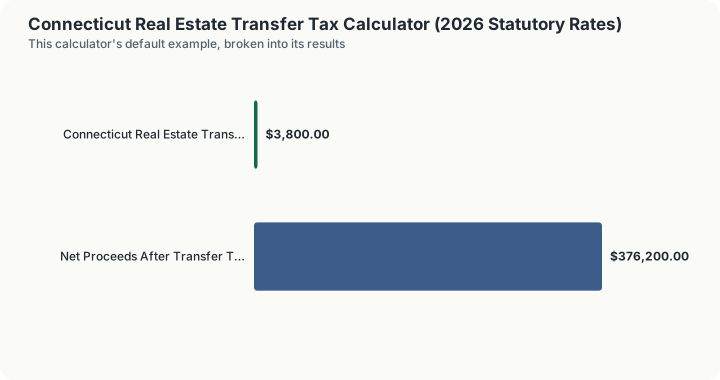
Quick Answer: A $380,000 home sale in Connecticut owes $3,800.00 in combined state conveyance tax and municipal tax, an effective 1% blended rate driven by marginal state brackets plus a flat municipal component.
Overview
Connecticut's state conveyance tax, under Gen. Stat. Section 12-494, is a genuine marginal bracket system on residential property: 0.75% on the portion of the sale price up to $800,000, 1.25% on the portion from $800,000 to $2.5 million, and 2.25% on anything above that. Each bracket applies only to the slice of price within it, the same marginal logic used for income tax brackets, so a $3 million sale is not taxed at 2.25% across the board.
On top of the state brackets, every Connecticut municipality imposes its own base conveyance tax, typically 0.25% of the sale price, and 19 designated municipalities are authorized to charge up to double that local rate. The conveyance tax is customarily paid by the seller at closing, consistent with how Section 12-494 structures the obligation, though the purchase contract can reassign it. Connecticut's marginal design places real weight on getting the bracket math right rather than applying a single blended rate.
How This Is Calculated
Connecticut is one of only five states with a genuinely graduated state conveyance tax, meaning each rate applies only to the slice of price inside its own band rather than to the whole sale.
The bracket schedule is:
| Portion of Sale Price | Marginal Rate |
|---|---|
| $0 to $800,000 | 0.75% |
| $800,000 to $2,500,000 | 1.25% |
| Above $2,500,000 | 2.25% |
The municipal conveyance tax is then added as a flat 0.25% of the full sale price, not marginally. That 0.25% is the base rate every town charges; 19 designated municipalities may double it, and this calculator models the base. The engine walks the state brackets, adds the flat municipal component, and returns the sum.
Worked Example
Connecticut layers a graduated state conveyance tax and a flat municipal one. Start with the baseline sale, which sits wholly inside the first state bracket.
Step 1 -- The consideration. Contract sale price = $380,000
Step 2 -- State bracket 1, the first $800,000 at 0.75%. Only $380,000 of price exists to tax: $380,000 x 0.0075 = $2,850.00
Step 3 -- State conveyance tax subtotal. No higher bracket is reached, so the state total is $2,850.00
Step 4 -- The municipal conveyance tax, applied to the full price. $380,000 x 0.0025 = $950.00
Step 5 -- Total conveyance tax due. $2,850.00 + $950.00 = $3,800.00
Step 6 -- Net proceeds after tax. $380,000.00 - $3,800.00 = $376,200.00
Step 7 -- The effective rate. $3,800.00 / $380,000 = 1.000%
Now the calculator's $1,500,000 scenario, which crosses the first bracket boundary at $800,000.
Step 8 -- State bracket 1 filled to its ceiling. $800,000 x 0.0075 = $6,000.00
Step 9 -- State bracket 2, the portion from $800,000 to $1,500,000 at 1.25%. $700,000 x 0.0125 = $8,750.00
Step 10 -- State conveyance tax subtotal. $6,000.00 + $8,750.00 = $14,750.00
Step 11 -- Municipal tax on the full price. $1,500,000 x 0.0025 = $3,750.00
Step 12 -- Total on the luxury sale. $14,750.00 + $3,750.00 = $18,500.00
Step 13 -- The effective rate at $1.5M. $18,500.00 / $1,500,000 = 1.233%
Connecticut's brackets are marginal, and the boundary at $800,000 is worth testing directly because so many people assume it is a cliff. It is not. A $799,000 sale owes $7,990.00 in total conveyance tax; an $801,000 sale owes $8,015.00. Two thousand dollars more price buys twenty-five dollars more tax, because only the $1,000 above the line is exposed to the 1.25% rate while the rest keeps the 0.75%. Contrast that with New York or New Jersey, where crossing $1,000,000 by a single dollar adds $10,000 outright. The third Connecticut bracket, 2.25% above $2,500,000, works the same marginal way. Note also that the municipal component in Steps 4 and 11 is a 0.25% base rate; nineteen designated municipalities may add up to another 0.25% that the engine does not model.
What This Does Not Account For
- The higher municipal rate in 19 designated towns. Nineteen Connecticut municipalities are authorized to charge up to 0.5% municipal conveyance tax instead of the standard 0.25%, which would raise the effective total rate on any sale in those towns above what this calculator's baseline shows.
- The mansion tax on residential sales above $2.5 million. While the third state bracket (2.25% above $2,500,000) is modeled here as a standard marginal bracket, some Connecticut guidance describes this top tier informally as a mansion tax; this calculator treats it consistently with the other marginal brackets rather than as a separate cliff-style surcharge.
- Exemptions for certain transfer types. Connecticut exempts certain transfers, including those between spouses, into revocable trusts, and by operation of law, from the conveyance tax. This calculator assumes a standard taxable arm's-length sale.
- Recording fees and title insurance. Connecticut town clerks charge separate flat recording fees, and title insurance premiums are entirely separate from the conveyance tax calculated here.
Common Pitfalls
- Applying the top bracket rate to the entire sale price. Connecticut's state conveyance tax is marginal, meaning only the portion of the price above each threshold is taxed at the higher rate; applying 2.25% to a $3,000,000 sale's full price instead of just the amount above $2,500,000 substantially overstates the tax.
- Forgetting the municipal component entirely. The state bracket table alone understates total tax due by roughly a quarter to a half percentage point, since nearly every Connecticut municipality layers its own conveyance tax on top of the state brackets.
- Assuming every municipality charges the same local rate. The 0.25% baseline this calculator uses is the standard rate, but 19 designated municipalities can charge up to 0.5%, meaningfully raising the effective total in those specific towns.
- Confusing Connecticut's marginal bracket structure with a cliff-style mansion tax. Unlike New York or New Jersey, where crossing the mansion tax threshold applies a flat rate to the entire price, Connecticut's brackets are genuinely marginal at every tier, so there is no sudden jump in liability at a threshold.
Frequently Asked Questions
What is Connecticut's real estate transfer tax rate?
Who pays the conveyance tax in Connecticut?
Is Connecticut's conveyance tax marginal or a flat cliff like New York's mansion tax?
Which Connecticut municipalities charge the higher 0.5% local rate?
How does the effective rate change as sale price increases in Connecticut?
Sources
- Connecticut Department of Revenue Services: Real Estate Conveyance Tax, Conn. Gen. Stat. Section 12-494. portal.ct.gov/drs