Quick Answer: At $100 monthly ARPU, an 80% gross margin, 3% monthly churn and a 10% annual discount rate, the margin-adjusted and discounted lifetime value of a customer is $2,104.35. The textbook ARPU-over-churn formula reports $3,333.33 for the same customer, 58.4% more, because it counts revenue instead of profit and treats a dollar arriving in month forty as worth a dollar today.
What does this calculator do?
Lifetime value is quoted more often than it is computed honestly. The formula everyone knows, average revenue per account divided by monthly churn, is a real result and it is derived correctly: under a constant monthly churn hazard the expected customer lifetime is one divided by the churn rate, so lifetime revenue is ARPU divided by churn. The problem is that lifetime revenue is not lifetime value. Two corrections stand between them, and both push the number down.
The first is margin. Serving a customer costs money: hosting, support, payment processing, the account manager's time. Only the gross margin is ever available to pay back acquisition cost or fund anything else, so only the gross margin belongs in a lifetime value figure. At an 80% margin this correction removes a fifth of the number immediately.
The second is time. A customer with a 33-month expected lifetime delivers a substantial share of that margin two and three years out. If capital has any cost to you at all, those dollars are worth less than the ones arriving this month. Discounting them is not conservatism, it is arithmetic.
This calculator computes all three figures side by side so the size of the gap is visible: the simple revenue LTV, the gross-margin LTV, and the discounted gross-margin LTV that is the headline.
How is this calculated?
simple LTV = A/m; gross-margin LTV = A⋅G/m
discounted LTV = (A⋅G⋅(1 + d))/(d + m)
where $A$ is monthly ARPU, $G$ the gross margin rate, $m$ the monthly churn rate and $d$ the monthly discount rate. The discounted form is the sum of a geometric series in which each month's margin is multiplied by survival $(1-m)$ and divided by $(1+d)$, with cash received at the start of each month.
Step 1: Compute the monthly gross margin per customer. $100 x 0.80 = $80.00
Step 2: Compute the average customer lifetime. 1 / 0.03 = 33.3 months
Step 3: Compute the simple revenue LTV. $100 / 0.03 = $3,333.33
Step 4: Apply the margin correction. $80.00 / 0.03 = $2,666.67
That is the gross-margin LTV, undiscounted. The first correction alone removed $666.66.
Step 5: Convert the annual discount rate to a monthly one. 10% / 12 = 0.833% per month
This is a simple division by twelve, not a compounded twelfth root. That is the convention this engine uses throughout, and it is what the test vectors assert.
Step 6: Form the denominator of the perpetuity. 0.00833 + 0.03 = 0.038333
The discount rate and the churn rate enter the denominator together, which is the whole reason the closed form works: each month a customer is lost with probability $m$ and each month a dollar loses value at rate $d$, and the two decays multiply.
Step 7: Apply the discounted formula. $80.00 x 1.008333 / 0.038333 = $80.67 / 0.038333 = $2,104.35
Step 8: Measure the overstatement of the naive figure. $3,333.33 / $2,104.35 - 1 = 58.4%
Worked Example
A software business charges $100 a month, keeps 80 cents of every revenue dollar after the cost of serving the account, loses 3% of customers each month, and values future cash at 10% a year.
Step 1: Monthly margin. $100 x 0.80 = $80.00
Step 2: Month one margin, discounted. Cash arrives at the start of the month with the customer certain to be present, so it is undiscounted: $80.00
Step 3: Month two. Survival is 0.97, so expected margin is $80.00 x 0.97 = $77.60. Discounted one month at 0.833%: $77.60 / 1.008333 = $76.96
Step 4: Month three. Survival 0.97^2 = 0.9409, expected margin $75.27, discounted two months: $74.03
Step 5: The pattern. Each month's contribution is the previous one multiplied by 0.97/1.008333 = 0.9620. Summing that geometric series to infinity gives $80.00 / (1 - 0.9620) = $2,104.35, which is exactly what the closed form returns.
Step 6: Where the value actually sits. Because each month is 96.2% of the one before, the first twelve months contribute roughly $770, the first twenty-four roughly $1,258, and the tail beyond month sixty contributes under $200. The bulk of the value arrives in the first two years, which matters a great deal when acquisition cost has to be repaid from it.
Change one input at a time and the sensitivities are stark. Halving churn to 1.5% lifts LTV to $3,457, a 64% gain from a single lever. Halving gross margin to 40% halves LTV exactly, to $1,052, because margin scales the whole series linearly. Removing discounting entirely raises LTV to $2,666.67, so the time correction alone is worth about $562 on these inputs.
Reading the Accumulation Off the Schedule
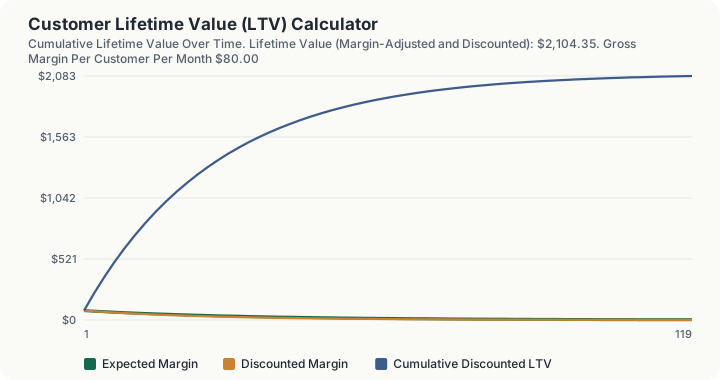
Step 6 characterises where the value sits. The schedule gives the running total directly, sampled every other month.
Step 7: Month 1. Discounted margin $80.00, cumulative LTV $80.00
Step 8: Month 3. Discounted margin $74.03, cumulative LTV $230.99
Step 9: Month 5. Discounted margin $68.51, cumulative LTV $370.72
Step 10: Month 13, just past the first year. Cumulative LTV $832.91
Step 11: Month 25, just past the second year. Cumulative LTV $1,305.79
Step 12: Month 119, where the schedule ends. Cumulative LTV $2,083.45, against the closed-form $2,104.35
Ten years of a customer relationship recovers $2,083.45 of the $2,104.35 the infinite sum promises; the remaining $20.90 is spread across every month after year ten and will never arrive in any planning horizon. The more useful boundary is month 25. Sixty-two percent of the whole value is collected inside two years, which means an acquisition cost of $1,300 or more is not repaid until the third year even though the headline LTV is $2,104.35. Payback period, not LTV, is what determines whether the growth can be funded.
What does this calculator not account for?
- A constant monthly churn hazard. Real churn is front-loaded, and a business that loses a lot of customers in month one and almost none after month twelve has a very different value profile than a flat 3% implies, even at the same blended rate.
- No expansion revenue. ARPU is held flat for the whole lifetime. A business with genuine net revenue retention above 100% is understated here, and the correction is not small.
- Gross margin is held constant. Support costs per account often fall with tenure, and payment processing rarely does.
- The monthly discount rate is the annual rate divided by twelve, a simple division rather than a compounded twelfth root. This is the stated convention of the engine, and it produces a slightly higher monthly rate than compounding would.
- No acquisition cost. Lifetime value here is a gross figure. Netting off what it cost to acquire the customer is the LTV:CAC question, which is a separate calculator.
- No taxes, no overheads, no cost of capital beyond the discount rate you supply.
- No segmentation. One blended ARPU, margin and churn across every customer type. Where the segments differ materially, a blended LTV can be higher than the LTV of every segment measured separately.
- The schedule shown is 120 months. The closed-form totals are true perpetuities and are not truncated at that horizon, so the table will not sum to the headline.
What mistakes do people make with this?
- Quoting the ARPU-over-churn figure as lifetime value. It is lifetime revenue, and on these defaults it is 58.4% too high. It is not a conservative estimate of anything; it is a different quantity.
- Using contribution margin from the P&L rather than true cost to serve. If your gross margin line includes costs that do not vary with the number of customers, the margin used here will be too low; if it excludes support and payment fees, too high.
- Ignoring discounting on long-lived customers. The lower the churn, the longer the tail, and the more the discount rate matters. At 1% monthly churn most of the naive LTV sits in years four and beyond.
- Comparing your LTV to somebody else's. Two businesses quoting "LTV of $3,000" may be computing entirely different things. Always ask which of the three figures they mean.
- Treating LTV as cash available today. It is a present value of a stream that arrives over years. It cannot fund acquisition spending this quarter.
- Assuming lower churn and higher margin are independent levers. Discounting to reduce churn cuts margin. Cutting support costs to raise margin often raises churn. The formula multiplies them, but the business does not.
Frequently Asked Questions
Why is my LTV so much lower than the simple formula says?
Should I use gross margin or contribution margin?
What discount rate should I use?
How does churn affect LTV compared to margin?
Is there a benchmark LTV I should be aiming for?
Sources
- U.S. Small Business Administration, the official authority for the business this calculator relates to. sba.gov
Also consulted: Expected lifetime under a constant monthly churn hazard $m$ is $1/m$ months, the expectation of a geometric distribution. This is the derivation behind the familiar ARPU-over-churn formula; The discounted form is the sum ∑_(t = 0)^∞AG((1 − m)/(1 + d))ᵗ = (AG(1 + d))/(d + m), with cash received at the start of each month; The monthly discount rate is the annual rate divided by twelve. This is a stated convention of this engine rather than a derived result; compounding instead would give a slightly lower monthly rate and a slightly higher LTV.
No authority publishes lifetime value benchmarks, and no primary source is cited, because none exists. There is no government, regulatory or standards body that defines customer lifetime value, sets a methodology, or publishes normal ranges. The default inputs here ($100 ARPU, 80% gross margin, 3% monthly churn, 10% annual discount rate) are illustrative values chosen to demonstrate the arithmetic. They are not benchmarks and should be replaced with your own figures. The mathematics is standard and is what the engine implements: