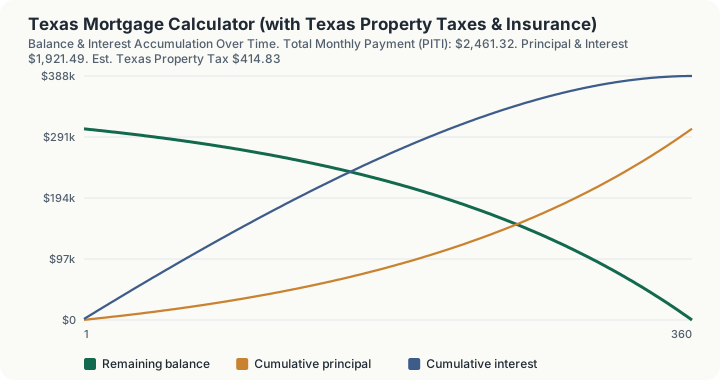
Quick Answer: A $380,000 Texas home with 20% down at 6.5% APR carries a total monthly payment (PITI) of approximately $2,461.32, made up of $1,921.49 in principal and interest, $414.83 in property tax, and $125 in insurance.
Overview
Texas has no state individual income tax, and its property tax rate is the direct consequence: at 1.31% effective, it is the eighth highest in the country. Texas school districts, counties, and cities lean heavily on property tax revenue because there is no income tax collection to draw from, which is why the property tax portion of a Texas mortgage payment, $414.83 a month on a $380,000 home in this worked example, is nearly triple the $142.50 that the same home would generate in South Carolina or Tennessee at their 0.45% effective rates.
Texas does offer real relief mechanisms that this calculator's flat statewide rate does not capture: a homestead exemption that shields a portion of a primary residence's value from school district taxation, and a 10% annual cap on how much a homestead's assessed value can increase year over year regardless of market appreciation. Both can materially lower the effective rate a homeowner actually pays compared to the 1.31% approximation used here, particularly for long-term owners in fast-appreciating markets like Austin or parts of the Dallas-Fort Worth metro.
The mortgage payment math, principal and interest amortized over a 30-year fixed term, uses the same engine applied across every mortgage calculator on this platform. Only the property tax rate and surrounding state context change from state to state.
How This Is Calculated
- Down payment and loan principal. Down payment percentage is applied to the home price; the remainder becomes the loan principal.
- Principal and interest (P&I). The loan principal is amortized over 360 months (30 years):
- Property tax. Home price is multiplied by Texas's 1.31% effective rate and divided by 12 for a monthly figure.
- Insurance. A flat $125 monthly homeowners insurance estimate is added.
- Total PITI. Principal, interest, tax, and insurance are summed into the headline monthly payment.
Worked Example
Using the calculator's default inputs:
- Home Price: $380,000.00
- Down Payment: 20% ($76,000.00)
- Interest Rate: 6.5%
- Term: 360 months (30 years)
Step by step:
- Loan principal: $380,000 − $76,000 = $304,000.00
- Monthly principal and interest at 6.5% over 360 months: $1,921.49
- Texas property tax: $380,000 × 1.31% = $4,978.00 per year, or $414.83 per month
- Homeowners insurance estimate: $125.00 per month
- Total monthly PITI: $1,921.49 + $414.83 + $125.00 = $2,461.32
- Total interest paid over the full 30-year term: $387,735.24
What This Does Not Account For
- The homestead exemption. Texas allows homeowners to exempt a portion of their primary residence's appraised value from school district property tax, which can meaningfully lower the effective rate below the 1.31% statewide estimate used here. The exemption must be actively filed with the county appraisal district.
- The 10% homestead appraisal cap. Texas limits how much a homestead's assessed value can increase in a given year to 10%, regardless of actual market appreciation, which can keep long-term owners' effective tax rate well below what a new buyer at current market price would pay.
- Wide variation by school district and municipal utility district (MUD). Texas property tax rates are set locally by counties, cities, school districts, and, in many newer suburban developments, municipal utility districts that layer additional tax on top of the base rate; 1.31% is a statewide approximation and can understate MUD-heavy areas significantly.
- PMI for down payments under 20%. This calculator does not add private mortgage insurance, typically required when the down payment is below 20%.
- Property tax exemptions for seniors, disabled homeowners, and veterans. Texas offers additional exemptions and tax ceilings for qualifying homeowners aged 65 and older, disabled homeowners, and disabled veterans, none of which are reflected in the statewide estimate here.
- The offsetting effect of zero state income tax. This calculator only computes the mortgage payment; it does not model the take-home pay advantage of living in a no-income-tax state.
Common Pitfalls
- Not filing for the homestead exemption after closing. New Texas homeowners must apply for the homestead exemption with their county appraisal district; failing to file leaves the property taxed at the full, unexempted rate.
- Underestimating MUD and PID fees in new-construction suburbs. Rapidly developed areas around major Texas metros often carry municipal utility district or public improvement district assessments on top of standard property tax, sometimes pushing the effective rate well above 1.31%.
- Assuming the appraisal cap applies to a new purchase. The 10% annual appraisal increase cap only applies once a homestead exemption is in place and generally does not protect a buyer's very first year of ownership, when the appraised value may jump to reflect the recent sale price.
- Overlooking the down payment threshold for PMI. Below 20% down, expect an additional PMI line item not reflected in this calculator's output.
- Comparing Texas's total tax burden using only the property tax figure. Texas has no income tax and a moderate 6.25% state sales tax (with local add-ons up to 8.25% combined), so the full cost-of-living picture depends on income, spending, and property value together, not property tax in isolation.
Frequently Asked Questions
Why is Texas's property tax rate so high?
Does Texas have a state income tax?
What is the Texas homestead exemption, and how much does it save?
How does the 10% appraisal cap work?
Are there extra property tax breaks for seniors or veterans in Texas?
What happens if I put down less than 20%?
Sources
- Texas Comptroller of Public Accounts: Property Tax Assistance Division, homestead exemption and appraisal cap guidance. comptroller.texas.gov
- Consumer Financial Protection Bureau: Regulation Z mortgage disclosure standards and PMI requirements. ecfr.gov/current/title-12/chapter-X/part-1026
Also consulted: Texas Comptroller of Public Accounts: Property tax exemptions for seniors, disabled persons, and veterans.