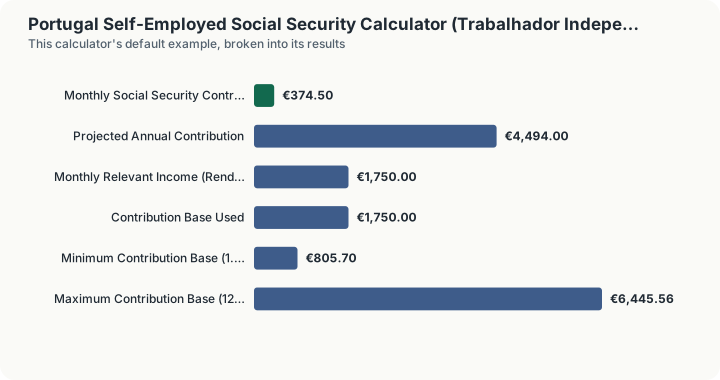
Quick Answer: A self-employed services provider (trabalhador independente) earning an average of €2,500/month has a "relevant income" of €1,750/month (70% of gross income) and, since this exceeds the minimum contribution base, pays €374.50/month -- €4,494.00/year -- in Social Security contributions at the standard 21.4% rate.
Overview
Portugal's Social Security (Segurança Social) system doesn't charge self-employed workers (trabalhadores independentes) on their full gross income. Instead, it applies a "relevant income" coefficient first: 70% of gross income for service providers, but only 20% for those selling goods or products, reflecting an assumption that a larger share of a goods-seller's revenue goes to cost of goods rather than personal income. Contributions are then calculated on this relevant income, floored at a legal minimum base and capped at a legal maximum, both expressed as multiples of the IAS (Indexante dos Apoios Sociais, Portugal's official social-support reference index).
The system is also structurally quarterly: your actual monthly contribution base each quarter is based on your relevant income from the previous quarter, creating a built-in lag between what you earn and what you contribute on. This calculator models a steady-state average monthly income rather than simulating that quarter-by-quarter lag explicitly, which is the right approach for understanding your typical ongoing contribution level even though the real month-to-month mechanics involve that reporting delay.
How This Is Calculated
- Relevant income. Gross monthly income multiplied by the activity-type coefficient: 70% for services, 20% for the sale of goods/products.
- Contribution base. Relevant income, floored at 1.5× the IAS (the legal minimum base) and capped at 12× the IAS (the legal maximum base).
- Monthly contribution. The contribution base multiplied by the 21.4% self-employed contribution rate.
- First-year exemption. A newly-registered independent worker is commonly understood to be exempt from contributions during their first 12 months of activity.
- Annual contribution. Monthly contribution multiplied by 12, as a steady-state annual projection.
Worked Example
Using the calculator's default inputs (€2,500/month, services, not first-year exempt):
- Relevant income: 2,500 × 70% = €1,750 -- above the €805.70 minimum base (1.5× IAS), so no floor adjustment applies.
- Contribution base: €1,750 (the relevant income itself, since it exceeds the floor and is under the cap).
- Monthly contribution: 1,750 × 21.4% = €374.50.
- Annual contribution: 374.50 × 12 = €4,494.00.
Sale of Goods, €4,000/Month
- Relevant income: 4,000 × 20% = €800 -- below the €805.70 minimum base (1.5× IAS), so the floor applies.
- Contribution base is floored at €805.70, not the full €800 relevant income.
- Monthly contribution: 805.70 × 21.4% = €172.42.
The much lower 20% coefficient for goods sellers means a higher-earning goods-seller can still owe less in contributions than a lower-earning service provider, purely because of the different relevant-income treatment.
High Earner, €10,000/Month Services, Capped
- Relevant income: 10,000 × 70% = €7,000 -- this exceeds the €6,445.56 maximum base (12× IAS).
- Contribution base is capped at €6,445.56, not the full €7,000 relevant income.
- Monthly contribution: 6,445.56 × 21.4% = €1,379.35. Annual: €16,552.20.
First-Year Exemption
A newly-registered independent worker within their first 12 months of activity owes €0 in monthly and annual contributions under this exemption.
What This Does Not Account For
- The €20 floor on the contribution itself, and the zero-income case. Separately from the €805.70 minimum contribution base, Portugal applies a minimum contribution of €20 per month where declared income is very low, and a substantially higher fixed charge for someone who keeps an activity open but declares no income at all. Neither of those special cases is modeled here; this calculator applies the ordinary base floor and the 21.4% rate.
- The real quarterly lag mechanics (your contribution base each quarter is actually set from the PRIOR quarter's relevant income, not your current-quarter income in real time) are not simulated month-by-month -- this calculator computes a steady-state average instead.
- Accumulated activity (self-employed plus also employed elsewhere), which has its own combined-contribution rules, is not modeled -- this calculator assumes self-employment is your only activity.
- Voluntary additional contributions some independent workers make to boost their future pension beyond the mandatory minimum are not modeled.
- Income tax (IRS) on your Category B business/professional income is calculated entirely separately from this Social Security contribution -- see this platform's Portugal IRS calculator for the income-tax side.
- Sudden, large income swings quarter to quarter interact with the real quarterly-lag system in ways this steady-state model doesn't capture precisely.
Common Pitfalls
- Assuming contributions are based on your full gross income. The relevant-income coefficient (70% or 20%) applies first -- your actual contribution base is meaningfully lower than your raw gross income, especially for goods sellers.
- Confusing the services and goods coefficients. A large gap exists between the two (70% vs. 20%), and misclassifying your activity type can significantly misstate your expected contribution.
- Forgetting the quarterly lag in real life. While this calculator computes a steady-state average, your actual monthly contribution in any given month is really set from your relevant income the prior quarter -- a sudden income change takes a quarter to fully show up in your contribution base.
- Not realizing there's a maximum base cap. High earners sometimes assume contributions scale linearly forever with income, when in fact the base is capped at 12× IAS regardless of how much higher your actual relevant income is.
- Missing the first-year exemption when budgeting as a new independent worker, or conversely assuming it lasts longer than 12 months.
Frequently Asked Questions
Why is the coefficient different for services vs. goods?
Does the first-year exemption apply automatically?
What is the IAS and why does it matter here?
Do I pay this contribution on top of income tax?
Does the contribution base really update every quarter?
Sources
- Portuguese Tax and Customs Authority, the official authority for the national tax authority this calculator relates to. portaldasfinancas.gov.pt
Also consulted: Código dos Regimes Contributivos do Sistema Previdencial de Segurança Social: the 21.4% contribution rate for independent workers, the 70% relevant-income coefficient for services and 20% for the sale of goods, the quarterly-lagged contribution base, and the first-12-months exemption for a newly-registered independent worker; The 2026 IAS value of €537.13, set by ministerial order published in Diário da República on 30 December 2025; 2026 contribution base limits re-verified 2026-08-28 across multiple independent Portuguese sources reporting the same figures: minimum base €805.70 (1.5x IAS), maximum base €6,445.56 (12x IAS), contribution rate 21.4%, and a €20 per month minimum contribution in low-income cases.