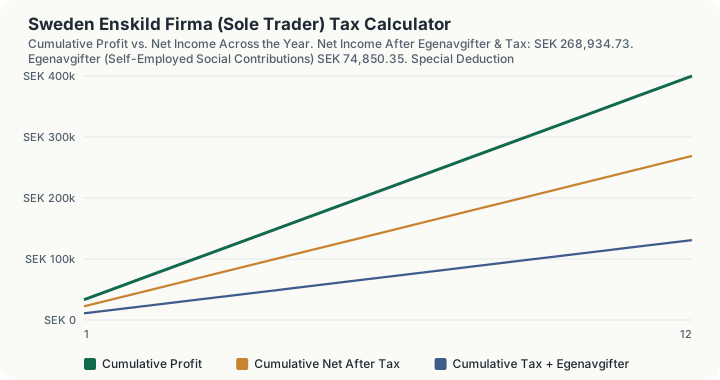
Quick Answer: An active sole trader (enskild firma) in Stockholm kommun with SEK 400,000 of annual business profit is charged SEK 89,850.35 of egenavgifter (self-employed social contributions, at the full 28.97% rate) before relief, takes the maximum SEK 15,000 sarskilt avdrag against that charge to leave SEK 74,850.35 payable, and owes SEK 56,214.92 in income tax on the remaining profit. That is SEK 131,065.27 in total tax and contributions, leaving SEK 268,934.73 of net income (about SEK 10,922.11/month suggested for F-skatt).
Overview
Running an enskild firma (sole proprietorship) in Sweden means you are personally liable for two things a regular employee's employer normally handles: egenavgifter (the self-employed equivalent of payroll social contributions, funding pension, health insurance, and parental leave) and F-skatt, the preliminary tax you pay directly to Skatteverket in monthly installments rather than having an employer withhold it from a paycheck. Neither is optional, and both are calculated on your business profit, not your revenue.
Egenavgifter is where most first-time sole traders get surprised. At the full rate, it's 28.97% of your adjusted profit -- not a small line item, and structurally different from an employee's arbetsgivaravgifter (employer social contributions), which an employer pays on top of your gross salary and you never see directly. As a sole trader, egenavgifter comes straight out of your own bottom line, alongside ordinary kommunal and (above a threshold) statlig income tax on what's left. This calculator computes the full chain: egenavgifter, the special deduction that partially offsets it, the resulting taxable profit, and the income tax due on that -- so you can see your true net income from the business, not just the pre-tax profit figure your bookkeeping shows.
How This Is Calculated
- Egenavgifter rate selection. The full 28.97% rate applies to an active sole trader under 66. A reduced 10.21% rate applies from age 66. Sole traders born 1937 or earlier pay 0%. A passive business (one you don't actively work in, roughly less than a third of full-time) pays a different, lower särskild löneskatt (special payroll tax) rate of 24.26% instead of full egenavgifter, and does not qualify for the special deduction below.
- Egenavgifter amount -- a self-consistent calculation. Egenavgifter is levied on your profit after deducting the egenavgifter itself, which makes the calculation circular. Solved algebraically:
- Special deduction (sarskilt avdrag). Lag (2023:748) reduces the egenavgifter themselves, not your taxable profit, and Skatteverket measures it as 7.5% of the underlag (the surplus after egenavgifter), capped at SEK 15,000 a year. It requires an active business paying the full rate with a surplus above SEK 40,000, and it cannot cut the charge below the alderspensionsavgift.
- Net profit for income tax. Profit minus the egenavgifter actually payable after the sarskilt avdrag. The relief is not subtracted a second time here, because it has already reduced the contribution charge.
- Income tax. The resulting net profit is taxed exactly like ordinary earned income -- grundavdrag, kommunalskatt at your kommun's rate, jobbskatteavdrag, and statlig inkomstskatt above the 2026 threshold (see the Sweden Net Salary by Kommun Calculator for the full income-tax mechanics reused here).
- Total cost and net income. Egenavgifter plus income tax, subtracted from gross profit.
Worked Example
Using the calculator's default inputs (SEK 400,000 profit, Stockholm, active business, under 66):
- Egenavgifter rate: 28.97% (full active rate).
- Egenavgifter: (0.2897 × 400,000) ÷ 1.2897 = SEK 89,850.35.
- Sarskilt avdrag: the underlag is 400,000 − 89,850.35 = 310,149.65, and 7.5% of that is 23,261.22, so the SEK 15,000 cap binds. Egenavgifter payable: 89,850.35 − 15,000 = SEK 74,850.35.
- Net profit for income tax: 400,000 − 74,850.35 = SEK 325,149.65.
- Income tax on that net profit, in Stockholm (30.55% kommunalskatt after grundavdrag and jobbskatteavdrag, below the statlig threshold): SEK 49,219.59.
- Total tax and contributions: 74,850.35 + 56,214.92 = SEK 131,065.27.
- Net income: 400,000 − 131,065.27 = SEK 268,934.73, roughly SEK 10,922.11/month suggested for F-skatt installments.
Same Profit, Different Situations
| Situation | Egenavgifter Rate | Egenavgifter | Net Income |
|---|---|---|---|
| Active, under 66 | 28.97% | SEK 74,850.35 | SEK 268,934.73 |
| Active, 66+ | 10.21% | SEK 37,056.53 | SEK 297,915.89 |
| Passive business | 24.26% | SEK 78,094.32 | SEK 266,447.18 |
Turning 66 and staying active in the business cuts the contribution rate by nearly two-thirds, a meaningful incentive for sole traders who keep working past the standard retirement age.
Carrying the F-skatt Installments Across the Year
The schedule spreads the year evenly across twelve months, which is how preliminary F-skatt is actually paid.
Step 8 -- After month one. Cumulative profit SEK 33,333.33, tax and egenavgifter SEK 10,922.11, net SEK 22,411.22
Step 9 -- After month two. Cumulative profit SEK 66,666.67, tax and egenavgifter SEK 21,844.21, net SEK 44,822.46
Step 10 -- After month six. Cumulative profit SEK 200,000.00, tax and egenavgifter SEK 65,532.64, net SEK 134,467.36
Step 11 -- After month twelve. Cumulative profit SEK 400,000.00, tax and egenavgifter SEK 131,065.27, net SEK 268,934.73
By midsummer, SEK 65,532.64 has already gone to Skatteverket. The evenness is the thing to plan around rather than trust: F-skatt installments do not care that a consultancy bills nothing in July or that a seasonal trade earns two thirds of its profit between May and August. The debit falls in twelve equal parts regardless, so the cash held back in the strong months has to cover the weak ones.
What This Does Not Account For
- Only 8 kommuner (Stockholm, Göteborg, Malmö, Uppsala, Linköping, Örebro, Västerås, Helsingborg) are modeled for the income-tax portion; see the Sweden Net Salary by Kommun Calculator's own limitations for the kommunalskatt rate approximations.
- The alderspensionsavgift floor is modeled, but the exact split is not. Skatteverket notes that in some years the sarskilt avdrag works out below 7.5%, because it depends on how the egenavgifter divide between their component charges and the allmän löneavgift. This calculator applies the headline 7.5% and only enforces the floor that the reduction cannot take the charge below the alderspensionsavgift, so in a year where that split binds it may show slightly more relief than Skatteverket allows.
- Two conditions on the special deduction are not checked. The sarskilt avdrag requires a surplus from active business above SEK 40,000, and it may never reduce egenavgifter below the alderspensionsavgift component. This calculator applies the deduction without testing either condition, so it will grant it to a small business that does not qualify.
- The special deduction's base. The statute computes the 7.5% on the egenavgifter contribution base. This calculator computes it on gross profit. The two differ, though for any profit above roughly SEK 200,000 the SEK 15,000 cap binds either way and the distinction stops mattering.
- The exact statutory egenavgifter component breakdown (ålderspensionsavgift, sjukförsäkringsavgift, föräldraförsäkringsavgift, etc., which together sum to the headline rate) is not itemized -- only the combined rate is modeled.
- Sjukpenninggrundande inkomst (SGI) and its effect on sick pay/parental benefit levels is not modeled; egenavgifter funds these benefits, but the benefit calculation itself is a separate system.
- VAT (moms), employer's contributions on any employees you hire, and corporate-structure alternatives (aktiebolag) are entirely out of scope -- this calculator is specific to a sole proprietorship's own egenavgifter and income tax.
- Negative profit years, loss carryforwards, and the first-year startup deduction some new sole traders qualify for are not modeled.
- F-skatt is a suggested starting installment, not your actual assigned rate -- Skatteverket sets your real preliminary tax based on your own income estimate submitted at registration or via your tax return, and can differ materially from this calculator's simple annual-total-divided-by-12 approach.
Common Pitfalls
- Budgeting only for income tax and forgetting egenavgifter. At the full rate, egenavgifter alone can exceed 20% of your gross profit before any income tax is even applied -- a common source of underpaid F-skatt and a surprise tax bill.
- Confusing egenavgifter with an employee's payroll deductions. An employee's payslip shows income tax withheld; the employer's contribution is invisible to them. A sole trader pays both roles' worth of contribution, just under a different name and a different (generally somewhat lower, since there's no employer margin) combined rate.
- Forgetting the special deduction only applies to active businesses. A passive enskild firma gets no schablonavdrag, one of several ways the passive/active distinction changes the math beyond just the headline rate.
- Not adjusting F-skatt when profit changes mid-year. If your business has a strong or weak year, update your preliminary tax registration with Skatteverket rather than letting a stale F-skatt rate under- or over-collect all year.
- Ignoring the age-66 rate change. Sole traders who keep working past 66 sometimes don't realize their contribution rate has dropped substantially, and continue budgeting at the old, higher rate.
Frequently Asked Questions
What's the difference between egenavgifter and arbetsgivaravgifter?
Why is egenavgifter calculated with that circular-looking formula?
Do I still pay egenavgifter if my enskild firma makes very little profit?
Does the special deduction reduce my egenavgifter directly?
Should I register as active or passive?
Sources
- Skatteverket: "Egenavgifter" official guidance, including the 2026 full rate (28.97%), the reduced 66+ rate (10.21%), and the exemption for those born 1937 or earlier. skatteverket.se
Also consulted: Skatteverket: "Särskild löneskatt" official guidance for the passive-business rate (24.26%); Lag (2023:748) om sarskilt avdrag vid berakning av egenavgifter och allman loneavgift i vissa fall, and Skatteverket's Rattslig vagledning on the same: a deduction of 7.5% of the contribution base, capped at SEK 15,000 per year, available where the surplus from active business exceeds SEK 40,000, taken from the egenavgifter themselves and never reducing them below the alderspensionsavgift. Re-verified 2026-08-28; Skatteverket: kommunalskatt, grundavdrag, jobbskatteavdrag, and statlig inkomstskatt sources as cited in the Sweden Net Salary by Kommun Calculator, reused unchanged for the income-tax portion of this calculation.