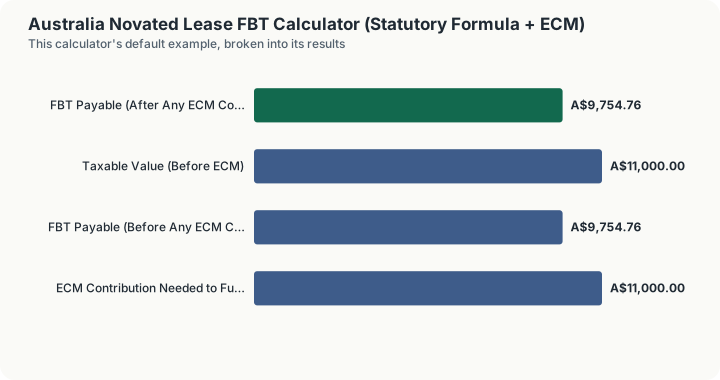
Quick Answer: A A$55,000 car provided under a novated lease with no employee contribution has a taxable value of A$11,000 (20% statutory fraction), which grosses up to A$20,754.80 and generates A$9,754.76 in Fringe Benefits Tax. Making an A$11,000 after-tax employee contribution (the Employee Contribution Method) reduces the taxable value to zero, fully eliminating the FBT liability -- the standard way Australian novated leases avoid FBT altogether.
Overview
A novated lease lets an employee salary-package a car through their employer, with lease payments and running costs deducted from pre-tax salary. Because the employer is technically providing a car benefit, this triggers Fringe Benefits Tax (FBT) -- a tax the EMPLOYER pays, but which is almost universally passed through to the employee via their salary package in practice, making it a real cost that shapes whether a novated lease is worthwhile.
The "statutory formula method" is the standard way FBT is calculated on a novated-lease car: a flat 20% of the car's base value, regardless of how far you actually drive it (a simplification introduced in 2011, replacing an older system with different percentages depending on distance travelled). The key mechanism nearly every novated lease uses to reduce or eliminate this FBT liability is the Employee Contribution Method (ECM): the employee makes an after-tax contribution toward the car's running costs, and this contribution reduces the taxable value dollar-for-dollar, down to a floor of zero. Contribute enough, and the FBT liability disappears entirely -- which is exactly how most novated lease providers structure the arrangement by default. Separately, eligible electric vehicles are fully exempt from FBT altogether, regardless of the statutory formula or any ECM contribution.
How This Is Calculated
- Taxable value. The car's base value (generally its GST-inclusive purchase price, excluding registration and stamp duty in most published examples) multiplied by the flat 20% statutory fraction.
- Gross-up. The taxable value is "grossed up" using the Type 2 gross-up rate (1.8868), which adjusts for the fact that the benefit was provided using pre-tax dollars.
- FBT payable. The grossed-up value multiplied by the FBT rate (47%).
- Employee Contribution Method (ECM). An after-tax employee contribution toward the car's running costs reduces the taxable value directly, dollar-for-dollar, before the gross-up and FBT calculation -- not the FBT amount itself, but the value it's calculated on.
- EV exemption. If the vehicle is an eligible battery-electric or hydrogen fuel-cell car (first held and used from 1 July 2022, valued below the luxury car tax threshold for fuel-efficient vehicles), FBT is exempt entirely -- the statutory formula and ECM calculations don't apply at all.
Worked Example
Using the calculator's default inputs (A$55,000 base value, not an EV, no ECM contribution):
- Taxable value: 55,000 × 20% = A$11,000.00.
- Grossed up: 11,000 × 1.8868 = A$20,754.80.
- FBT payable: 20,754.80 × 47% = A$9,754.76.
Fully Offsetting FBT with an ECM Contribution
Contributing exactly A$11,000 after-tax (equal to the taxable value before ECM) reduces the taxable value to A$0, and FBT payable drops to A$0.00 -- a complete elimination of the FBT liability, in exchange for the after-tax contribution itself.
A Partial Contribution
Contributing only A$5,000 after-tax reduces the taxable value to 11,000 − 5,000 = A$6,000, which still generates some FBT, just meaningfully less than the no-contribution scenario -- the reduction is proportional, not all-or-nothing.
An Eligible Electric Vehicle
A A$65,000 battery-electric vehicle under the FBT exemption owes A$0 in FBT regardless of any ECM contribution -- the exemption applies at the vehicle level, before the statutory formula or ECM calculation even comes into play.
What This Does Not Account For
- The FBT rate (47%), Type 2 gross-up rate (1.8868), and the flat 20% statutory fraction rely on established, long-stable ATO-published figures NOT independently re-fetched this session -- ato.gov.au blocked every automated fetch attempt during this build's research. Verify these figures against ato.gov.au before relying on this calculator for an actual salary-packaging decision.
- The PHEV FBT exemption removal (1 April 2025) and its grandfathering for pre-existing binding commitments likewise rely on established prior knowledge of a widely-reported 2024-25 Federal Budget measure, not independently re-fetched this session.
- This calculator models FBT only -- it does not compute the actual salary-packaging savings (income tax saved on pre-tax lease payments), lease finance costs, running-cost budgets, or a full cost-benefit comparison against outright car ownership.
- The exact luxury car tax fuel-efficient threshold that determines EV FBT-exemption eligibility is not hardcoded as a "current" figure -- confirm your specific vehicle's eligibility against the current threshold before assuming exemption.
- Type 1 vs. Type 2 gross-up distinction. This calculator uses the Type 2 rate throughout (the applicable rate when the employer cannot claim GST credits on the benefit, the common case for a novated lease); Type 1 applies in different circumstances not modeled here.
- State-based EV incentives, stamp duty concessions, or registration discounts for electric vehicles are entirely separate from FBT and not modeled.
Common Pitfalls
- Assuming the employer absorbs the FBT cost. In nearly all real-world salary-packaging/novated-lease arrangements, the FBT liability is passed through to the employee as part of the overall package cost -- it's a real, budgeted expense, not a free employer cost.
- Not making an ECM contribution when one would eliminate the FBT liability. Most novated lease providers structure the arrangement to include an ECM contribution by default specifically to avoid FBT -- check whether your specific arrangement already does this before assuming a large FBT bill applies.
- Assuming EVs are exempt automatically regardless of value. The exemption requires the vehicle to be valued below the luxury car tax threshold for fuel-efficient vehicles -- a very expensive EV can still fall outside the exemption.
- Confusing plug-in hybrids with fully electric or hydrogen vehicles for exemption purposes. PHEVs lost the exemption for new arrangements from 1 April 2025, unless grandfathered under a pre-existing binding commitment -- don't assume a hybrid automatically qualifies the same way a battery-electric car does.
- Ignoring the base-value definition. The statutory formula generally uses the GST-inclusive purchase price EXCLUDING registration and stamp duty in most published examples -- using the full drive-away price can overstate the taxable value.
Frequently Asked Questions
Does the calculation change in NSW, Victoria, Queensland, the ACT or anywhere else?
Who actually pays FBT on a novated lease car?
What is the Employee Contribution Method (ECM) and why does it matter?
Are all electric vehicles automatically FBT-exempt?
Does the statutory formula depend on how far I drive the car?
Is this the only method for calculating car fringe benefits?
Sources
- U.S. Small Business Administration, the official authority for the business this calculator relates to. sba.gov
Also consulted: Long-stable, widely-published ATO figures for the FBT rate (47%), Type 1 (2.0802) and Type 2 (1.8868) gross-up rates, and the flat 20% statutory formula fraction (in force since 1 July 2011) -- NOT independently re-fetched this session due to ato.gov.au blocking automated access; verify against ato.gov.au/tax-rates-and-codes/fringe-benefits-tax-rates-and-thresholds before publishing; Treasury Laws Amendment (Electric Car Discount) Act 2022, establishing the EV FBT exemption for eligible vehicles first held and used from 1 July 2022; The widely-reported 2024-25 Federal Budget measure removing plug-in hybrid vehicles from the FBT exemption for new arrangements from 1 April 2025, with grandfathering for pre-existing binding commitments.