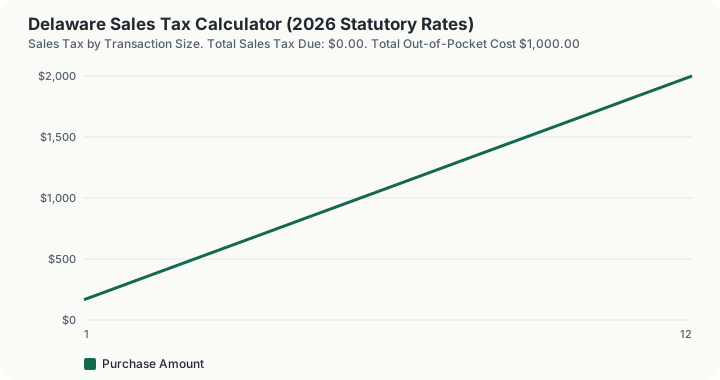
Quick Answer: A $1,000 purchase in Delaware incurs $0.00 in state sales tax and costs $1,000.00 out the door before tax, since Delaware is one of the five NOMAD states and does not levy a statewide general sales tax.
One of Five States With No Sales Tax
Delaware is one of only five states with no statewide general sales tax, and unlike Alaska it does not allow its counties or municipalities to impose one either. The state rate is 0.00% and it stays that way at every level of government.
Retailers in Delaware simply do not collect sales tax on general merchandise, which is part of why the state has long marketed itself to shoppers in neighboring Pennsylvania, New Jersey, and Maryland as a tax-free destination for larger purchases. Businesses operating in Delaware still need to track other transaction-based taxes, notably its gross receipts tax on sellers, which works differently from a point-of-sale sales tax, but a consumer checking out at a Delaware register will not see a sales tax line item at all.
That has made Delaware a common stop for big-ticket shopping (furniture, electronics, vehicles) for residents of nearby states where combined state and local rates run into the mid-to-high single digits. It is also part of why Delaware appears so often on lists of tax-friendly states for retirees and businesses alike, alongside its separate, and unrelated, reputation as a favorable state for business incorporation.
How This Is Calculated
Delaware has no sales tax. There is no state rate, no county rate, no municipal rate, and no special district rate, so a $1,000 purchase costs $1,000 at the register. What Delaware levies instead is a gross receipts tax on sellers, assessed on the business's total receipts rather than added to the customer's bill, which is why it does not show up as a line item on a receipt the way a sales tax would.
The general form still holds, with both rate terms equal to zero:
The calculator still runs the full sequence so the output is explicit rather than blank:
- Take the entered amount as the base. No adjustments are made to the price before tax is computed.
- No item-level exemption filtering. With a zero rate there is nothing to exempt from. Every category returns the same result.
- Compute the state portion. The base is multiplied by the state statutory rate.
- Apply the local surcharge. Delaware has no local sales taxes, so this term is zero as well and the local toggle has no effect.
- Sum and total. The state and local amounts are added to give total tax, and the total is added back to the price to give the out-of-pocket cost.
Worked Example
For a $1,000 retail purchase in Delaware:
- Starting purchase price. The buyer rings up a $1,000.00 taxable retail purchase in Delaware, the baseline amount before any tax consideration.
- State statutory rate applied. Delaware is one of the five NOMAD states (alongside the other four with no general sales tax), so its state sales tax rate is 0.00%: $1,000.00 × 0.00% = $0.00 in state tax owed.
- No state tax due. Because the statutory rate is zero, the state sales tax line item is $0.00 regardless of the purchase amount, whether it is $10 or $10,000.
- Total out-of-pocket cost. With no state sales tax added, the buyer's total out-of-pocket cost equals the original purchase price: $1,000.00.
This example reflects only the statewide rate. Some localities within Delaware may still impose limited local option or municipal taxes on specific purchases, so a shopper's actual receipt total can differ slightly from the $1,000.00 shown here depending on where the purchase takes place.
A Sweep of Twelve Zeros, and What It Hides
Every row of the tier schedule above returns the same number. At $166.67 the tax is $0.00; at the $1,000.00 baseline it is $0.00; at $2,000.00, the top of the sweep, it is $0.00. The total out-of-pocket cost equals the purchase amount at all twelve rungs, and it does so at $25,000.00 as well. Delaware is one of the five NOMAD states, and this calculator's state rate and local rate are both stored as zero.
The marginal figure, such as it is. Each additional $1,000 of taxable purchase in Delaware costs $0.00 in sales tax. There is no threshold to walk across, no bracket edge, no exemption cliff and no reverse calculation worth performing, because the reverse calculation is the identity: a $1,000 all-in budget buys exactly $1,000.00 of goods, where the same budget in a 7% state buys somewhere in the low $930s. On a $25,000 vehicle the engine returns $0.00 of tax against $1,890.00 in Georgia and $1,587.50 in Connecticut.
The local toggle is inert here. Switching the average local surcharge on or off leaves the answer at $0.00 either way, because Delaware's stored local rate is zero as well. Delaware has no county or municipal general sales tax for the toggle to add, so unlike most states on this site the two scenarios in the panel above return identical numbers.
What the zero conceals. Delaware raises the revenue elsewhere, and this calculator models none of it. The state levies a gross receipts tax on the seller rather than the buyer, assessed on the business's total receipts with no deduction for cost of goods, and sellers routinely price it into the shelf tag. Nothing on this page reads a gross receipts rate, so a Delaware price that looks tax-free at the register may already carry the tax inside it, invisibly to this engine.
Vehicles, the largest gap. Delaware charges a motor vehicle document fee of 4.25% on the greater of purchase price or NADA book value when a vehicle is titled. Enter a $25,000 car above and this calculator returns $0.00, because the document fee is a title charge rather than a sales tax and no input on this page can express it. That is the single most consequential thing this calculator omits for a Delaware buyer, and it is a limitation of the model rather than a feature of the state. Lodging, motor fuel and public utility taxes are likewise outside the code path.
What This Does Not Account For
- Statutory exemptions on unprepared groceries, prescription medications, or manufacturing equipment.
- Special industry excise taxes (lodging hotel taxes, vehicle rental fees, alcohol/tobacco excise).
- Use tax compliance on out-of-state untaxed online purchases.
- B2B resale certificate exemptions or direct pay permit programs.
Common Pitfalls
- Confusing State and Combined Rates: Quoting the state base rate without factoring in local city and county add-on taxes.
- Overlooking Consumer Use Tax: Failing to self-report and remit use tax on untaxed out-of-state purchases on your state income tax return.
- Missing Annual Sales Tax Holidays: Many states offer annual tax-free weekends for back-to-school items, severe weather supplies, or energy-efficient appliances.
- Failing to Collect Resale Certificates: Selling wholesale without collecting valid exemption certificates exposes sellers to full sales tax liability upon audit.
Frequently Asked Questions
What is the sales tax rate in Delaware?
Are groceries taxed in Delaware?
How does use tax differ from sales tax?
Are digital goods and SaaS taxable in Delaware?
Sources
- Delaware Division of Revenue: 2026 Sales and Use Tax Rate Schedules. revenue.delaware.gov
- Streamlined Sales Tax Governing Board (SSTGB): State Taxability Matrix. streamlinedsalestax.org/for-businesses/taxability-matrix