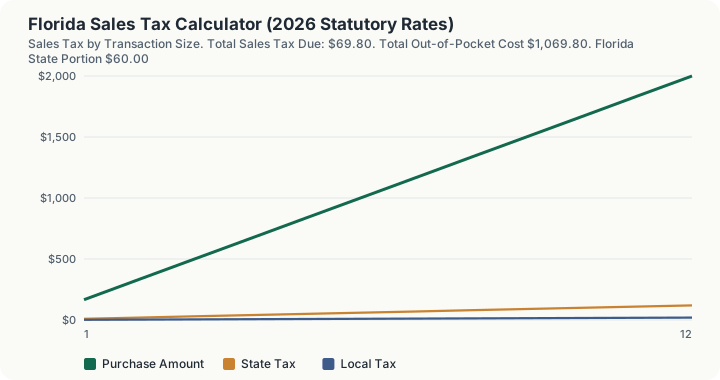
Quick Answer: A $1,000 taxable purchase in Florida costs $69.80 in combined state and local sales tax, for a total of $1,069.80 out the door.
Florida's 6% Base and Its County Add-Ons
What does a $1,000 purchase actually cost after tax in Florida? The answer starts with the state's 6.00% rate, but it does not end there. Local jurisdictions (cities, counties, and in some cases special taxing districts) are free to add their own surcharges on top of that, and the statewide average of those add-ons is 0.98%, which brings the typical combined rate to 6.98%.
That leaves Florida a bit below the roughly 7.3% average combined rate seen across the states that levy a general sales tax. That gap between the advertised price and the out-the-door total is exactly what this calculator is built to make transparent, using Florida's statewide average combined rate of 6.98%. Budgeting for a big-ticket purchase (a vehicle, an appliance, a piece of furniture) without accounting for that gap is one of the more common ways shoppers in Florida underestimate what they will actually owe at checkout.
How This Is Calculated
Florida charges 6.00% at the state level and lets counties add a discretionary sales surtax on top, which averages 0.98% statewide and pushes the typical combined rate to 6.98%, or $69.80 on a $1,000 purchase. Florida's surtax has an unusual limit: on a single sale of a tangible item, the county surtax applies only to the first $5,000 of the price, while the 6% state tax applies to the whole amount. That cap means the effective combined rate on a large single-item purchase falls as the price rises.
Below the surtax cap the two rates share a base and can be combined into one multiplication:
The calculator executes these steps:
- Establish the taxable base. The calculator uses the pre-tax price exactly as entered.
- No item-level exemption filtering and no surtax cap. The $5,000 single-item surtax limit is not modeled, so results for large single items overstate the county portion. Groceries and prescription drugs are exempt in Florida and are not filtered out here either.
- Apply the state rate to the base. That gives the state share of the tax.
- Apply the county surtax. The 0.98% average blends counties that levy no surtax at all with counties charging 1.5% or more.
- Combine into a total. State and local tax are added, then the combined tax is added to the purchase price for the final transaction amount.
Worked Example
For a $1,000 taxable purchase in Florida:
- Starting purchase price. The buyer rings up a $1,000.00 taxable retail purchase in Florida, the baseline amount before any tax is applied.
- State portion. Florida's statutory state sales tax rate of 6.00% applies to the full purchase amount: $1,000.00 × 6.00% = $60.00 owed to the state.
- Local portion. Local municipal, county, and special-district surcharges add an average of 0.98% on top of that: $1,000.00 × 0.98% = $9.80 more.
- Combined tax due. Summing the two pieces, $60.00 in state tax plus $9.80 in local surcharge comes to $69.80 in total sales tax owed on the transaction.
- Total out-of-pocket cost. Adding that $69.80 in tax to the $1,000.00 purchase price brings the buyer's total out-of-pocket cost to $1,069.80.
This example uses Florida's statewide average local rate of 0.98%; actual combined rates vary by city and county, so a real receipt could show a combined rate above or below the 6.98% average used here.
Extracting Florida Tax from a Tax-Inclusive Total
Florida's 6.00% state rate plus a 0.98% average county discretionary surtax gives the 6.98% combined figure this page uses. The tier schedule applies that combined rate to twelve purchase sizes, so nothing steps and the interesting arithmetic is the reverse direction rather than the forward one.
Two rungs. Row 3 rings up $500.00 and returns $30.00 of state tax and $4.90 of local, $34.90 combined. Row 6, the $1,000 baseline, returns $60.00 and $9.80 for $69.80. Doubling the purchase doubles both components, so each $100 of Florida spend carries $6.98 of tax at any point on the sweep.
Turning the surtax off, priced. With the local toggle off the engine returns $60.00 instead of $69.80. The county discretionary sales surtax is therefore worth $9.80 on the baseline, about 16% of the state portion. Anyone quoting Florida's headline 6% and stopping there is understating a $1,000 purchase by that $9.80, and a $25,000 purchase by roughly $245: the engine returns $1,745.00 of combined tax on $25,000 against $1,500.00 of state tax alone.
The reverse question, done properly. Given $1,000 to spend including tax, the correct pre-tax price is the extraction, not a subtraction. Enter $934.75 and the engine returns $65.25 of tax and a total of exactly $1,000.00. That is the ceiling on the sticker price.
The subtraction error, priced. Taking 6.98% off $1,000.00 gives $930.20. Run through the engine that returns $64.93 of tax and a $995.13 total, leaving $4.87 of the budget unspent and pricing the item $4.55 below what the budget actually supports. The error is small on a $1,000 purchase and material on a car.
Where the surtax model breaks down. Florida's discretionary surtax is capped: on most single-item sales of tangible personal property the county surtax applies only to the first $5,000 of the price, while the 6% state rate applies to the whole amount. This engine applies the average 0.98% to the entire base with no cap anywhere in the path, so above $5,000 it overstates the local portion. On the $25,000 figure above, the surtax component the engine charges is $245.00 where the capped statutory amount would be far smaller. The engine also has no item-level logic, so groceries, prescription drugs and the higher rates on commercial rent and transient lodging are all treated as general tangible personal property.
What This Does Not Account For
- Statutory exemptions on unprepared groceries, prescription medications, or manufacturing equipment.
- Special industry excise taxes (lodging hotel taxes, vehicle rental fees, alcohol/tobacco excise).
- Use tax compliance on out-of-state untaxed online purchases.
- B2B resale certificate exemptions or direct pay permit programs.
Common Pitfalls
- Confusing State and Combined Rates: Quoting the state base rate without factoring in local city and county add-on taxes.
- Overlooking Consumer Use Tax: Failing to self-report and remit use tax on untaxed out-of-state purchases on your state income tax return.
- Missing Annual Sales Tax Holidays: Many states offer annual tax-free weekends for back-to-school items, severe weather supplies, or energy-efficient appliances.
- Failing to Collect Resale Certificates: Selling wholesale without collecting valid exemption certificates exposes sellers to full sales tax liability upon audit.
Frequently Asked Questions
What is the sales tax rate in Florida?
Are groceries taxed in Florida?
How does use tax differ from sales tax?
Are digital goods and SaaS taxable in Florida?
Sources
- Florida Department of Revenue: 2026 Sales and Use Tax Rate Schedules. floridarevenue.com
- Streamlined Sales Tax Governing Board (SSTGB): State Taxability Matrix. streamlinedsalestax.org/for-businesses/taxability-matrix