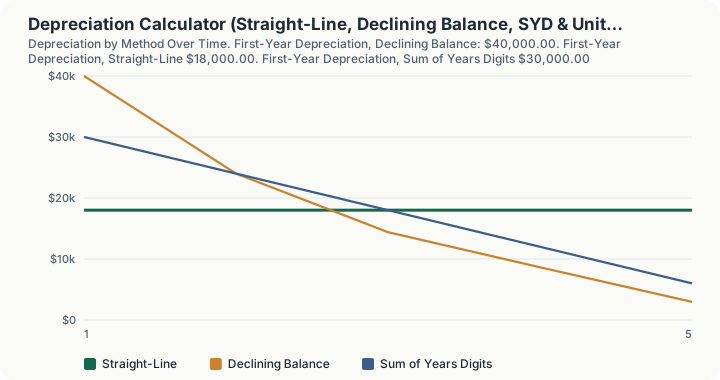
Quick Answer: A $100,000 asset with a $10,000 salvage value over five years depreciates $40,000.00 in year one under double declining balance, against $30,000 under sum of years digits, $25,000 under units of production at 25,000 units a year against a 90,000 unit lifetime estimate, and $18,000 straight-line. All four methods total exactly $90,000 over the life. Accelerated methods do not deduct more: only sooner.
What does this calculator do?
Four methods allocate the cost of an asset across its useful life, and the single most important thing about them is what they have in common: they all depreciate the same total amount. The depreciable base is cost less salvage, $90,000 on the default $100,000 asset, and every method exhausts it.
What differs is timing.
- Straight-line spreads the base evenly, $18,000 a year here. Simple, and what most financial statements use.
- Declining balance applies a fixed percentage to the reducing book value, front-loading the charge heavily: $40,000 in year one.
- Sum of years digits front-loads too, but more gently than double declining balance: $30,000 in year one.
- Units of production ignores time altogether and allocates by output, giving $25,000 in year one at the default 25,000 units against a 90,000 unit lifetime estimate.
Front-loading matters because a deduction taken today is worth more than the same deduction in five years. It does not change the total.
The fourth method is different in kind from the first three. Straight-line, declining balance and sum of years digits are all functions of elapsed time: the charge arrives whether or not the asset is used. Units of production is a function of usage, so an idle year charges $0.00 and a heavily worked year charges more.
How is this calculated?
Straight-line:
D = (Cost − Salvage)/Life
Declining balance applies a rate of factor ÷ life to the opening book value each year. At a factor of 2 over five years that is 40% a year. Note it applies to book value, not the depreciable base, which is why salvage does not affect the early years. The method switches to straight-line when that becomes more favourable, and never depreciates below salvage.
Sum of years digits weights each year by its remaining life over the sum of the digits. For a five-year asset the sum is 1+2+3+4+5 = 15, so year one takes 5/15 of the base, year two 4/15, and so on.
Units of production divides the depreciable base by the estimated lifetime output to get a rate per unit, then charges that rate against each year's actual output:
D_unit = (Cost − Salvage)/(Total Estimated Units); D_period = D_unit × Units_period
At the defaults that is $90,000 / 90,000 units = $1.0000 per unit, and 25,000 units a year gives $25,000 a year. The calculator applies the units figure you enter to every year of the useful life; it does not model a varying production profile. Two consequences the code enforces: a year with zero output takes zero expense, and once cumulative output reaches the lifetime estimate the remaining base is taken in that year and every later year charges nothing, so total depreciation still cannot exceed $90,000 however far actual output overshoots the estimate.
Worked Example
A machine shop capitalises a press at $100,000, expects to sell it for $10,000 after five years, and wants to see what each of the four methods charges in year one, and, more usefully, where book value sits once two years have run.
Step 1: The depreciable base. $100,000 cost - $10,000 salvage = $90,000
Every method below exhausts this same $90,000. Nothing that follows changes the total.
Step 2: Straight-line, year one. $90,000 / 5 years = $18,000
Step 3: The declining balance rate. factor 2 / 5-year life = 40% a year
Step 4: Declining balance, year one. 40% x $100,000 opening book value = $40,000
Note the rate applies to book value, not to the depreciable base. That is why year one is $40,000 rather than 40% of $90,000.
Step 5: The sum of the years digits. 1 + 2 + 3 + 4 + 5 = 15
Step 6: Sum of years digits, year one. $90,000 x 5/15 = $30,000
Step 7: The year-one spread. $40,000 declining balance - $18,000 straight-line = $22,000 taken earlier
Carrying Into Year Two
The second year is where the methods visibly separate, because declining balance now works on a book value that has already fallen.
Step 8: Opening book value under declining balance. $100,000 - $40,000 = $60,000
Step 9: Declining balance, year two. 40% x $60,000 = $24,000
Step 10: Straight-line, year two. $90,000 / 5 = $18,000 again, unchanged by definition
Step 11: Sum of years digits, year two. $90,000 x 4/15 = $24,000
Step 12: Accumulated depreciation after two years, declining balance. $40,000 + $24,000 = $64,000
Step 13: Accumulated depreciation after two years, straight-line. $18,000 + $18,000 = $36,000
Step 14: Accumulated depreciation after two years, sum of years digits. $30,000 + $24,000 = $54,000
Step 15: Book value after two years, declining balance. $100,000 - $64,000 = $36,000
Step 16: Book value after two years, straight-line. $100,000 - $36,000 = $64,000
Step 17: Book value after two years, sum of years digits. $100,000 - $54,000 = $46,000
Two years in, the same asset is carried at $36,000, $46,000 or $64,000 depending purely on the method chosen. That $28,000 spread between the extremes is not a difference in the asset: it is a difference in the accounting policy, and it reverses completely by year five, when all of them land on the $10,000 salvage value and all of them have charged $90,000.
Units of Production, Which Tracks Output Rather Than Time
Step 18: The rate per unit. $90,000 depreciable base / 90,000 estimated lifetime units = $1.0000 per unit
Step 19: Units of production, year one. $1.0000 x 25,000 units = $25,000
Step 20: Units of production, year two. $1.0000 x 25,000 units = $25,000, giving accumulated depreciation of $50,000 and a book value of $50,000
Step 21: Units of production, year three. $1.0000 x 25,000 units = $25,000, accumulated $75,000, book value $25,000
Step 22: Year four, where the estimate runs out. Cumulative output reaches 100,000 units against a 90,000 unit estimate, so the raw $25,000 charge is trimmed to what is left of the base: $25,000 book value - $10,000 salvage = $15,000
Step 23: Year five. Book value already equals salvage, so the charge is $0 no matter how many units the press turns out.
Accumulated depreciation under units of production therefore runs $25,000, $50,000, $75,000, $90,000, $90,000, and $90,000 is the same total as the other three methods reach.
If the press runs harder, at 40,000 units a year: year one takes $40,000, year two another $40,000, and year three is trimmed to the remaining $10,000. The asset is fully depreciated in three years instead of five, and the total is still $90,000.
If the press sits idle all year: the charge is $0. This is the one method under which an unused asset does not depreciate, and the reason a plant that shuts down for a year still reports straight-line expense but no units-of-production expense.
At a 1.5 factor instead of 2: the rate becomes 30%, giving $30,000 in year one: coincidentally the same as sum of years digits here, though the later years differ.
With no salvage value: declining balance still gives $40,000 in year one, because the rate applies to book value rather than the depreciable base. Straight-line rises to $20,000, since the whole $100,000 is now depreciable.
What does this calculator not account for?
- Tax depreciation. These are book methods. US tax depreciation uses MACRS, with its own class lives and half-year or mid-quarter conventions, handled by separate primitives and pages.
- Section 179 expensing and bonus depreciation, which can deduct much or all of an asset's cost immediately.
- Partial-year conventions. This assumes full years. Real assets are bought mid-year and most regimes prorate.
- A varying production profile. Units of production applies the single units figure entered to every year of the life. A real asset that produces 40,000 units in year one and 8,000 in year five needs the years entered separately, which this page does not offer.
- Component depreciation, where parts of an asset with different lives are depreciated separately.
- Impairment, which writes an asset down outside the normal schedule.
- Revaluation, permitted under IFRS but not US GAAP.
- Disposal. Selling above or below book value creates a gain or loss, and for tax purposes may trigger depreciation recapture.
What mistakes do people make with this?
- Believing accelerated methods deduct more. They do not. All four total the same $90,000 here. The benefit is the time value of taking deductions earlier, not a larger total.
- Applying the declining balance rate to the depreciable base. It applies to opening book value, which is why the year-one charge is $40,000 rather than 40% of $90,000.
- Forgetting the salvage floor. Declining balance would otherwise depreciate past salvage. The method stops there, which is also why it switches to straight-line late in life.
- Confusing book and tax depreciation. A company will commonly use straight-line in its accounts and MACRS on its return, and the difference creates deferred tax.
- Assuming double declining is always best. For an asset that genuinely wears evenly, straight-line reflects reality better, and financial statement users may prefer it.
- Ignoring the mid-year convention. Most real acquisitions get a partial first year, so a real year-one charge is often about half of what a full-year model shows.
Frequently Asked Questions
Which method deducts the most?
What happens under units of production if the asset outlives its unit estimate?
Why is year one $40,000 rather than 40% of the $90,000 base?
What does the factor mean?
Is this the same as MACRS?
Why would I choose straight-line?
When should I use units of production?
What happens at the end of the life?
Sources
- Internal Revenue Service, the official authority for the tax rules this calculator relates to. irs.gov
Also consulted: Standard accounting depreciation mathematics. Straight-line, declining balance and sum of years digits are conventional methods with no jurisdictional content; Units of production divides the depreciable base by estimated lifetime units and charges that rate against each period's output, trimming the period in which cumulative output reaches the estimate so the total never exceeds the base; The declining balance implementation switches to straight-line when advantageous and never depreciates below salvage value, which is the usual convention.