Quick Answer: For 2026, bonus depreciation is 100% and permanent, letting you deduct the full cost of qualifying property in the year you place it in service, a major change from the phase-down schedule that was previously in effect.
Overview
Bonus depreciation lets a business immediately deduct a percentage of the cost of qualifying property in the year it is placed in service, instead of spreading that deduction across the asset's normal multi-year MACRS recovery period. For years, this percentage was scheduled to decline: 100% through 2022, then stepping down to 80% in 2023, 60% in 2024, 40% in 2025, and 20% in 2026, before disappearing entirely in 2027 under the original Tax Cuts and Jobs Act of 2017.
That phase-down no longer applies. The One Big Beautiful Bill Act, signed into law on July 4, 2025, eliminated the scheduled decline entirely and restored 100% bonus depreciation on a permanent basis for qualified property acquired after January 19, 2025. This calculator uses that current 100% figure as its default, while still allowing you to model the old phase-down percentages for comparison, historical analysis, or planning around property acquired before the January 19, 2025 cutoff, which may still fall under the prior schedule's lower percentages.
How This Is Calculated
The calculator models three layers of first-year expensing that stack in a specific, IRS-mandated order.
Layer 1: Section 179 expensing. This is a separate election, distinct from bonus depreciation, that lets a business immediately expense qualifying property up to a dollar cap. For 2026, that cap is $2,560,000, and it phases out dollar-for-dollar once total qualifying property placed in service for the year exceeds $4,090,000, disappearing completely at $6,650,000 of purchases. Section 179 is applied first, and only to the extent taxable income allows (this calculator does not model the taxable income limitation, which is a separate constraint from the dollar cap).
Layer 2: Bonus depreciation. Whatever basis remains after any Section 179 election is then multiplied by the bonus depreciation percentage. At the current 100% rate, this means the entire remaining basis is expensed immediately, leaving nothing for regular depreciation. At a lower percentage, such as the old 40% rate for comparison, only that fraction of the remaining basis is immediately expensed.
Layer 3: Regular MACRS depreciation. Whatever basis is left after Section 179 and bonus depreciation is depreciated over the asset's normal recovery period using the IRS half-year convention percentage tables from Publication 946. The property class (3, 5, 7, 10, 15, or 20 years) determines which set of annual percentages applies. Under the half-year convention, an asset placed in service at any point during the year is treated as if placed in service at the midpoint, which is why the final year of the schedule also picks up a partial-year percentage.
Worked Example
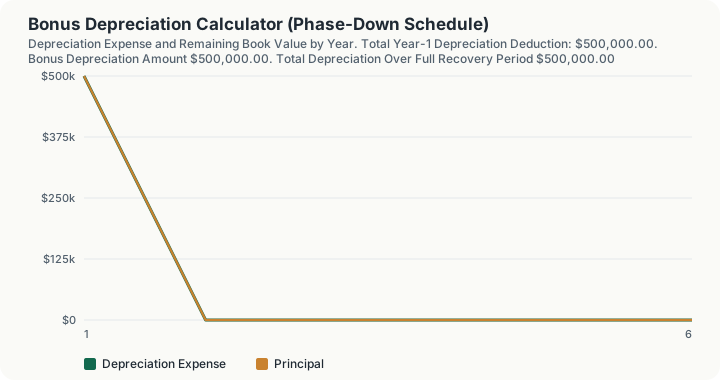
Scenario 1: Current 2026 law. A business places $500,000 of 5-year MACRS equipment into service, elects no Section 179, and applies the current 100% bonus depreciation rate. The entire $500,000 is deducted in year one, because 100% of the remaining basis after Section 179 (which is the full $500,000, since no Section 179 was elected) is immediately expensed. Nothing remains for regular MACRS depreciation in years two through six.
Scenario 2: Prior-law comparison. The same business instead places $200,000 of 5-year property into service, elects $50,000 of Section 179, and uses the old 40% bonus depreciation rate that applied for 2025 under prior law, for comparison purposes.
- After Section 179: $200,000 - $50,000 = $150,000 remaining basis.
- Bonus depreciation: $150,000 x 40% = $60,000.
- Remaining depreciable basis: $150,000 - $60,000 = $90,000, depreciated under the 5-year MACRS half-year table (20.00%, 32.00%, 19.20%, 11.52%, 11.52%, 5.76%).
- Year 1 total: the upfront $50,000 Section 179 plus $60,000 bonus depreciation, plus 20.00% of the remaining $90,000 basis ($18,000), for a total of $128,000.00.
- Years 2 through 6: $28,800.00, $17,280.00, $10,368.00, $10,368.00, and $5,184.00, which sum with year one to exactly $200,000.00, reconciling perfectly to the original cost.
Comparing the two scenarios on identical dollar amounts shows the practical effect of the law change: under the old 40% rate, a large majority of the deduction was still front-loaded into year one, but a meaningful remainder trickled out over five more years. Under the current 100% rate, that trickle disappears entirely.
Reading the Recovery Years Under 100% Bonus
Scenario 1 has an unusual schedule, and it is worth stepping through precisely because there is so little of it.
Step 1 -- Recovery year 1. Depreciation expense $500,000.00
Step 2 -- Recovery year 2. Depreciation expense $0.00
Step 3 -- Accumulated after two years. $500,000.00 + $0.00 = $500,000.00
Step 4 -- Remaining depreciable basis. $500,000.00 - $500,000.00 = $0.00
Step 5 -- Recovery years 3 through 6. $0.00 in each, because there is no basis left to recover
The entire five-year MACRS table is consumed before it starts. That is the cash-flow attraction of full expensing and also its trap: the deduction is a timing benefit, not a permanent one, and having taken all of it in year one the business faces years two through six with no depreciation shield at all against income the asset is still producing. A firm expecting higher marginal rates later, or expecting a loss year now, can be worse off electing 100% bonus than spreading the deduction, which is why the election is made asset class by asset class rather than by default.
What This Does Not Account For
- It does not model the Section 179 taxable income limitation. Section 179 expensing cannot exceed the business's taxable income from the active conduct of any trade or business; any excess carries forward to future years. This calculator only applies the dollar cap and phase-out, not the income limitation.
- It does not distinguish between different placed-in-service dates within the same tax year for property that straddles the January 19, 2025 OBBBA effective date. Property acquired before that date may still be subject to the prior law's phase-down percentage even in a 2025 or 2026 tax year; this calculator assumes the property qualifies for current law.
- It does not model state conformity. A significant number of states do not conform to federal bonus depreciation rules, or conform only partially, meaning your state tax deduction can differ substantially from the federal figure this calculator produces.
- It does not address qualified improvement property nuances, listed property limitations for vehicles, or the specific "original use" and "acquisition" requirements that determine whether property actually qualifies for bonus depreciation at all.
- It does not model depreciation recapture upon a future sale of the asset. Front-loading depreciation through Section 179 and bonus depreciation increases the amount of gain subject to recapture if the asset is later sold at a gain.
Common Pitfalls
- Assuming bonus depreciation still phases down as it did under prior law. Anyone relying on older articles, software, or spreadsheets built before mid-2025 may still show the 20% figure that was scheduled for 2026 under the original Tax Cuts and Jobs Act, before the One Big Beautiful Bill Act eliminated that phase-down.
- Confusing Section 179 and bonus depreciation as the same thing. They are separate elections with different rules: Section 179 has a dollar cap and a taxable income limitation and can be applied selectively asset by asset, while bonus depreciation, once elected (or not affirmatively opted out of, since bonus depreciation is generally automatic unless you elect out), generally applies uniformly to an entire class of property placed in service that year.
- Forgetting that 100% expensing accelerates, but does not increase, total depreciation. The total amount depreciated over an asset's life is always equal to its full depreciable basis regardless of how the deduction is timed; front-loading changes when you get the tax benefit, not how much benefit you ultimately receive.
- Ignoring the interaction with a sale. Because 100% bonus depreciation reduces the asset's basis to zero (or near zero) immediately, a subsequent sale of that asset for any meaningful amount can trigger a large recapture gain, which is fully taxable and easy to underestimate when planning purely around the initial deduction.
- Not checking whether used property qualifies. Bonus depreciation has applied to both new and used qualifying property since the 2017 Tax Cuts and Jobs Act, a change from much older law that limited bonus depreciation to new property only; some taxpayers still mistakenly believe only new equipment qualifies.
Frequently Asked Questions
Is 100% bonus depreciation guaranteed to stay in effect indefinitely?
What property actually qualifies for bonus depreciation?
Should I always elect the maximum Section 179 and bonus depreciation available?
Can I elect out of bonus depreciation if I want the deduction spread out instead?
Does bonus depreciation reduce my Social Security or self-employment tax?
Sources
- Thomson Reuters Tax & Accounting, "IRS Provides Guidance on Post-OBBB Bonus Depreciation." irs.gov
- IRS Publication 946, "How To Depreciate Property," Table A-1, for the MACRS half-year convention percentage tables used in this calculator. irs.gov/publications/p946
Also consulted: BDO, "One Big Beautiful Bill Act Expands 100% Depreciation Expensing Opportunities," confirming the permanent restoration of 100% bonus depreciation for property acquired after January 19, 2025; Section179.org, "2026 Section 179 Tax Deduction: Limits & Calculator," for the 2026 Section 179 dollar limit of $2,560,000 and phase-out threshold of $4,090,000, reflecting IRS Revenue Procedure 2025-32's inflation adjustments.