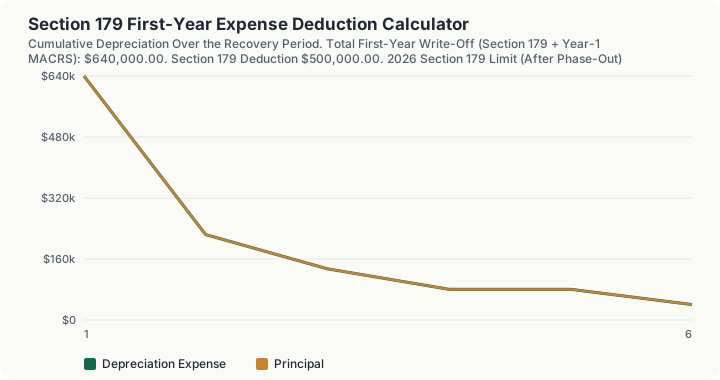
Quick Answer: Section 179 lets a business immediately expense up to $2,560,000 of qualifying equipment in 2026, phased out dollar-for-dollar once total qualifying purchases for the year exceed $4,090,000, with any remaining basis depreciated normally under MACRS. On this calculator's baseline, $1,200,000 of five-year property against $500,000 of business taxable income yields a $640,000 total first-year write-off: $500,000 of Section 179 capped by income, plus $140,000 of Year-1 MACRS on the $700,000 of basis left over.
Overview
Most business equipment can't be deducted all at once when purchased. Ordinarily it has to be capitalized and depreciated gradually over its useful life, a multi-year process called MACRS depreciation. Section 179 of the tax code is the major exception. It lets a business elect to immediately expense the full cost of qualifying equipment, up to an annual dollar limit, in the year it's placed in service, rather than spreading the deduction out over several years.
The limit and the phase-out threshold that sits above it are both adjusted for inflation every year, and both were substantially raised by the One Big Beautiful Bill Act, signed into law July 4, 2025, which permanently increased the base Section 179 limit to $2,500,000 and the phase-out threshold to $4,000,000, effective for tax years beginning after December 31, 2024, with both figures indexed for inflation starting with tax years beginning after December 31, 2025. For 2026, those inflation adjustments bring the actual limit to $2,560,000 and the phase-out threshold to $4,090,000. This calculator applies those exact 2026 figures, walks through the phase-out mechanics, and then depreciates whatever cost is left over using the platform's shared MACRS engine.
How This Is Calculated
The calculation runs in four steps.
Step 1: Apply the phase-out, if any. The Section 179 limit itself shrinks dollar-for-dollar once the total cost of all qualifying property your business places in service during the year, not just the single item you are evaluating, exceeds the $4,090,000 threshold. If your total qualifying purchases for the year are $4,500,000, for example, that is $410,000 over the threshold, and the available limit drops from $2,560,000 to $2,150,000. Once total purchases exceed the limit plus the threshold, roughly $6,650,000 for 2026, the adjusted limit hits zero and no Section 179 deduction is available at all for that year, a rule specifically designed to target the benefit at small and mid-sized businesses rather than very large capital-intensive companies.
Step 2: Cap the deduction at the smaller of cost or the (possibly reduced) limit. The tentative Section 179 deduction for the specific piece of equipment you are evaluating is the smaller of its actual cost or the limit from Step 1.
Step 3: Cap the deduction at business taxable income. Section 179 cannot create or increase a business loss. The deduction is further limited to your business's taxable income before the deduction itself; any amount that gets cut off by this limit carries forward to future years rather than being lost, though that carryforward mechanic is not modeled on this page.
Step 4: Depreciate whatever is left. Any cost not expensed under Section 179 becomes the depreciable basis for ordinary MACRS depreciation, using the IRS half-year convention tables from Publication 946. The calculator also lets you apply a bonus depreciation percentage to that remaining basis before the MACRS table percentages are applied, reflecting that bonus depreciation and Section 179 can be layered together on the same asset.
Worked Example
Income-limited case. A business buys $1,200,000 of five-year property, its only Section 179 purchase for the year, and has $500,000 of business taxable income before the deduction. Total qualifying purchases of $1,200,000 are well under the $4,090,000 threshold, so the full $2,560,000 limit is available, and the tentative deduction is the smaller of cost ($1,200,000) or the limit ($2,560,000), which is $1,200,000. But taxable income of only $500,000 caps the actual deduction at $500,000. The remaining $700,000 of basis is depreciated under five-year MACRS; the Year 1 table rate of 20% applies to that $700,000, producing $140,000 of additional first-year depreciation. Total first-year write-off: $500,000 + $140,000 = $640,000.
Phase-out case. A business buys $3,000,000 of seven-year property, and this is part of $4,500,000 of total qualifying purchases for the year. That total exceeds the $4,090,000 threshold by $410,000, which reduces the available limit from $2,560,000 to $2,150,000. With $5,000,000 of taxable income, that is not a further constraint, so the Section 179 deduction is the full $2,150,000. The remaining $850,000 of basis depreciates under seven-year MACRS, where the Year 1 table rate is 14.29%, producing $121,465.00 of additional first-year depreciation. Total first-year write-off: $2,150,000 + $121,465.00 = $2,271,465.00.
Full phase-out case. A business with $7,000,000 of total qualifying purchases for the year, well above the roughly $6,650,000 point where the limit hits zero, gets no Section 179 deduction at all on a $1,000,000 piece of equipment, regardless of its taxable income. The entire $1,000,000 depreciates under ordinary five-year MACRS instead, starting with $200,000 in Year 1.
Carrying the Income-Limited Case Through the Recovery Period
The MACRS schedule below the calculator runs the $700,000 of remaining basis out over six tax years, five-year property being recovered across six under the half-year convention.
Step 1 -- Year one. Depreciation expense $640,000.00, the $500,000 Section 179 deduction plus the 20% first-year table rate on the remaining basis. Ending book value $560,000.00
Step 2 -- Year two. Depreciation expense $224,000.00, accumulated $864,000.00, ending book value $336,000.00
Step 3 -- Year three. Depreciation expense $134,400.00, accumulated $998,400.00, ending book value $201,600.00
Step 4 -- Year six, the half-year tail. Depreciation expense $40,320.00, accumulated $1,200,000.00, ending book value $0.00
Accumulated depreciation reaches the full $1,200,000.00 cost. The income limitation did not shrink the total write-off in this schedule; it moved $700,000 of it out of year one and spread it across the five years that follow. Whether that timing is expensive depends entirely on what your marginal rate does over those years, which is the calculation this page cannot make for you.
What This Does Not Account For
This calculator does not model the Section 179 carryforward of any amount disallowed by the business-taxable-income limitation, which can be claimed in future years once income allows it. It does not distinguish between different categories of qualifying property beyond the five-year and seven-year MACRS classes offered here; Section 179 also covers certain real property improvements, off-the-shelf software, and other categories with their own specific rules and, in some cases, their own sub-limits, such as the separate $32,000 cap for 2026 on certain heavy sport utility vehicles. It does not model state conformity; many states cap their own Section 179 limit well below the federal figure or decouple from it entirely, so a large federal deduction does not always translate into an equally large state deduction. It does not model the interaction between Section 179 and 100% bonus depreciation beyond letting you apply a bonus percentage to the remaining basis; in practice, many businesses today can achieve a full first-year write-off through 100% bonus depreciation alone without needing Section 179 at all, and the choice between the two, or a blend, depends on business-specific factors like state conformity and taxable income management this calculator does not evaluate. It does not verify that specific equipment actually qualifies as Section 179 property, which generally must be tangible, depreciable business property used more than 50% for business purposes.
Common Pitfalls
- Applying the phase-out threshold to a single item instead of total purchases. The $4,090,000 threshold for 2026 is based on the combined cost of everything a business places in service during the year, not any single asset.
- Forgetting the taxable income limitation. A business having a break-even or loss year cannot use Section 179 to create a bigger loss; the deduction is capped at taxable income, with the excess simply carried forward.
- Assuming Section 179 and bonus depreciation are mutually exclusive. They are not. A business commonly applies Section 179 first (subject to its taxable-income and phase-out limits), then applies bonus depreciation to whatever basis remains, exactly as this calculator models.
- Not checking state conformity before promising a client or partner a specific state tax benefit. Several states impose a much lower Section 179 cap than the federal limit or do not allow it at all, which can create a meaningful gap between the federal and state deductions on the same purchase.
- Electing Section 179 on property that will be disposed of, converted to personal use, or drop below 50% business use shortly after purchase. Doing so can trigger depreciation recapture, effectively clawing back part of the deduction.
Frequently Asked Questions
What is the 2026 Section 179 deduction limit?
At what point does the phase-out completely eliminate the deduction?
Can I choose which specific assets to apply Section 179 to if I bought several this year?
Is Section 179 the same thing as bonus depreciation?
Does buying more equipment always increase my deduction?
Sources
- Internal Revenue Service, Revenue Procedure 2025-32 (2026 inflation-adjusted Section 179 limit and phase-out threshold), irs.gov/pub/irs-drop/rp-25-32.pdf
- Internal Revenue Service, Publication 946, How To Depreciate Property (MACRS half-year convention tables), irs.gov/publications/p946
- 26 U.S.C. Section 179, Internal Revenue Code, as amended by the One Big Beautiful Bill Act (Public Law 119-21, Section 70301) law.cornell.edu/uscode/text/26/179
- Internal Revenue Service, Form 4562 instructions, Depreciation and Amortization. irs.gov