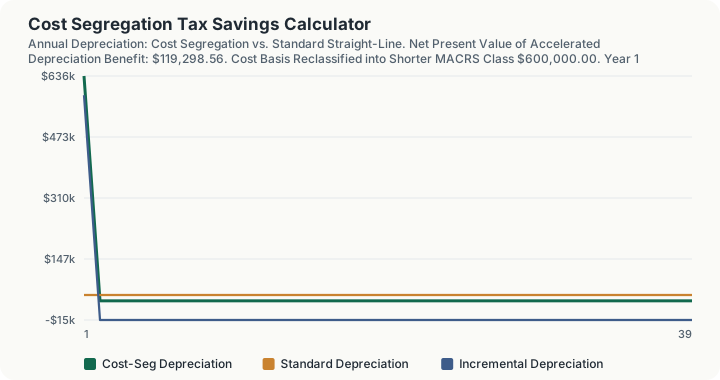
Quick Answer: Reclassifying 20% to 40% of a building's cost into shorter 5, 7, or 15-year MACRS property classes lets an owner front-load depreciation deductions, and because a tax dollar saved today is worth more than the same dollar saved decades from now, that acceleration has real, calculable present value even though the total depreciation claimed over the building's life never changes.
Overview
Under the default rules of IRC § 168(c), a commercial building is depreciated straight-line over 39 years, and a residential rental building over 27.5 years. Those default lives apply to the building as a single asset. But a building is not really one asset; it is an assembly of dozens of different components with genuinely different useful lives. Carpeting wears out and gets replaced long before the roof does. Certain electrical and plumbing work tied specifically to equipment, decorative millwork, specialty lighting, and site improvements like paving, fencing, and landscaping are all recognized under the tax code as shorter-lived personal property or land improvements, eligible for 5-year, 7-year, or 15-year MACRS recovery instead of the building's default life.
A cost segregation study is the engineering-based process of identifying and documenting which components of a purchased or newly constructed building qualify for these shorter classes, and what portion of the total cost basis they represent. Once identified, those components can be depreciated on the accelerated MACRS schedule (with the applicable half-year convention) rather than languishing on the 39-year straight-line schedule for the rest of the building. Properly performed studies typically reclassify somewhere between 20% and 40% of a building's total depreciable basis, depending on the property type; a hotel or restaurant, with extensive specialty electrical, plumbing, and finish work, tends to sit at the higher end of that range, while a simple warehouse tends to sit at the lower end.
The financial benefit of cost segregation is entirely a matter of timing, not magnitude. Every dollar of a building's basis gets fully depreciated eventually, whether it takes 39 years on the standard schedule or 5 years on an accelerated one. Cost segregation does not create new deductions out of nothing. What it does is move existing deductions earlier, which matters because of the time value of money: a dollar of tax saved this year can be reinvested, used to pay down debt, or simply held, and is worth strictly more than a dollar of tax saved twenty years from now. The value of a cost segregation study is best measured as the net present value of that acceleration, not as a raw total-dollars figure, because the raw total is identical with or without the study.
The picture has become significantly more dramatic since the One Big Beautiful Bill Act (OBBBA) permanently restored 100% first-year bonus depreciation for qualifying property acquired and placed in service after January 19, 2025. Under 100% bonus depreciation, property in a MACRS class of 20 years or less, which includes essentially everything a cost segregation study identifies, can be expensed entirely in the first year, rather than spread across its MACRS recovery schedule. Combined with a cost segregation study, this means a substantial share of a building's cost basis can become an immediate, first-year deduction.
How This Is Calculated
This calculator builds two parallel depreciation schedules for the same total building cost basis and compares them year by year.
Standard scenario: the entire basis is depreciated straight-line over the building's normal life, 39 years for commercial property or (approximately) 27.5 years for residential rental property.
Cost segregation scenario: the basis is split. The share identified as reclassified property is depreciated using the IRS half-year convention MACRS table for the chosen class (5, 7, or 15 years), with the bonus depreciation percentage applied first. The remaining share stays on the same 39-year or 27.5-year straight-line schedule as the standard scenario.
For each year, the calculator computes the difference between what would have been depreciated under the standard schedule and what is actually depreciated under the cost segregation schedule. That difference, multiplied by the owner's marginal tax rate, is the incremental cash tax savings (or, in later years, the incremental tax cost, since the standard schedule eventually "catches up") attributable to the study in that year. Each year's incremental tax savings is discounted back to the present using the chosen discount rate, and the sum of all discounted values is the net present value benefit:
`
NPV Benefit = Σ [ (Cost-Seg Depreciation(t) − Standard Depreciation(t)) × Tax Rate ] / (1 + Discount Rate)^t
`
Because both scenarios depreciate the exact same total cost basis, the year-by-year incremental depreciation figures always sum to zero across the full depreciation horizon; the calculator's schedule confirms this reconciliation explicitly. The NPV benefit is positive precisely because the large positive incremental amounts happen in the earliest years (heavily discounted less) and the offsetting negative amounts happen in far later years (heavily discounted more).
This calculator models a single representative MACRS class per run for the reclassified share, since that keeps the comparison and the schedule transparent. A real cost segregation study typically allocates across multiple classes simultaneously (some 5-year, some 7-year, some 15-year components); running this calculator once per class, with each class's respective share of the basis, approximates a full multi-class study.
Worked Example
An investor buys a commercial building with a $2,000,000 depreciable basis, excluding land. An engineering study reclassifies 30% of it into 15-year property -- parking, landscaping, specialty electrical -- which under current law is eligible for 100% bonus depreciation. The owner's marginal rate is 32% and they discount future cash at 8%.
Step 1 -- The reclassified amount. $2,000,000 x 30% = $600,000
Step 2 -- What stays on the long schedule. $2,000,000 - $600,000 = $1,400,000 over 39 years
Step 3 -- Year one depreciation without a study. $2,000,000 / 39 = $51,282.05
Step 4 -- Year one on the remaining basis with a study. $1,400,000 / 39 = $35,897.44
Step 5 -- Year one on the reclassified basis. $600,000 x 100% bonus = $600,000 expensed immediately
Step 6 -- Total year one depreciation with the study. $600,000 + $35,897.44 = $635,897.44
Step 7 -- The year one increase. $635,897.44 - $51,282.05 = $584,615.39
Step 8 -- Year one cash tax saved. $584,615.39 x 32% = $187,076.92
Year Two, Where the Bill Arrives
This is the half of the picture a promotional cost segregation pitch leaves out. The reclassified basis is gone, so year two depreciates less than doing nothing would have.
Step 9 -- Year two depreciation with the study. $1,400,000 / 39 = $35,897.44
Step 10 -- Year two depreciation without the study. $2,000,000 / 39 = $51,282.05
Step 11 -- Year two incremental depreciation. $35,897.44 - $51,282.05 = -$15,384.61
Step 12 -- Year two incremental tax effect. -$15,384.61 x 32% = -$4,923.08, a tax cost, not a saving
Step 13 -- Cumulative incremental depreciation after two years. $584,615.39 - $15,384.61 = $569,230.78
That -$15,384.61 repeats in every one of the remaining 38 years, and by year 39 the cumulative incremental depreciation is back to exactly zero.
Step 14 -- Total lifetime depreciation, either way. $2,000,000 with the study and $2,000,000 without it
Step 15 -- Net present value of the timing shift at 8%. = $119,298.56
Steps 8 and 15 are the two numbers a seller of these studies will quote very differently. Nothing was deducted that would not have been deducted anyway -- step 14 is emphatic about that -- so the entire economic benefit is $119,298.56 of present value bought by moving $584,615.39 of deduction forward and paying it back at $15,384.61 a year. The study's own fee comes out of that $119,298.56, not out of the $187,076.92.
What This Does Not Account For
- The IRS mid-month depreciation convention. Real depreciation schedules prorate the first and last year based on the specific calendar month the property is placed in service; this calculator uses whole-year amounts for simplicity.
- The cost of the cost segregation study itself. Engineering-based studies typically cost several thousand to tens of thousands of dollars depending on building size and complexity; this fee should be subtracted from the NPV benefit shown here to get a true net return on the study.
- Depreciation recapture on sale. Accelerated depreciation taken now generally increases the depreciation recapture exposure (taxed up to 25% for real property, and as ordinary income for personal property components) when the building is eventually sold. See the separate depreciation recapture calculator on this site.
- Multiple simultaneous MACRS classes. A real study usually spans more than one class at once; this calculator models one class per run.
- Passive activity loss limitations, at-risk rules, and the excess business loss limitation, all of which can defer or limit an owner's ability to actually use large first-year depreciation losses against other income.
- State tax conformity. Some states decouple from federal bonus depreciation rules entirely, which materially changes the after-state-tax value of the acceleration.
Common Pitfalls
- Treating the total depreciation figure as "extra" money. Cost segregation does not increase total lifetime depreciation. It only changes when it is claimed. Evaluating the benefit on anything other than a present-value or discounted-cash-flow basis overstates its true worth.
- Ignoring depreciation recapture at sale. Front-loading depreciation increases the recapture liability due when the property is eventually sold, which partially offsets the acceleration benefit; the two should always be evaluated together for a full holding-period analysis.
- Forgetting passive loss limitations. A large first-year loss from bonus-depreciated cost segregation components may not be immediately usable against an owner's other income if passive activity loss rules apply, turning an expected current-year cash benefit into a suspended loss carried forward.
- Applying a reclassification percentage outside the typical 20%-40% range without a real study to support it. Aggressive, unsupported reclassification percentages are one of the more common triggers for IRS scrutiny of cost segregation studies.
- Assuming state tax treatment mirrors federal treatment. A number of states do not conform to federal bonus depreciation, meaning the state-level benefit can be substantially smaller than the federal benefit modeled here.
Frequently Asked Questions
Does cost segregation actually increase how much I can deduct in total?
What share of a building's cost can typically be reclassified?
How does 100% bonus depreciation change the cost segregation math?
Will I owe more tax when I sell the building because of the accelerated depreciation?
Is a cost segregation study worth doing for every building?
Sources
- Internal Revenue Code § 168(c), recovery periods for nonresidential real property (39 years) and residential rental property (27.5 years). law.cornell.edu/uscode/text/26/168
- Internal Revenue Service, Publication 946, "How To Depreciate Property," Table A-1 (half-year convention). irs.gov/publications/p946
- Internal Revenue Service Notice 2026-11, interim guidance on post-OBBBA bonus depreciation. irs.gov
- Internal Revenue Code § 1245 and § 1250, depreciation recapture on the disposition of business property. law.cornell.edu/uscode/text/26/1245
Also consulted: Internal Revenue Code § 168(e), classification table for 5, 7, and 15-year MACRS property; Internal Revenue Code § 168(k), as amended by the One Big Beautiful Bill Act (Pub. L. 119-21, enacted July 4, 2025), permanent 100% bonus depreciation for property placed in service after January 19, 2025.