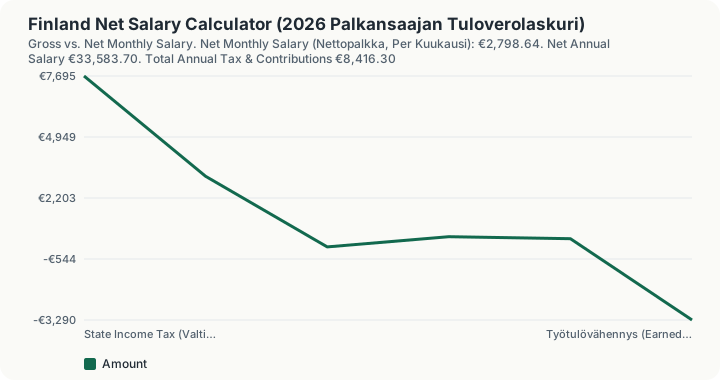
Quick Answer: An employee in Finland earning a €42,000.00 gross annual salary, paying the 2026 national-average municipal tax rate of 7.57% and no church tax, takes home an estimated €33,583.70 net per year (€2,798.64 net per month) in 2026 -- after €7,695.30 in state income tax (valtion tulovero), €3,179.40 in municipal tax (kunnallisvero), and €831.60 in health insurance contributions (sairausvakuutusmaksu), reduced by a €3,290.00 työtulövähennys (earned-income tax credit), for €8,416.30 in total tax and contributions.
Overview
Finland's wage-earner tax system runs through several layers that stack on top of one another: a progressive state income tax (valtion tulovero) set nationally, a flat-rate municipal tax (kunnallisvero) that varies by all of Finland's municipalities, an optional church tax (kirkollisvero) for members of the Evangelical Lutheran or Orthodox Church, and a two-part health insurance contribution (sairausvakuutusmaksu) that funds Kela's national health insurance system. Working against all of these is the työtulövähennys (earned-income tax credit) -- a substantial credit that reduces your total tax bill directly, not just your taxable income, and which most online "quick" tax estimates leave out entirely, overstating what wage earners actually owe.
This calculator is for the country of Finland, and every figure is denominated in euros (€) -- Finland's currency, distinct from Sweden's krona, Norway's krone, or Denmark's krone. It models the full 2026 combination: the five-bracket state income tax schedule (notably simplified for 2026, after the temporary "solidaarisuusvero" surtax on very high incomes was repealed), the perusvähennys basic allowance that shields municipal tax on lower incomes, your chosen municipal and church tax rates, both components of the health insurance contribution, and the työtulövähennys credit that offsets all of the above.
How This Is Calculated
- Perusvähennys (municipal basic allowance). Applies only to municipal tax, church tax, and health insurance -- not state tax. If your gross salary is at or below €4,265, the entire amount is deducted; above that, the allowance shrinks by 18% of the excess, reaching zero at roughly €27,959.
- State income tax (valtion tulovero). A five-bracket progressive schedule applied directly to gross salary for 2026:
| Bracket (taxable income) | Marginal rate |
|---|---|
| €0-€22,000 | 12.64% |
| €22,000-€32,600 | 19.00% |
| €32,600-€40,100 | 30.25% |
| €40,100-€52,100 | 33.25% |
| Above €52,100 | 37.50% |
- Municipal tax (kunnallisvero) and church tax (kirkollisvero). Both are flat-rate taxes applied to gross salary minus the perusvähennys. Municipal tax is mandatory and set independently by each municipality (4.70%-10.90% in 2026, national average 7.57%); church tax applies only to registered parish members, at a rate their parish sets (1.0%-2.0% in 2026, average 1.66%).
- Health insurance contribution (sairausvakuutusmaksu). Two separate components: the sairaanhoitomaksu (health care contribution), 1.10% of the same perusvähennys-reduced base as municipal tax; and the päivärahamaksu (daily allowance contribution), 0.88% of your full gross wage -- but only if your annual wage reaches at least €17,255. Below that threshold, no päivärahamaksu is charged at all; at or above it, the full wage is charged, not just the amount above the threshold.
- Työtulövähennys (earned-income tax credit). A credit -- not a deduction -- worth 18% of gross salary, capped at €3,430. Above €35,000 of gross salary, the credit shrinks by 2% of the excess, but never falls below €3,119 (the floor reached once salary hits €50,550, since 3,430 − 2%×15,550 = 3,119).
- Net salary. Gross salary, minus state tax, municipal tax, church tax, and health insurance contributions, plus back the työtulövähennys credit.
Worked Example
Using the calculator's default inputs:
- Gross Annual Salary: €42,000.00
- Municipal Tax Rate: 7.57% (2026 national average)
- Church Tax: Not a member (0%)
Step by step:
- Perusvähennys: 42,000 > 4,265, so 4,265 − 18%×(42,000−4,265) = 4,265 − 6,792.30 → negative → €0.00. Municipal tax base = €42,000.00.
- State income tax: 22,000×12.64% + 10,600×19% + 7,500×30.25% + 1,900×33.25% = 2,780.80 + 2,014.00 + 2,268.75 + 631.75 = €7,695.30.
- Municipal tax: 42,000×7.57% = €3,179.40. Church tax: not a member → €0.00.
- Health insurance: sairaanhoitomaksu = 42,000×1.10% = €462.00; päivärahamaksu (42,000 ≥ 17,255) = 42,000×0.88% = €369.60; total = €831.60.
- Työtulövähennys: base = min(42,000×18%, 3,430) = 3,430 (capped); phase-out = (42,000−35,000)×2% = €140.00; credit = 3,430 − 140 = €3,290.00.
- Total tax before credit: 7,695.30 + 3,179.40 + 0.00 + 831.60 = €11,706.30. After credit: 11,706.30 − 3,290.00 = €8,416.30.
- Net salary: €42,000.00 − €8,416.30 = €33,583.70/year, or €2,798.64/month.
For comparison, the same salary earner in Kauniainen (4.70% municipal tax, the lowest 2026 rate) would owe considerably less municipal tax and take home more per month. A higher earner at €80,000/year in Halsua (10.90%, the highest 2026 rate) with 1.5% church tax owes €21,516.05 in state tax, €8,720.00 in municipal tax, and €1,200.00 in church tax, netting €4,174.91/month.
What This Does Not Account For
- TyEL pension insurance and unemployment insurance contributions. A real Finnish payslip also deducts the employee's TyEL earnings-related pension contribution (roughly 7.15%-8.65% of gross, depending on age) and unemployment insurance contribution (roughly 0.5%-1.5%). In reality, these are subtracted from gross before state and municipal tax are calculated, reducing the real taxable base below gross salary. This calculator applies tax directly to gross salary and does not model either contribution -- so it does not reproduce a full payslip figure, only the four components explicitly covered here.
- The order in which työtulövähennys is credited. By law, the credit is applied first against state tax, then municipal tax, then health insurance contributions, then church tax, in that specific sequence. This calculator applies it against the combined total instead -- the bottom-line net salary is identical either way, but the individual line-item breakdown may differ by a few cents from an official crediting-order allocation.
- The child bonus to työtulövähennys. Taxpayers with minor children get an additional €105 added to their työtulövähennys cap per child; this is not modeled.
- Per-municipality exact kunnallisvero/kirkollisvero. Rather than modeling all of Finland's municipalities and parishes individually, this calculator uses an adjustable rate defaulting to the 2026 national average; enter your own municipality's and parish's published rate for a more precise estimate.
- Other itemized deductions. Commuting cost deductions (matkakuluvähennys), union dues, and other itemized earned-income deductions beyond perusvähennys and työtulövähennys are not included.
Common Pitfalls
- Forgetting TyEL and unemployment insurance entirely change the "real" take-home figure. This calculator's net salary is higher than a real payslip's net salary would be, because it doesn't subtract the ~8-10% combined TyEL and unemployment insurance contributions a real employer withholds. Treat this as an estimate of the tax-and-health-insurance layer only, not a full payslip replica.
- Assuming työtulövähennys is a deduction from taxable income. It isn't -- it's a credit subtracted directly from the tax bill itself, which is why it has an outsized effect on lower and middle incomes relative to its modest-sounding 18% headline rate.
- Ignoring how much municipal tax varies. The gap between Kauniainen's 4.70% and Halsua's 10.90% is more than 6 percentage points of your entire municipal-taxable income -- a very large swing for anyone comparing job offers or relocation across Finnish municipalities.
- Assuming everyone pays church tax. Only registered members of the Evangelical Lutheran or Orthodox Church pay kirkollisvero; if you're not a member (or have formally resigned, "eroaminen kirkosta"), your rate is 0%.
Frequently Asked Questions
What is työtulövähennys and why does it matter so much?
Why doesn't my result match my actual payslip?
Do I have to pay church tax?
Why is the state tax schedule different in 2026 than in recent years?
How much does my municipality actually matter?
Sources
- Vero.fi press release / Veronmaksajain Keskusliitto ry -- 2026 kirkollisveroprosentit (church tax rates): average 1.66%, range 1.0%-2.0%. vero.fi
Also consulted: Veronmaksajain Keskusliitto ry (Finnish Taxpayers' Association) -- 2026 state income tax bracket table (mirroring Finlex 1140/2025, "Laki vuoden 2026 tuloveroasteikosta"), cross-checked against independently reported total-tax reference points at several income levels; Veronmaksajain Keskusliitto ry -- 2026 ansiotulosta tehtävät vähennykset (earned-income deductions): työtulövähennys (18%, €3,430 cap, phase-out €35,000-€50,550) and perusvähennys (€4,265 cap, 18% reduction rate); Veronmaksajain Keskusliitto ry -- 2026 kunnallisveroprosentit (municipal tax rates): national average 7.57%, range 4.70%-10.90%; Vero.fi -- "Vakuutetun sairausvakuutusmaksu" official guidance; Valtioneuvosto/Sosiaali- ja terveysministeriö press release confirming 2026 sairaanhoitomaksu (1.10%) and päivärahamaksu (0.88%, €17,255 threshold) rates.