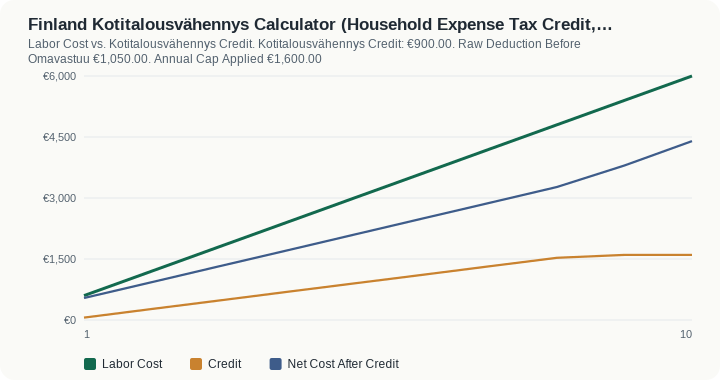
Quick Answer: Paying a registered company €3,000.00 in labor costs (työkorvaus) for home renovation, domestic help, or care services in Finland lets you claim a €900.00 kotitalousvähennys tax credit for 2026: 35% of the labor cost (€1,050.00), minus the €150.00 annual self-paid deductible (omavastuu).
What does this calculator do?
Kotitalousvähennys is Finland's household expense tax credit: a direct reduction in your tax bill (not just taxable income) for money spent on home renovation and maintenance work, domestic help, or care/nursing services, whether you buy the work from a registered company or directly employ someone yourself. It's one of the most widely used personal tax credits in Finland, and it's genuinely worth understanding closely: the credit rate, cap, and deductible differ significantly depending on how you arrange the work.
For 2026, current law sets the credit at 35% of the labor-cost portion of an invoice from a registered company (työkorvaus), or 13% of wages if you employ someone directly yourself (palkka), plus, in the direct-employment case, your mandatory employer side costs (sivukulut: health insurance, pension, accident, and unemployment insurance contributions) are separately fully deductible on top of that 13%. Either way, there's a €1,600 per person, per year cap, and a €150 per year self-paid deductible (omavastuu) below which no credit is given at all. A couple who each separately claim the credit for shared household expenses can receive up to €3,200 combined. All figures are in euros (€), Finland's currency.
A note on a pending, but not yet enacted, proposal: as of this calculator's verification date, Finland's government had submitted a bill to Parliament proposing to raise the rate to 40% and the cap to €2,100, intended to apply retroactively for tax year 2026 if passed. That bill had not yet been enacted at the time of writing: its own official announcement stated implementation "depends on Parliament's schedule." This calculator uses the current, confirmed 35%/€1,600 figures, not the pending proposal, so as not to overstate a benefit that may not (yet) exist. Check vero.fi for the latest status if you're filing near year-end.
How is this calculated?
Raw Deduction = (Rate × Labor Cost) + Employer Side Costs (if directly employed)
Credit = min(Cap, max(0, Raw Deduction − € 150))
Where the rate and cap depend on how the work was arranged:
| Work Type | Rate | Annual Cap |
|---|---|---|
| Bought from a company (työkorvaus) | 35% | €1,600 |
| Directly employed (palkka) + side costs | 13% of wages + 100% of side costs | €1,600 |
| Oil-heating replacement, bought from a company (2022-2027) | 60% | €3,500 |
| Oil-heating replacement, directly employed (2022-2027) | 30% | €3,500 |
The €150 omavastuu applies once per person per tax year, regardless of how many separate jobs you claim it against, so it's most efficient to combine multiple smaller jobs onto one claim rather than letting the deductible eat into several small claims separately.
Worked Example
Using the calculator's default inputs:
- Work Type: Bought From a Company (Työkorvaus)
- Labor Cost: €3,000.00
- Oil Heating Replacement: No
Step by step:
- Rate: Company-purchased work → 35%.
- Raw deduction: €3,000.00 × 35% = €1,050.00.
- After omavastuu: €1,050.00 − €150.00 = €900.00.
- Cap check: €900.00 is below the €1,600.00 standard cap, so no capping applies.
- Kotitalousvähennys credit: €900.00.
For comparison, a larger €6,000.00 job at the same 35% rate would produce a raw deduction of €2,100.00, or €1,950.00 after the omavastuu, which exceeds the €1,600.00 cap, so the credit is capped at €1,600.00 exactly, with €350.00 of otherwise-eligible expense going unused. A household replacing oil heating with a €5,000.00 company-purchased installation, however, gets the elevated 60% rate: €5,000.00 × 60% = €3,000.00, minus €150.00 omavastuu = €2,850.00, well within the higher €3,500.00 oil-heating cap.
What does this calculator not account for?
- The pending 40%/€2,100 proposal. As detailed above, a bill to raise the standard rate and cap was before Parliament as of this calculator's verification, intended to apply retroactively to 2026 if passed, but it was not yet law. This calculator will need updating once/if that bill is enacted; check vero.fi for the current status.
- Materials and non-labor costs. Only the labor portion of an invoice from a company is eligible: VAT-inclusive materials, equipment, and travel costs billed separately are not eligible for the credit, and this calculator assumes the labor-cost input you provide already excludes materials.
- Doubling the cap for couples. The credit is personal: each spouse in a household can separately claim up to their own €1,600 cap (€3,200 combined) against shared expenses. This calculator computes the credit for one applicant at a time; if you and a partner are both claiming, run the calculator once per person's share of the eligible cost.
- The +105 €/child child bonus to a different credit. This calculator's kotitalousvähennys is unrelated to the separate työtulövähennys child bonus modeled in our net salary calculator: the two are distinct credits.
- Combining ordinary work and oil-heating-replacement work in the same year. The €150 omavastuu applies once per person per year in total, not once per work category; this calculator models each work type in isolation and does not combine a mixed claim across both categories in a single computation.
- Income tax liability limits. Like most Finnish tax credits, kotitalousvähennys can only reduce your tax bill down to zero: it is not refundable beyond your actual tax liability for the year. This calculator computes the theoretical credit amount, not whether your specific tax bill is large enough to absorb it.
What mistakes do people make with this?
- Forgetting the €150 omavastuu applies before the cap, not after. A common mental-math error is applying the cap first and the deductible second; the correct order is: compute the raw percentage-based deduction, subtract the €150 deductible once, and only then compare the result to the cap.
- Assuming materials are eligible. Only labor is eligible when buying from a company: a renovation invoice that bundles materials and labor together needs to be itemized to isolate the labor-only portion before applying the 35% rate.
- Using the direct-employment rate for company-purchased work, or vice versa. The rate difference is dramatic (35% vs. 13%): always match the rate to how the work was actually arranged, not to whichever produces a better result.
- Not claiming your spouse's separate €1,600 cap. Because the credit is personal, a couple splitting a large renovation bill and each claiming their own share can together access up to €3,200: many taxpayers unknowingly leave this on the table by only claiming under one person's name.
- Assuming the pending 40%/€2,100 proposal is already in effect. As of this calculator's verification, it was still a bill before Parliament, not enacted law: don't budget around it until it's confirmed passed.
Frequently Asked Questions
Has the rate really not changed to 40% yet?
What counts as eligible work for kotitalousvähennys?
Can both spouses claim it for the same renovation?
Why is the direct-employment rate so much lower than the company rate (13% vs. 35%)?
Is there really a special rate for giving up oil heating?
Sources
- Vero.fi: official 2026 press release, "Kotitalousvähennykseen ehdotetaan korotusta, matkakulujen omavastuu pienenee," confirming current law (35%/13%, €1,600 cap, €150 omavastuu) and explicitly describing the 40%/€2,100 increase as a pending, not-yet-enacted government bill. vero.fi/tietoa-verohallinnosta/uutishuone/lehdist%C3%B6tiedotteet/2026/kotitalousvahennykseen-ehdotetaan-korotusta-matkakulujen-omavastuu-pienenee
Also consulted: Veronmaksajain Keskusliitto ry (Finnish Taxpayers' Association), corroborating summary of current kotitalousvähennys rates, the personal €1,600/€3,200-per-couple cap structure, and the €150 omavastuu; Veronmaksajain Keskusliitto ry and Finnish energy-renovation industry sources, corroborating the 2022-2027 oil-heating-replacement enhanced rate (60%/30%) and €3,500 cap.