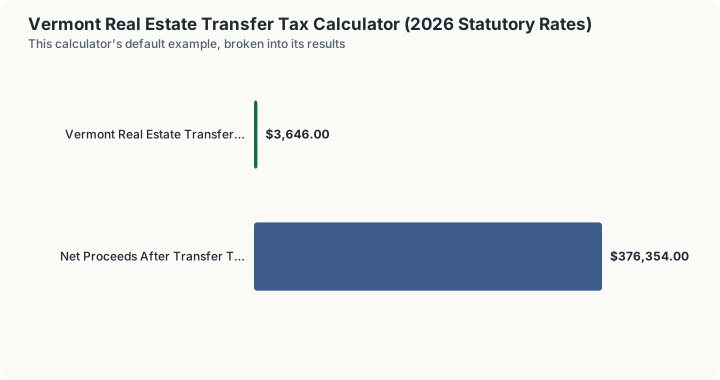
Quick Answer: A $380,000 principal-residence home sale in Vermont owes $3,646.00 in Property Transfer Tax, driven by a two-tier marginal structure of 0.5% on the first $200,000 and 1.47% on the remainder.
Overview
Vermont's Property Transfer Tax under 32 V.S.A. Section 9602 splits into two very different schedules depending on how the property will be used. For a principal residence, the first $200,000 of value is taxed at just 0.5%, and everything above that is taxed at a combined 1.47%, the base 1.25% rate plus a 0.22% Clean Water Surcharge. Non-principal-residence property, including second homes, rentals, and investment purchases, instead faces a flat 3.40% rate (3.62% with the surcharge) on the entire value, more than double the effective rate on a comparable primary residence.
Vermont is also unusual among taxed states in assigning payment to the buyer rather than the seller, a reversal of the norm found in most other states with a transfer tax. This calculator applies the principal-residence schedule as its default, since that is the applicable schedule for the large majority of Vermont home purchases; a second-home or investment purchase should budget for the substantially higher flat non-principal-residence rate instead.
How This Is Calculated
Vermont taxes a principal residence on a two-tier marginal schedule, and taxes everything else at a far higher flat rate. This calculator models the principal-residence case.
| Portion of Purchase Price | Marginal Rate |
|---|---|
| $0 to $200,000 | 0.5% |
| Above $200,000 | 1.47% |
The 1.47% top tier is the 1.25% general rate plus the 0.22% Clean Water Surcharge. Being marginal, it applies only to dollars above $200,000: the first $200,000 stays at 0.5% no matter how much the house costs. The engine walks both tiers and sums them.
A second home, a rental, or any other non-principal residence is taxed at a flat 3.4%, or 3.62% including the surcharge, on the whole price. That is a different calculation and is not what the number above shows.
Worked Example
Vermont's transfer tax has a low first tier and then a steep jump, and at typical Vermont prices most of the consideration sits in the upper tier. The baseline sale shows why.
Step 1 -- The consideration. Contract sale price = $380,000
Step 2 -- Tier 1, the first $200,000 at 0.5%. $200,000 x 0.005 = $1,000.00
Step 3 -- Tier 2, the portion above $200,000 at 1.47%. $180,000 x 0.0147 = $2,646.00
Step 4 -- Total transfer tax due. $1,000.00 + $2,646.00 = $3,646.00
Step 5 -- Net proceeds after tax. $380,000.00 - $3,646.00 = $376,354.00
Step 6 -- The effective rate. $3,646.00 / $380,000 = 0.959%
Now the calculator's $1,500,000 scenario.
Step 7 -- Tier 1 unchanged. $200,000 x 0.005 = $1,000.00
Step 8 -- Tier 2 on the remaining $1,300,000. $1,300,000 x 0.0147 = $19,110.00
Step 9 -- Total transfer tax due. $1,000.00 + $19,110.00 = $20,110.00
Step 10 -- The effective rate at $1.5M. $20,110.00 / $1,500,000 = 1.341%
The $200,000 boundary is marginal rather than a cliff, and the test confirms it: a $199,000 sale owes $995.00, a $201,000 sale owes $1,014.70. Two thousand dollars of price adds $19.70 of tax, not a step change. What makes Vermont distinctive is how low the boundary sits. At $200,000 it is far below the state's median sale price, so on almost every real Vermont transaction the 1.47% upper tier does most of the work and the 0.5% relief applies to a shrinking fraction of the price, which is why the effective rate climbs from 0.959% to 1.341% between Steps 6 and 10. The 1.47% figure itself is the general 1.25% rate plus the 0.22% Clean Water Surcharge. Every figure above assumes a principal residence; a second home, rental or investment property is taxed at a flat 3.40% instead, plus the surcharge, and the engine does not model that schedule.
What This Does Not Account For
- Non-principal-residence purchases. Second homes, rental property, and investment real estate are taxed at a flat 3.40% (3.62% with the Clean Water Surcharge) applied to the entire purchase price, not the tiered schedule modeled here. This calculator assumes a primary-residence purchase.
- The homestead exemption for lower-value principal residences. Vermont exempts a portion of a qualifying principal residence's value (indexed periodically) from the general Property Transfer Tax under certain conditions; this calculator does not model that partial exemption.
- Town clerk recording fees. Vermont town clerks charge a separate flat recording fee to file the deed, unrelated to the value-based Property Transfer Tax calculated here.
- Current use (Act 250) land use change tax. Property enrolled in Vermont's current use program can trigger a separate land use change tax upon certain transfers, which is entirely distinct from the Property Transfer Tax and not modeled by this calculator.
Common Pitfalls
- Applying the 1.47% rate to the entire purchase price. Vermont's Property Transfer Tax is marginal for principal residences, so only the portion above $200,000 is taxed at 1.47%; applying that rate to the full price overstates the tax, especially on lower-value homes.
- Using the principal-residence rate for a second home or rental. Vermont's flat 3.40% (3.62% with surcharge) rate for non-principal-residence property is more than double the effective rate most buyers see on their primary home, and applying the wrong schedule produces a materially wrong number.
- Forgetting the Clean Water Surcharge. The 0.22% surcharge is easy to overlook because it is layered on top of the 1.25% general tax rather than appearing as its own separate line item on most closing summaries, but it is part of the statutory 1.47% combined rate above $200,000.
- Assuming the seller pays. Vermont's Property Transfer Tax is a buyer-paid tax, unlike some states' conveyance taxes that fall on the seller by default; buyers budgeting a Vermont purchase need to include it in their cash-to-close figure.
Frequently Asked Questions
What is Vermont's real estate transfer tax rate?
Who pays the Property Transfer Tax in Vermont?
Does this calculator model second-home or investment property purchases?
Why does Vermont's effective rate keep rising as the sale price increases?
What is the Clean Water Surcharge included in Vermont's rate?
Sources
- Vermont Department of Taxes: Property Transfer Tax guidance under 32 V.S.A. 9602. tax.vermont.gov