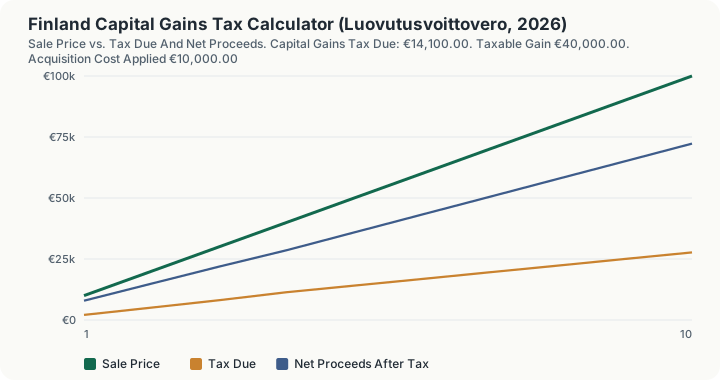
Quick Answer: Selling shares for €50,000.00 that you bought 3 years ago for €8,000.00, while also receiving €5,000.00 of dividends the same year, produces €14,100.00 of Finnish capital gains tax for 2026. The hankintameno-olettama deemed acquisition cost of €10,000.00 (20% of the sale price) beats your €8,000.00 actual cost, so the taxable gain is €40,000.00. Pooled with the dividends, your taxable capital income is €45,000.00, taxed at 30% on the first €30,000.00 (€9,000.00) and 34% on the remaining €15,000.00 (€5,100.00).
Overview
Finland taxes capital income (pääomatulo) on a schedule entirely separate from the one that applies to wages. Where earned income runs through a five-bracket state schedule plus municipal tax, church tax and health insurance contributions, capital income faces just two rates: 30% on the first €30,000 of taxable capital income per person per calendar year, and 34% on everything above that. Capital gains on the sale of shares, funds, property, cryptocurrency and other assets (luovutusvoitto) are taxed under this schedule.
Two features of the Finnish system surprise people more than any others, and this calculator is built around both.
The first is pooling. The €30,000 threshold is not applied to each gain separately, and it is not applied to gains as a category. It is applied to your combined taxable capital income for the year: capital gains, taxable dividends, rental income, and interest that was not already subject to final source withholding all land in one pot, and the 34% rate begins where that pot passes €30,000. A €25,000 gain is not automatically a 30%-rate event. If the same person also collected €20,000 of rental income, half that gain sits above the threshold and is taxed at 34%. Timing a disposal without looking at the rest of your capital income for the year is the single most expensive mistake available here.
The second is the hankintameno-olettama, or deemed acquisition cost. Rather than deducting what you actually paid, a natural person or a domestic estate may deduct a flat statutory percentage of the sale price: 20% if the asset was owned for less than 10 years, or 40% if it was owned for 10 years or more. You use whichever basis produces the lower taxable gain, and in practice Vero applies the more favorable one for you. For an asset that has appreciated dramatically -- old shares, a cottage bought decades ago, an inherited holding whose original cost documentation is long gone -- the deemed cost is frequently worth far more than the real one. The catch is that when you use it, no other deduction is allowed alongside it: broker commissions, selling costs and improvement expenditure all vanish. The comparison is therefore between (actual cost plus selling expenses) and (the deemed percentage of the sale price), which is exactly the comparison this calculator runs.
On top of that sit two exemptions and a loss-relief regime, all of which this calculator models: the own-home exemption for a permanent residence held and lived in for at least two years, the small-disposal exemption for a year in which total sale proceeds stay at or below €1,000, and tappiontasaus, the rule allowing capital losses to be carried forward for five years.
This calculator is denominated in euros (€), Finland's currency.
How This Is Calculated
The calculation runs in five steps.
Step 1 -- choose the acquisition basis. The deemed cost depends only on the sale price and the holding period:
The actual basis is the real cost plus any selling and improvement expenses. The calculator uses the larger of the two, because a larger deductible basis means a smaller gain:
Step 2 -- compute the gross gain.
Because the deemed cost is always a fraction of the sale price, a disposal computed on the deemed basis can never produce a loss -- it produces a gain of either 80% or 60% of the sale price. Only the actual-cost basis can generate a deductible loss.
Step 3 -- apply any exemption. If the dwelling was your own or your family's permanent home and you both owned it and lived in it for at least two years, the whole gain is exempt. Separately, if your total sale proceeds from property disposals across the calendar year came to €1,000 or less, the gain is exempt.
Step 4 -- pool with other capital income and apply losses.
Step 5 -- apply the two-step rate schedule.
Worked Example
Using the calculator's default inputs:
- Sale Price: €50,000.00 (shares)
- Actual Acquisition Cost: €8,000.00
- Years Owned: 3
- Other Capital Income This Year: €5,000.00 (dividends)
Step by step:
- Deemed acquisition cost: the shares were owned under 10 years, so 20% × €50,000.00 = €10,000.00.
- Basis comparison: €10,000.00 deemed vs. €8,000.00 actual. The deemed cost is larger, so it is used.
- Taxable gain: €50,000.00 − €10,000.00 = €40,000.00.
- Pooled taxable capital income: €40,000.00 gain + €5,000.00 dividends = €45,000.00.
- Tax at 30%: 30% × €30,000.00 = €9,000.00.
- Tax at 34%: 34% × €15,000.00 = €5,100.00.
- Total capital gains tax: €9,000.00 + €5,100.00 = €14,100.00, an effective 31.33% on the pooled capital income.
A second example, showing the 40% deemed cost and a loss carryforward. A cottage held 12 years, bought for €40,000.00 and sold for €120,000.00, with a €10,000.00 capital loss carried forward from two years earlier:
- Deemed acquisition cost: owned 10 years or more, so 40% × €120,000.00 = €48,000.00, which beats the €40,000.00 actual cost.
- Taxable gain: €120,000.00 − €48,000.00 = €72,000.00.
- Loss relief: the €10,000.00 carried loss is within the five-year window, so €72,000.00 − €10,000.00 = €62,000.00 taxable capital income.
- Tax: 30% × €30,000.00 = €9,000.00, plus 34% × €32,000.00 = €10,880.00, for a total of €19,880.00.
Note how much the deemed cost is worth in that second case. Using the €40,000.00 actual cost would have produced an €80,000.00 gain, €70,000.00 taxable after losses, and €22,600.00 of tax -- €2,720.00 more.
What This Does Not Account For
- Inherited and gifted assets. Where an asset was acquired by inheritance or gift, the acquisition cost is generally the value used in the inheritance or gift taxation rather than any price paid, and gifts sold within one year of receipt are subject to a specific anti-avoidance rule. This calculator takes whatever acquisition cost you enter at face value.
- Which dividends are actually taxable, and how much of them. Dividends from listed companies are only partly taxable as capital income, and dividends from unlisted companies split between capital income and earned income under a separate net-asset-based rule. Enter only the taxable portion of your dividends in the other-capital-income field; this calculator does not perform that split.
- Source-withheld deposit interest. Ordinary bank deposit interest is subject to a final withholding tax and sits outside the ordinary capital income base entirely. It must not be entered as other capital income, and capital losses can never be set against it.
- Corporate and non-resident sellers. The hankintameno-olettama is available to natural persons and domestic estates only. Companies, and sellers taxed under a different regime or a tax treaty as non-residents, are outside this calculator's scope.
- Business and agricultural disposals. Assets held in a business source of income (elinkeinotoiminta) or an agricultural source are taxed under separate rules rather than as ordinary capital income.
- Partial own-home use. Where only part of a dwelling served as your permanent home, or the two-year condition is met for only part of the ownership period, the exemption is apportioned. This calculator applies the exemption on an all-or-nothing basis.
- Loss ordering across multiple years. Carried losses must be used chronologically, oldest first, and each expires five years after the year it arose. This calculator takes a single aggregate carryforward figure and does not track individual vintages or their expiry dates.
- Payment mechanics. Capital gains tax is settled through your tax return and the residual tax (jäännösvero) or prepayment (ennakkovero) process, not withheld at the point of sale. This calculator gives the liability, not the payment schedule or any late-payment interest.
Common Pitfalls
- Treating the €30,000 threshold as per-transaction. It is a single annual, per-person threshold covering all of your taxable capital income together. Two €20,000 gains in the same year do not each get their own 30% band.
- Assuming the deemed cost is always better. For an asset that appreciated only modestly, the actual cost is usually larger and therefore more favorable. The deemed cost only wins when the asset has gained a great deal, or when the holding period pushes it to 40%.
- Adding selling expenses on top of the deemed cost. You cannot. If the deemed cost is used, broker commission and every other disposal expense is disallowed. The calculator shows both bases so you can see exactly what the deemed route costs you in lost deductions.
- Counting the holding period from the wrong date. Both the 10-year deemed-cost step and the two-year own-home condition run from the date of the binding purchase agreement, not the deed registration, the payment date, or the day you moved in.
- Assuming ownership alone qualifies a home for the exemption. Owning a dwelling for two years is not enough. You must also have used it continuously for at least two years as the permanent home of yourself or your family. A property you owned for a decade but rented out throughout is fully taxable.
- Reading the €1,000 small-disposal limit as a per-sale or per-gain test. It is a test on total sale proceeds across all property disposals in the calendar year. Two €700 sales total €1,400 and fail it, even though each alone would pass, and a €900 sale that produced only €50 of gain still qualifies because the test never looks at the gain.
- Letting a carried loss expire. Losses last only five years beyond the year they arose. A loss you keep meaning to use against "next year's" gain can quietly run out of time.
Frequently Asked Questions
Is Finland's capital gains tax really a flat 30%?
Does the €30,000 threshold reset for each asset I sell?
How do I know whether to use the deemed acquisition cost?
My cottage has been in the family for 30 years and I have no purchase receipts. What do I do?
Can I use the own-home exemption on a summer cottage?
Does the own-home exemption have a value cap?
Can a capital loss reduce tax on my salary?
How long do capital losses last?
Do I pay capital gains tax when I sell cryptocurrency?
What if I sell at a loss and have no other capital income?
Sources
- Vero (Verohallinto, vero.fi) -- official guidance on pääomatulot (capital income): the 30% rate on taxable capital income up to €30,000 per person per year and 34% on the excess, applied to the combined total of capital gains, taxable dividends, rental income and non-source-withheld interest. vero.fi
Full citation detail, including the cross-corroboration notes, is recorded in engine/primitives/finland-tax.ts, section 5.
Also consulted: Vero (vero.fi) -- guidance on luovutusvoitot and the hankintameno-olettama: a deemed acquisition cost of 20% of the sale price for assets owned under 10 years and 40% for assets owned 10 years or more, available to natural persons and domestic estates, usable instead of the actual cost where more favorable, with no other deductions permitted alongside it; Vero (vero.fi) -- guidance on oman asunnon luovutusvoitto: full exemption where the seller both owned the dwelling and used it as the permanent home of themselves or their family for at least two years, with the ownership period running from the binding purchase agreement date; Vero (vero.fi) -- the small-disposal exemption: gains are exempt where total sale proceeds from property disposals in a calendar year do not exceed €1,000, measured on gross proceeds rather than on the gain; Vero (vero.fi) -- guidance on luovutustappio and tappiontasaus: capital losses are deductible against capital gains in the loss year and the following five years, used oldest-first; losses arising in 2016 or later may also offset other capital income once gains are exhausted, but never source-withheld deposit interest.