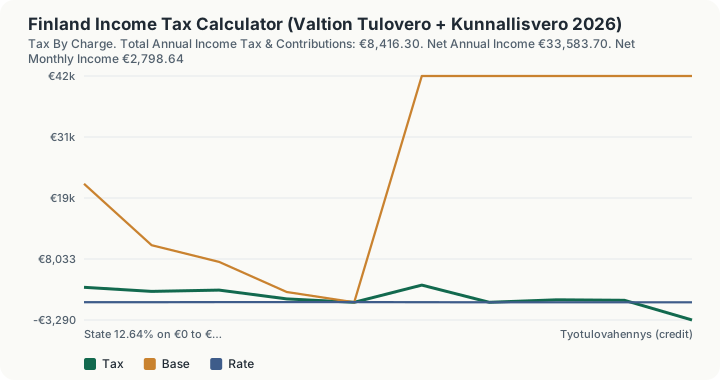
Quick Answer: €42,000 of gross earned income at the 2026 national average municipal rate of 7.57%, with no church tax, attracts €8,416.30 of Finnish income tax and health insurance contributions. That leaves €33,583.70 net, or €2,798.64 a month, for an average rate of 20.04%. The marginal rate on the next €100 is 44.80%, two full points above the 42.80% you get by adding the rates on the payslip, because this salary sits inside the band where the työtulovähennys credit is being withdrawn.
What does this calculator do?
A Finnish salary meets four separate charges: valtion tulovero (state income tax) on a five-band progressive schedule, kunnallisvero (municipal tax) at a rate each municipality sets for itself, kirkollisvero (church tax) for parish members only, and the two components of the sairausvakuutusmaksu (health insurance contribution). A single credit, the työtulövähennys, is then set against the total.
Two structural features dominate the result.
The first is that there is no national municipal rate. Every Finnish municipality sets its own kunnallisvero, and for 2026 they run from 4.70% in Kauniainen to 10.90% in Halsua. That is a spread of more than six points on the same salary, decided entirely by postcode. The 7.57% default here is the published 2026 national average and is offered only as a starting point.
The second is that the marginal rate a payslip implies is usually wrong. The perusvähennys tapers away at 18% of the excess, so through the low range each extra euro enlarges the municipal base by more than a euro. The työtulövähennys builds at 18% up to its cap, so below the cap each extra euro buys back 18 cents of credit. And between €35,000 and €50,550 the credit is withdrawn at 2%, adding two points to the real marginal rate. This calculator does not assert a marginal rate from a formula: it measures it, by recomputing the entire tax on €100 more income.
2026 is also the first year without the temporary solidaarisuusvero. Its repeal cut the top state bracket from a combined figure near 44.25% to 37.50%, and reduced the schedule from six bands to five.
How is this calculated?
State tax is charged on gross earned income through the bracket table; municipal tax, church tax and the sairaanhoitomaksu share a different, smaller base:
B_kunnallis = G − perusv a hennys (G); T = T_valtio + (r_kunta + r_kirkko + 1.10%)B_kunnallis + 0.88%⋅G − C
where $C$ is the työtulövähennys credit.
Step 1: Compute the perusvähennys. If gross earned income is at or below €4,265, the allowance equals the income. Above that, it is €4,265 reduced by 18% of the excess, floored at zero, so it runs out entirely at about €27,959.
Step 2: Form the municipal tax base. Gross earned income minus the perusvähennys, floored at zero. This same base carries the municipal tax, the church tax and the sairaanhoitomaksu. It is not used for state tax.
Step 3: Run gross income through the state bracket table. 12.64% to €22,000, 19.00% from €22,000 to €32,600, 30.25% from €32,600 to €40,100, 33.25% from €40,100 to €52,100, and 37.50% above €52,100. Each band is charged only on the income falling inside it.
Step 4: Charge kunnallisvero on the municipal base. Your municipality's rate times the base from Step 2.
Step 5: Charge kirkollisvero on the same base. Your parish rate times the base. Zero if you are not a member.
Step 6: Charge the sairaanhoitomaksu at 1.10% of the municipal base.
Step 7: Charge the päivärahamaksu at 0.88% of gross wage income, if the threshold is met. This is all-or-nothing: reach €17,255 of annual wage income and the 0.88% applies to the full wage, not just the excess. Below the threshold it is not charged at all.
Step 8: Compute the työtulövähennys before withdrawal. 18% of earned income, capped at €3,430.
Step 9: Apply the withdrawal. Reduce the credit by 2% of the income between €35,000 and €50,550, floored at zero. Because the span itself is capped, the credit stops falling once income passes €50,550.
Step 10: Total the charges and subtract the credit. State tax + municipal tax + church tax + both health insurance components, less the työtulövähennys, floored at zero.
Step 11: Measure the true marginal rate. The calculator runs the entire calculation a second time on gross plus €100 and divides the difference in total tax by 100. Nothing about the taper or the withdrawal is asserted; it is observed in the result.
Worked Example
A €42,000 salary in a municipality charging the 2026 national average of 7.57%, with no church tax.
Step 1: Perusvähennys. €4,265 - (€42,000 - €4,265) x 18% = €4,265 - €6,792.30, which is negative, so €0.00
Step 2: Municipal tax base. €42,000 - €0 = €42,000.00
Step 3: State tax, first band. €22,000 x 12.64% = €2,780.80
Step 4: State tax, second band. (€32,600 - €22,000) x 19.00% = €10,600 x 19.00% = €2,014.00
Step 5: State tax, third band. (€40,100 - €32,600) x 30.25% = €7,500 x 30.25% = €2,268.75
Step 6: State tax, fourth band. (€42,000 - €40,100) x 33.25% = €1,900 x 33.25% = €631.75
Step 7: Total state income tax. €2,780.80 + €2,014.00 + €2,268.75 + €631.75 = €7,695.30
Step 8: Kunnallisvero. €42,000 x 7.57% = €3,179.40
Step 9: Kirkollisvero. €42,000 x 0.00% = €0.00
Step 10: Sairaanhoitomaksu. €42,000 x 1.10% = €462.00
Step 11: Päivärahamaksu. €42,000 is above the €17,255 threshold, so €42,000 x 0.88% = €369.60
Step 12: Total charges before the credit. €7,695.30 + €3,179.40 + €462.00 + €369.60 = €11,706.30
Step 13: Työtulövähennys before withdrawal. min(€42,000 x 18%, €3,430) = min(€7,560, €3,430) = €3,430.00
Step 14: Withdrawal. (€42,000 - €35,000) x 2% = €7,000 x 2% = €140.00
Step 15: Credit actually given. €3,430.00 - €140.00 = €3,290.00
Step 16: Total tax. €11,706.30 - €3,290.00 = €8,416.30
Step 17: Net annual income. €42,000.00 - €8,416.30 = €33,583.70
Step 18: Net monthly income. €33,583.70 / 12 = €2,798.64
Step 19: Average rate. €8,416.30 / €42,000 = 20.04%
Step 20: Nominal marginal rate from the payslip rates. 33.25% + 7.57% + 0% + 1.10% + 0.88% = 42.80%
Step 21: True marginal rate, measured on €100 more. 44.80%, because the extra €100 also withdraws €2 of credit. Of the next €100 of gross pay, €55.20 actually reaches you.
What does this calculator not account for?
- TyEL pension and unemployment insurance contributions are excluded. A real Finnish payslip also deducts an earnings-related pension contribution of roughly 7.15% to 8.65% depending on age, and an unemployment insurance contribution of roughly 0.5% to 1.5%. They are employee deductions but they are not taxes, and they are out of scope here. In reality both are subtracted from gross before tax is computed, which lowers the true taxable base, so a real payslip's tax figures will differ modestly from these.
- Capital income (pääomatulo) is not modelled. It runs on its own separate 30%/34% schedule and does not belong in the earned-income field.
- The credit is applied against the aggregate, not in the statutory order. Finnish law credits the työtulövähennys against state tax first, then municipal, then health insurance, then church tax. This calculator subtracts it from the total. The net total tax is identical; only the individual line-item split could differ by a few cents from an official allocation.
- The +€105 per child enhancement to the työtulövähennys is not modelled. Taxpayers with minor children are entitled to more credit than this calculator gives them.
- The abolished kunnallisverotuksen ansiotulovähennys is correctly omitted, not missing. That separate municipal earned-income deduction was folded into an enlarged työtulövähennys from tax year 2025.
- Only one municipal and one parish rate are modelled. You supply both. The church tax rate in particular varies by parish, from 1.0% to 2.0% in 2026 with a simple unweighted average across Evangelical Lutheran parishes of 1.66%; a membership-weighted average would be somewhat lower, since rates tend to be higher in smaller and rural parishes.
- Personal deductions are not modelled. Kotitalousvähennys (household expenses), commuting costs, trade union fees, voluntary pension contributions and interest deductions are all absent.
- This is an annual liability, not a withholding simulation. It does not reproduce the veroprosentti-and-tulorajä mechanic that a Finnish employer applies month by month.
What mistakes do people make with this?
- Assuming there is a Finnish municipal tax rate. There are hundreds. A €42,000 salary faces 4.70% in Kauniainen and 10.90% in Halsua, a difference of more than €2,600 a year in kunnallisvero alone on this base. Look up your own municipality rather than accepting the average.
- Adding the payslip rates to get your marginal rate. Between €35,000 and €50,550 the työtulövähennys withdrawal adds two points that appear nowhere on a payslip. Below about €27,959 the perusvähennys taper does something similar in the other direction. The nominal sum is right only in the gaps between these effects.
- Treating the päivärahamaksu as a marginal charge. It is a cliff. At €17,254 of wage income there is none; at €17,255 the 0.88% applies to the entire wage, not to the last euro.
- Applying the perusvähennys to state tax. It reduces only the municipal, church and sairaanhoitomaksu base. State tax is charged on undiminished gross.
- Using a 2025 bracket table. The solidaarisuusvero was repealed for 2026, cutting the top state marginal rate to 37.50% and reducing the schedule from six bands to five. A 2025 table overstates tax at high incomes substantially.
- Reading the net figure as take-home pay. TyEL and unemployment insurance still come out of it. The number here is net of tax, not net of everything a payslip deducts.
- Forgetting the credit has a floor. The withdrawal span stops at €50,550, so the credit never falls below €3,119 for anyone above that income. It does not taper to zero.
Frequently Asked Questions
Why is my real marginal rate higher than the sum of the rates?
What is the municipal tax rate in Finland?
Do I have to pay church tax?
What happened to the solidarity surtax?
What is the perusvähennys and when do I get it?
Is the health insurance contribution one charge or two?
Sources
- Verohallinto (vero.fi), "Vakuutetun sairausvakuutusmaksu" (syventävät vero-ohjeet 338472), corroborated by the Sosiaali- ja terveysministeriö release "Sairausvakuutusmaksut nousevat hieman vuonna 2026": sairaanhoitomaksu 1.10% of the municipal base for 2026, päivärahamaksu 0.88% of gross wage income once annual wage income reaches €17,255. vero.fi/syventavat-vero-ohjeet/ohje-hakusivu/338472/vakuutetun-sairausvakuutusmaksu2
Where a Vero page could not be confirmed directly, the figure was checked against Veronmaksajain Keskusliitto ry, the Finnish taxpayers' association.
Also consulted: Laki vuoden 2026 tuloveroasteikosta (Finlex 1140/2025), as mirrored by Veronmaksajain Keskusliitto ry, the 2026 state income tax schedule: 12.64% / 19.00% / 30.25% / 33.25% / 37.50% at €22,000 / €32,600 / €40,100 / €52,100, with cumulative-tax checkpoints that reproduce exactly from the bracket boundaries; Veronmaksajain Keskusliitto ry, 2026 deductions summary (sourced from the enacted 2026 tuloverolaki amendments), työtulövähennys at 18% of earned income capped at €3,430, withdrawn at 2% between €35,000 and €50,550; perusvähennys of €4,265 reduced by 18% of the excess; Veronmaksajain Keskusliitto ry, 2026 municipal tax rate survey, national average 7.57%, range 4.70% (Kauniainen) to 10.90% (Halsua); Verohallinto (vero.fi), "Kuntien ja seurakuntien tuloveroprosentit vuonna 2026", parish church tax rates for 2026, ranging 1.0% to 2.0%.