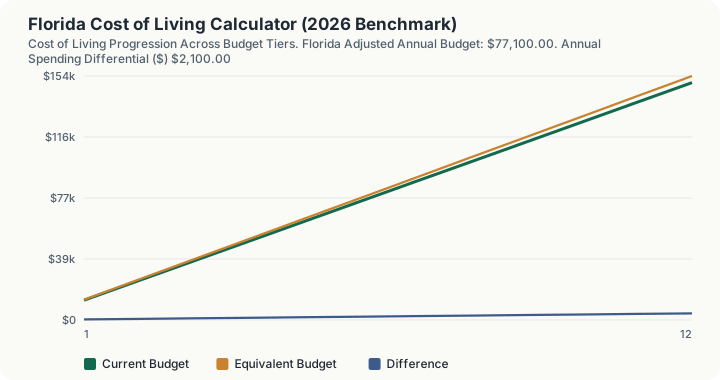
Quick Answer: Florida's cost of living is 2.8% above the U.S. national average (composite index 102.8), so a $75,000.00 national-average household budget costs about $77,100.00 a year in Florida.
What Sits Behind Florida's 102.8
Start with where Florida lands nationally: in the pricier upper third of all state rankings, with a composite index of 102.8 (2.8% above the 100.0 national baseline).
The state is among the pricier Southern states within the South, and the composite figure is not evenly distributed across categories: the housing index sits furthest from parity, at 110.2, while the grocery index sits at 105.4.
As a Sun Belt peninsula state with no state income tax, Florida illustrates why national pay benchmarks and one-size-fits-all relocation budgets break down at the state level: the gap between its housing figure and its overall index alone can swing a household's real budget by thousands of dollars a year.
Scaled against a $75,000 national-average budget, the Florida adjustment comes to roughly $2,100, with housing alone running 10.2 points above parity. Beyond the three components broken out here, MERIC's composite also weighs transportation, healthcare, and a broad miscellaneous-goods category that isn't published as a separate state index.
Key Index Components for Florida:
- Composite Benchmark Index: 102.8 (Rank #20, tied with Utah)
- Housing Cost Index: 110.2
- Utilities Cost Index: 101.4
- Grocery Cost Index: 105.4
How This Is Calculated
Florida ties Utah at rank 20 with a composite of 102.8, only 2.8% over the national baseline, which surprises people who follow Florida housing headlines. Housing does read high at 110.2, but groceries at 105.4 and utilities at 101.4 pull the composite back toward the national line. That composite is the figure the calculator applies to your budget.
- Baseline budget. You enter annual household spending priced at the national benchmark, index 100.0.
- Composite lookup. Florida's composite index of 102.8 is read from the 2026 MERIC state table, along with its rank of #20 among the 50 states.
- Single-factor scaling. The baseline is multiplied by 102.8 and divided by 100. Housing 110.2, groceries 105.4 and utilities 101.4 are context readings, not separately weighted terms, because MERIC's composite already carries category weights. A recent buyer facing current Florida housing prices is exposed to the 110.2 rather than the 102.8, and the gap between those two numbers is the main reason lived experience in Florida can diverge from the statewide index.
- Differential. The dollar and percentage difference against the baseline is taken from the scaled result, which is what the headline output and the monthly view report.
Worked Example
Using this calculator's baseline scenario: a household needing $75,000.00 a year to sustain a standard basket of goods (housing, groceries, utilities, transportation, and healthcare), priced at the U.S. national average (composite index 100.0).
- National baseline. $75,000.00 is the reference spending level at the national-average price level (index 100.0).
- Apply Florida's composite index. Florida's composite index of 102.8 (rank #20 nationally, tied with Utah) means local prices run 2.8% above the national basket. Scaling: $75,000.00 × (102.8 ÷ 100) = $77,100.00.
- Dollar differential. $77,100.00 − $75,000.00 = +$2,100.00, so a household living in Florida needs its budget to grow by that amount to match the same standard of living.
- Percentage and monthly view. That is +2.8% of the baseline, or $6,425.00/mo in Florida versus $6,250.00/mo nationally.
Florida runs only modestly pricier than the national baseline, with housing costs (index 110.2, 10.2 points above average) the largest single driver of the gap.
What a Florida Dollar Is Worth Going the Other Way
Florida's composite index of 102.8 is applied to your budget in a single multiplication. Nothing steps, so the two questions worth answering are what the next thousand dollars costs and how to run the conversion in reverse.
The marginal figure. Each additional $1,000 of national-baseline spending costs $1,028.00 in Florida. The engine returns $78,128.00 on a $76,000 baseline against $77,100.00 on $75,000. At the family scenario of $120,000 the adjusted figure is $123,360.00, a $3,360.00 differential.
The reverse question. A household already spending $75,000 a year in Florida wants to know the national-average equivalent. Enter $72,957.20 and the engine returns exactly $75,000.00 of Florida-adjusted cost, so that Florida household is living a $72,957.20 national lifestyle and is paying $2,042.80 a year for the privilege of the address.
The subtraction error, priced. Subtracting 2.8% from the $77,100.00 Florida figure gives $74,941.20. Run that back through the engine and it returns $77,039.55, $60.45 below the $77,100.00 you started with. The inverse of multiplying by 1.028 is dividing by 1.028, and subtracting the percentage is a different and slightly wrong operation.
One composite factor, and no category weighting. The engine multiplies your whole budget by 102.8 and divides by 100. It does not split spending into housing, groceries and utilities and weight each by its own index. Florida's housing index of 110.2 is more than seven points above the composite and its utilities index of 101.4 is more than a point below, but neither figure touches your result: they are shown so you can see where the composite comes from, and nothing more. A Florida renter facing the housing index rather than the composite is understated by this page.
Two things the index cannot see. Florida's composite is a statewide average, and this calculator has no metro input, so Miami-Dade and the rural panhandle return the same number. The composite also prices goods and services rather than taxes: Florida levies no personal income tax, which is a large part of the state's real affordability case for a working household, and none of it appears in the 102.8.
How to read the tier table above. The twelve rows hold the index fixed and vary only the budget. Row i prices budget × i ÷ 6 at the same composite 102.8, so at the default $75,000 baseline the tiers step $12,500.00 at a time: row 1 returns $12,850.00 on $12,500.00, row 4 returns $51,400.00 on $50,000.00, row 8 returns $102,800.00 on $100,000.00 and row 12 returns $154,200.00 on $150,000.00. Row 6 sits on exactly the $75,000.00 you entered and returns $77,100.00, the headline to the cent. The column is a straight line through the origin, so it can be read down without qualification.
The difference column is a constant fraction. Because every row applies the identical multiple, the third column is always 2.8% of that row's tier: $350.00 at row 1, $1,400.00 at row 4, $2,100.00 at row 6 and $4,200.00 at row 12. That is the cleanest way to see that the Florida premium does not scale with income in any way other than proportionally. A household at three times the budget pays three times the differential and not a cent more.
No sub-index appears in the table. Housing 110.2, groceries 105.4 and utilities 101.4 are printed on this page for context. They are never multiplied by a budget, in the table or in the headline, and no row of the schedule is a category cost.
What This Does Not Account For
- Intra-state variance between major metropolitan urban centers and rural counties within Florida.
- Discretionary lifestyle choices, private schooling, and luxury expenditures.
- State income and property tax impacts on disposable take-home salary.
- Dynamic seasonal utility price surges during peak winter heating or summer cooling months.
Common Pitfalls
- Comparing State Averages Instead of Metro Areas: Living in a major metro area is often 20%-40% more expensive than the statewide average.
- Focusing Solely on Housing: Overlooking higher utility, transportation, or food costs in colder or remote regions.
- Ignoring Net Take-Home Pay: Comparing gross salary without factoring in state income and sales tax differentials.
- Failing to Adjust for Family Size: Larger households experience disproportionately higher grocery and healthcare expenditures.
Frequently Asked Questions
Is Florida expensive to live in?
What is the biggest cost factor in Florida?
How much salary do I need to maintain my lifestyle in Florida?
How often are cost of living indices updated?
Sources
- U.S. Bureau of Economic Analysis (BEA): Regional Price Parities. bea.gov/data/prices-inflation/regional-price-parities-state-and-metro-area
- U.S. Bureau of Labor Statistics (BLS): Consumer Expenditure Survey. bls.gov/cex
- Florida Department of Revenue, the official state tax authority for Florida rates, rules and forms. floridarevenue.com
Also consulted: MERIC: Cost of Living Data Series (2025/2026).