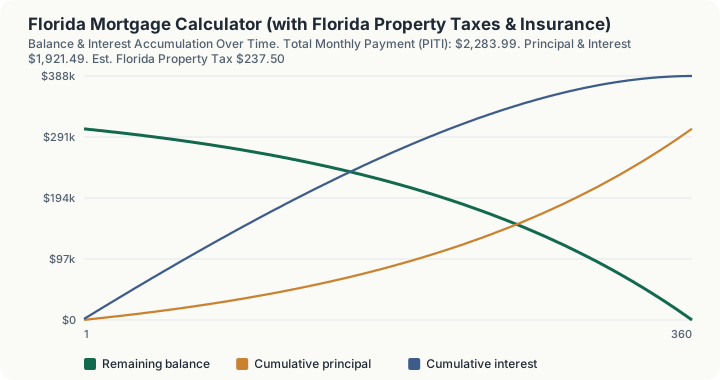
Quick Answer: On a $380,000 Florida home with 20% down at 6.5%, the total monthly payment lands near $2,284, including $238 in property tax at Florida's 0.75% effective rate, a payment made more affordable overall by Florida charging no state income tax.
Overview
Florida's appeal to buyers relocating from higher-tax states rests on two pillars: no state income tax and a property tax rate that, while not the lowest in the country, sits meaningfully below the national average and well below high-tax states like Connecticut or New Jersey. This calculator applies Florida's 0.75% effective property tax rate to the home purchase price, adds a flat monthly homeowners insurance estimate, and produces a complete PITI (Principal, Interest, Taxes, Insurance) payment, the number that actually determines monthly affordability rather than a bare principal-and-interest figure.
The income tax angle matters even though it does not appear directly in a mortgage payment: a buyer moving from a state with a 5% or 6% income tax bracket effectively gains back thousands of dollars a year in take-home pay, money that can be redirected toward a larger down payment, a shorter loan term, or simply a more comfortable monthly budget. This calculator isolates the housing-specific piece of that affordability picture so buyers can see the mortgage math clearly, separate from the income tax savings that make Florida attractive in the first place.
How This Is Calculated
- Down payment and loan principal. The down payment percentage is applied to the home price, and the remainder becomes the financed loan principal.
- Principal and interest. The loan principal amortizes over a standard 360-month (30-year) fixed term using PMT = P × r / (1 − (1 + r)^−n), with r equal to the monthly rate (annual APR divided by 12).
- Property tax. Florida's statewide effective average of 0.75% is applied to the full home purchase price and divided by 12 for a monthly escrow estimate.
- Homeowners insurance. A flat $125 monthly estimate is added, though this is the single most understated line item for Florida specifically, since coastal and hurricane-exposed properties routinely carry premiums several multiples higher than inland homes.
- Total PITI. Principal and interest, monthly tax, and monthly insurance sum to the headline monthly payment.
Worked Example
Using the calculator's baseline inputs: a $380,000 home, 20% down, and a 6.5% 30-year fixed rate.
- Down payment: $380,000 × 20% = $76,000
- Loan principal: $380,000 − $76,000 = $304,000
- Monthly rate: 6.5% ÷ 12 = 0.5417%
- Principal and interest: amortizing $304,000 over 360 months yields approximately $1,921.49 per month
- Monthly property tax: $380,000 × 0.75% ÷ 12 = $237.50
- Monthly insurance: $125.00 flat estimate
- Total PITI: $1,921.49 + $237.50 + $125.00 = approximately $2,283.99 per month
That $237.50 monthly tax figure sits well below the $525.67 a Connecticut buyer would pay on an identical $380,000 home, and unlike Connecticut, Florida does not layer a state income tax on top of that, which is the combination that draws so many buyers to the state despite its real insurance cost pressure.
What This Does Not Account For
- Florida's Save Our Homes homestead cap. Owner-occupied primary residences in Florida benefit from an assessment increase cap of 3% per year after the first year, plus a homestead exemption that reduces taxable value, both of which can lower the effective tax rate below 0.75% over time for long-term owners; this calculator models a purchase-year estimate without the cap's benefit.
- Windstorm and flood insurance realities. The flat $125 monthly insurance estimate is the weakest assumption in this model for Florida specifically. Coastal and flood-zone properties routinely carry premiums two to five times higher due to hurricane exposure, and separate flood insurance through the National Flood Insurance Program or private carriers is often required.
- County millage variation. Florida's 67 counties, plus municipal and special district levies, produce actual combined millage rates that differ from the 0.75% statewide effective average used here.
- Citizens Property Insurance Corporation exposure. In high-risk coastal areas where private insurers have withdrawn, Florida's state-backed insurer of last resort may be the only available option, often at a materially higher premium than this calculator's flat estimate.
- HOA and CDD fees. Many Florida communities, particularly newer developments, carry separate homeowners association dues or Community Development District assessments that are not part of a standard PITI calculation.
Common Pitfalls
- Using the flat $125 insurance estimate for a coastal Florida property. This is the most common source of budget shock for Florida buyers; a home in a hurricane-exposed zip code can easily carry insurance costs several times that estimate.
- Forgetting the homestead exemption and Save Our Homes cap when comparing to a prior year's tax bill. Long-term Florida homeowners often pay less than the current effective rate suggests, while new buyers reset to full market assessment in their first year.
- Overlooking flood zone determination. A property inside a FEMA-designated flood zone typically requires separate flood insurance regardless of what a lender's standard homeowners policy covers.
- Assuming no income tax means no housing cost tradeoff. Florida's insurance and property tax realities partially offset the income tax advantage in high-risk coastal areas, so a full relocation comparison should weigh all three factors together, not income tax alone.
- Ignoring county-to-county millage differences. Miami-Dade, Broward, and other high-cost counties can carry combined millage rates above the 0.75% statewide average used in this baseline model.
Frequently Asked Questions
Does Florida's lack of a state income tax actually offset its property and insurance costs?
What is the Save Our Homes cap and does it apply here?
Why is the $125 monthly insurance estimate flagged as unreliable for Florida?
Does every Florida county have the same property tax rate?
How does a smaller down payment change this Florida mortgage estimate?
Sources
- Florida Department of Revenue, Property Tax Oversight, statewide effective tax rate data. floridarevenue.com
- Consumer Financial Protection Bureau, Regulation Z and mortgage disclosure standards. ecfr.gov/current/title-12/chapter-X/part-1026
Also consulted: Florida Statutes, Save Our Homes assessment cap and homestead exemption provisions (Fla. Stat. § 193.155); Citizens Property Insurance Corporation, Florida homeowners insurance market data.