Quick Answer: Once an H-1B worker meets the Substantial Presence Test, their paycheck is taxed exactly like a US citizen's, full federal income tax brackets and full FICA withholding, with no visa-specific tax break or exemption.
Overview
A lot of confusion floats around how H-1B workers are taxed in the United States, mostly because other visa categories genuinely do work differently. F-1 students and J-1 exchange visitors are treated as nonresident aliens for their first several calendar years and are exempt from FICA (Social Security and Medicare) tax during that window under IRC §3121(b)(19). H-1B status carries no such exemption at any point. From the moment an H-1B worker meets the Substantial Presence Test, generally by being physically present in the US for at least 31 days in the current year and 183 "weighted" days across the current and two prior years, they are taxed as a full US resident alien.
That means an H-1B paycheck is calculated with the exact same mechanics as any American colleague sitting at the next desk: federal income tax withheld under the same progressive bracket schedule, plus the same 6.2% Social Security tax up to the annual wage base and 1.45% Medicare tax with no cap. There is no reduced rate, no special H-1B exemption, and no visa-based discount anywhere in the federal withholding formula.
This calculator intentionally stops at federal tax and FICA. State income tax varies too widely to build one universal number into a national H-1B tool, some states like Texas, Florida, and Washington charge no state income tax at all, while others exceed 10% at the top bracket. For a state-specific estimate, use one of this platform's state paycheck calculators alongside this one.
How This Is Calculated
- Compute FICA on full gross wages. Social Security tax is 6.2% of wages up to the annual wage base ($184,500 for 2026), and Medicare tax is 1.45% with no upper limit. Both are calculated on gross pay before any pre-tax deductions are subtracted, because traditional 401(k) and similar pre-tax retirement contributions reduce federal taxable wages but not FICA wages.
- Reduce gross pay by pre-tax deductions for federal income tax purposes only. 401(k) contributions, HSA contributions, and similar pre-tax benefits lower the wage base used for the federal income tax calculation, even though they do not lower FICA wages.
- Apply the standard deduction and 2026 federal brackets. The reduced taxable wage figure runs through the same
progressiveTaxprimitive used across every paycheck calculator on this platform, using the 2026 standard deduction and bracket table for the selected filing status. - Subtract FICA, federal tax, and pre-tax deductions from gross pay. What remains is annual net take-home pay, which is then divided evenly across the selected number of pay periods to produce a per-paycheck figure.
Worked Example
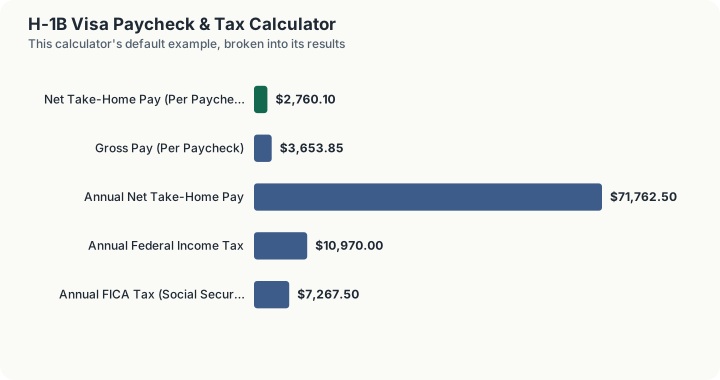
Consider an H-1B software engineer earning $95,000 annually, filing single, paid bi-weekly, with no pre-tax deductions this year.
- Social Security tax: $95,000 × 6.2% = $5,890.00
- Medicare tax: $95,000 × 1.45% = $1,377.50
- Total FICA: $5,890.00 + $1,377.50 = $7,267.50
- Federal taxable wages: $95,000 − $0 = $95,000; less the single standard deduction of $16,100 = $78,900 taxable
- Federal tax: 10% × $12,400 = $1,240; 12% × $38,000 = $4,560; 22% × $28,500 = $6,270; total = $12,070
- Total annual deductions: $7,267.50 + $12,070 + $0 = $19,337.50
- Annual net take-home pay: $95,000 − $19,337.50 = $75,662.50
- Net pay per bi-weekly paycheck (26 periods): $75,662.50 ÷ 26 = $2,910.10
Now a married H-1B worker earning $150,000, filing jointly with a non-working H-4 dependent spouse, paid monthly, contributing $10,000 to a traditional 401(k):
- FICA is calculated on the full $150,000, unaffected by the 401(k) contribution: Social Security = $150,000 × 6.2% = $9,300.00; Medicare = $150,000 × 1.45% = $2,175.00; total FICA = $11,475.00
- Federal taxable wages: $150,000 − $10,000 = $140,000; less the MFJ standard deduction of $32,200 = $107,800 taxable
- Federal tax: 10% × $24,800 = $2,480; 12% × $76,000 = $9,120; 22% × $7,000 = $1,540; total = $13,140
- Total annual deductions: $11,475 + $13,140 + $10,000 = $34,615
- Annual net take-home pay: $150,000 − $34,615 = $115,385
- Net pay per monthly paycheck (12 periods): $115,385 ÷ 12 = $9,615.42
What This Does Not Account For
- State income tax. This calculator deliberately covers federal tax and FICA only, since state rates and rules vary from 0% to over 13% depending on where the H-1B worker lives and works.
- Dual-status transition years. A worker who arrives mid-year and has not yet met the Substantial Presence Test may file as a dual-status alien for their arrival year, taxed as a nonresident for part of the year and a resident for the rest, with different withholding rules for each portion. This calculator assumes full-year resident tax treatment.
- Tax treaty benefits. Some countries have tax treaties with the US that can reduce withholding on specific income types even after residency status is established. This calculator does not apply treaty adjustments.
- Additional Medicare Tax withholding timing. Employers must withhold an extra 0.9% Medicare tax once wages from a single employer exceed $200,000, regardless of filing status, but the true liability depends on combined household wages and is reconciled on the tax return. This calculator computes the household-level Additional Medicare Tax threshold correctly for the annual figure but does not model employer-level withholding timing across multiple jobs.
- US-India totalization and Social Security agreement nuances. A few visa holders from countries with a Social Security totalization agreement with the US have special rules; this calculator applies standard domestic FICA rules uniformly.
Common Pitfalls
- Assuming H-1B workers are exempt from Social Security and Medicare tax. This is one of the most common myths, likely carried over from F-1/OPT rules. H-1B status has never carried a FICA exemption.
- Forgetting FICA applies to full gross pay, not reduced pay. Workers sometimes expect their 401(k) contribution to lower their Social Security and Medicare tax the same way it lowers federal income tax. It does not.
- Ignoring state tax entirely when comparing job offers across states. Two identical federal-and-FICA take-home numbers can differ by thousands of dollars once state tax is added, especially between a no-income-tax state and a high-tax state.
- Missing the Substantial Presence Test in an arrival year. A worker who just started an H-1B role mid-year may still be a nonresident alien for part of the year and should not assume full resident tax treatment applies from day one.
- Overlooking that H-4 dependent spouses without work authorization still allow Married Filing Jointly. Filing status choice materially changes the standard deduction and bracket thresholds used in this calculation.
Frequently Asked Questions
Do H-1B workers pay Social Security and Medicare tax?
Will I ever get my Social Security contributions back if I leave the US permanently?
Does this calculator include state income tax?
How is my filing status determined as an H-1B worker?
What is the Substantial Presence Test?
Sources
- Internal Revenue Service, "Substantial Presence Test." irs.gov/individuals/international-taxpayers/substantial-presence-test
- Internal Revenue Service, "Alien Liability for Social Security and Medicare Taxes." irs.gov/individuals/international-taxpayers/alien-liability-for-social-security-and-medicare-taxes-fica
- Social Security Administration, 2026 Fact Sheet (wage base and FICA rates). ssa.gov/news/press/factsheets/colafacts2026.pdf
- Internal Revenue Service, "IRS releases tax inflation adjustments for tax year 2026, including amendments from the One, Big, Beautiful Bill," Revenue Procedure 2025-32. irs.gov/newsroom/irs-releases-tax-inflation-adjustments-for-tax-year-2026-including-amendments-from-the-one-big-beautiful-bill